

Audio By Carbonatix
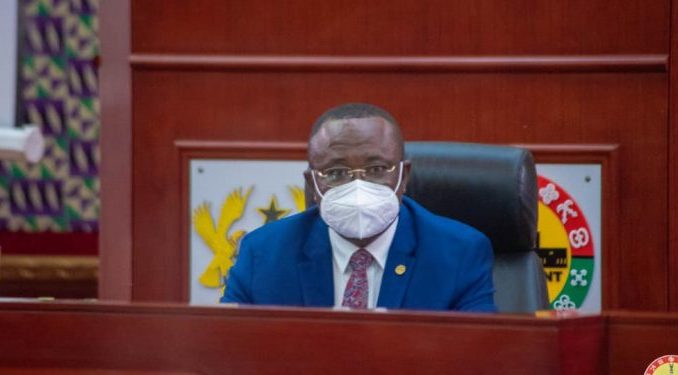
The Supreme Court has ruled that a Deputy Speaker of Parliament can be counted during the formation of a quorum for parliamentary decision-making and participation in voting while presiding.
The Court presided over by Justice Jones Dotse, therefore, affirmed the approval of the 2022 budget without NDC MPs' participation.
Private Legal Practitioner Justice Abdulai filed the case against the Attorney General.
He had asked the Supreme Court to interpret Articles 102 and 104 of the 1992 Constitution and declare the action of Mr Osei Owusu as unconstitutional.
He also wanted the Supreme Court to declare the whole proceedings in Parliament on November 30, 2021, which led to the passage of the 2022 budget as unconstitutional insisting the Deputy Speaker should not have counted himself as an MP when he presided over proceedings.
However, in defence on behalf of the state, the Attorney-General (A-G), Godfred Yeboah Dame, argued that no express provision in the 1992 Constitution stops a Deputy Speaker presiding over proceedings from voting or counting himself as part of MPs present to form the right quorum.
He argued that the quorum in Parliament formed under Article 102 is different from the quorum formed under Article 104 of the 1992 Constitution.
He stated that the quorum under Article 102 is for the conduct of business in Parliament, and that is why Article 102 provides that it should be one-third of members.
“Given that Parliament presently is made up of 275 members, the quorum under Article 102 for the conduct of its business is 92 MPs,” the A-G submitted.
According to the A-G, based on the clear provision of Article 102, any person presiding, either the Speaker or Deputy Speakers, is precluded from being part of that quorum.
On the other hand, the A-G believes that the quorum under Article 104 (1), which deals with the determination of matters through voting in Parliament, requires at least half of all MPs, and such a quorum is not the same as the one in Article 102.
Mr Dame contends that unlike Article 102, which precludes a “person presiding” from being part of the quorum, Article 104 (2) precludes explicitly “The Speaker”.
The A-G, therefore, holds the position that only the person elected as “The Speaker” of Parliament is barred from forming part of the quorum under Article 104 when presiding, and not the Deputy Speakers who preside over proceedings.
The Apex Court comprising Justices Jones Dotse, Nene Amegatcher, Prof Ashie Kotey, Mariama Owusu, Lovelace Johnson, Clemence Honyenuga, and Emmanuel Kulendi affirmed the arguments of the Attorney General.
The court also struck out portions of the standing orders of parliament which reads
“A Deputy Speaker or any other member presiding shall not retain his original vote while presiding.”
Latest Stories
-
GAEC must retain nuclear scientists for Ghana’s nuclear ambitions – Minister
31 minutes -
Man reportedly mistaken for game and shot by hunter dead in forest
34 minutes -
19-year-old mason jailed 15 years for defiling seven-year-old pupil
38 minutes -
Ghana’s banking sector assets rise 20.47% to GH¢500.2bn – BoG Governor
42 minutes -
22 injured as Sprinter bus overturns at Sege after tyre burst
44 minutes -
UN housing expert urges Ghana to strengthen Rent Control Department amid housing affordability concerns
52 minutes -
Delta-BCI partnership reaches 166,000 people with breast cancer education
1 hour -
Power restoration fault suspected in Kumasi Central Market fire
6 hours -
The 7-foot giant of Ngleshie Amanfro: Seven-foot Ghanaian Ephraim Saawa dreams of joining the national basketball team
7 hours -
Government promises support for Kumasi Central Market fire victims
7 hours -
Vibes The Movie: Big Ghun’s Ghanaian film earns five nominations at 2026 REFFA
7 hours -
‘I’m a fulfilled man’—Justice Korbieh on missing out on Supreme Court despite two nominations
8 hours -
MamaCare CEO warns unresolved conflicts among health workers could undermine maternal and neonatal care
8 hours -
Health professionals urged to translate medical knowledge into practice to save mothers
8 hours -
Retired judge Justice Francis Korbieh charges 1,568 new lawyers to uphold integrity
9 hours