

Audio By Carbonatix
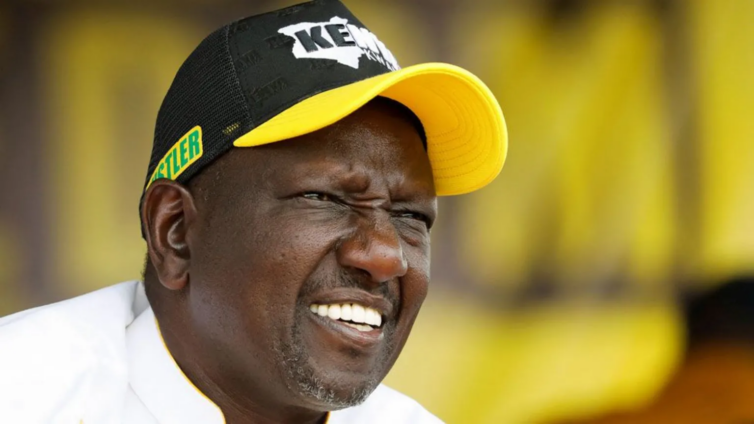
Kenya’s President William Ruto must be feeling punch-drunk - after suffering another blow to his plans to raise taxes for his cash-strapped, debt-burdened government.
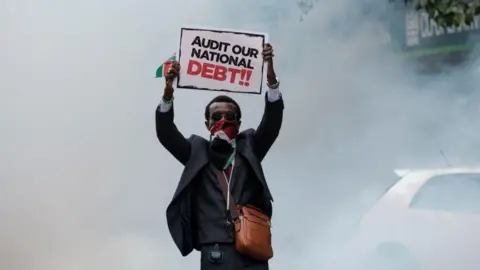
After the recent widespread anti-tax protests - that saw parliament set alight - he bowed to public pressure and withdrew his finance bill for the coming year.
But then last week the appeals court torpedoed his tax plans from last year.
Three judges unanimously ruled the 2023 legislation that had raised taxes on salaries, fuel and mobile money transactions was "fundamentally flawed” and "unconstitutional” as it had not followed laid down procedures.
Both moves pose challenges for government’s ability to raise extra cash to fund the national budget and service its $78bn (£61.4bn) public debt.
Ndindi Nyoro, the chairman of the parliamentary budget committee, told the BBC the latest ruling might cause significant shortfalls in this year’s budget and limit the government’s ability to run its affairs.
“If you look at both finance acts that have now fallen, cumulatively, we’re talking of over half a trillion shillings [$3.8bn] in lost revenue,” Mr Nyoro said.
The government presents a finance bill to parliament before the beginning of each financial year in July, introducing new taxes or changing existing ones, primarily to raise more money.
Around the same time, the government also presents what is known as an appropriations bill - this shows how the revenues will be allocated and spent across government departments.
The chaos of the government’s finances was illustrated when this year’s appropriations bill was signed into law as the corresponding finance bill to fund the spending plan was withdrawn.
With the government's tax plans for two consecutive years effectively derailed, analysts say spending may have to be aligned with the finance legislation from 2022.
Economist Odhiambo Ramogi says the latest court decision also creates uncertainly for taxpayers, although the court ruled that taxes already collected cannot be refunded.
The government has appealed against the ruling in the Supreme Court, the country's top court - and asked for the lower court’s decision to be suspended until its appeal is heard.
It argued that it was not feasible to immediately reconfigure systems to the 2022 legislation, and the situation might lead to a paralysis of some government services.
The Supreme Court refused but agreed it was an urgent matter and that the case would be heard this month - even though it is usually on recess in August.
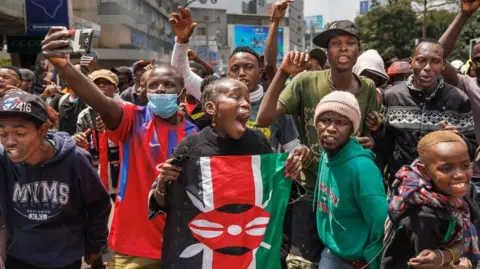
Immediate pressure is likely to come from financially struggling Kenyans who want to see prices go down, says economist Ken Gichinga.
A case in point will be at petrol pumps.
“People will want clarification on fuel prices,” he told the BBC.
Mr Ramogi argues the best option for the government is to "redraft another finance bill".
But given that Kenyans are strongly opposed to new taxes, the alternative would be to borrow more, he says.
Yet that too might be difficult, given the country’s debt levels and the recent downgrading of its rating by international credit rating agencies Moody’s and Fitch.
Others suggest the solution could be to raise taxes that are innovative and not overbearing for the public - though exactly how is not clear.
All the experts agree that for any future tax legislation, lawmakers will need to incorporate public opinion.
“Our national engagement and discourse on public affairs is shifting,” policy and governance expert Vincent Kimosop told the BBC, explaining that Kenyans are now actively participating in how their country is run.
Cutting down on spending will also need to continue.
Mr Nyoro said the government had already made significant cuts and it still might be forced to do away with its entire development budget and salaries for government workers.
“I would hate to imagine the education budget being cut, disruption in higher education funding, civil servants being laid off, healthcare coming a cropper,” he said.
The biggest problem for the Kenyan economy was the debt burden that the country has accrued over the last 12 years, he added.
In response to the withdrawn finance bill, Mr Ruto signed into law a supplementary appropriations bill to align with the reduction in expected revenues on Monday.
It reduces government expenditure by about $1.2bn, with cuts in the presidency, ministries and funding for transport and other development projects.
The move has been touted by the parliamentary budget committee as “reducing expenditure, with a delicate balance between austerity measures and cushioning the livelihoods of the people and the economy".
But the government also faces further legal headaches, with two rights groups challenging the government's authority to spend without corresponding revenue generation.
They argue the supplementary budget process in parliament did not follow the law - and have asked the courts to intervene to "end the consistent undermining of our constitution".
The government will have that to deal with in court as it awaits the outcome of its appeal at the Supreme Court.
Mr Nyoro says "there is no guarantee of success" for the government in its court battles - and all the choices Mr Ruto faces are tough - and even body armour will offer him little protection.
Latest Stories
-
29-year-old woman rescued after hiding in drain to escape attackers
54 seconds -
Gramps Morgan names Ghanaian business leader Monalisa Effah as Ghana-Jamaica Homecoming Ambassador
35 minutes -
CAF President urges faith in African football despite AFCON 2025 issues
54 minutes -
AFCON U-17: Black Starlets’ aim is to win trophy – Head Coach Prosper Ogum
58 minutes -
ENFA expands access to global capital for Ghanaian SMEs
1 hour -
Beyond security: Why mobile payment fraud has become a customer experience crisis
1 hour -
Former Effia MP demands full disclosure of Truedare AI deal, warns of ‘hidden risks’
2 hours -
Joseph Cudjoe raises alarm over potential revenue loss in Truedare AI Customs deal
2 hours -
Video: Awoshie-Anyaa Highway: Years of fatal crashes caused by faulty traffic lights
2 hours -
No financial transactions with Ghana Card yet, says NIA
2 hours -
Former Netherlands Fire Chief engages GNFS Tema Command on capacity building
2 hours -
Finance Ministry defends Publican AI rollout amid stakeholder concerns
2 hours -
Police arrest 5 in Asankrangwa robbery; cash and guns retrieved
2 hours -
Why I joined NPP – Jeneral Ntatia
2 hours -
Three UDS students remanded over alleged armed robbery
2 hours