

Audio By Carbonatix
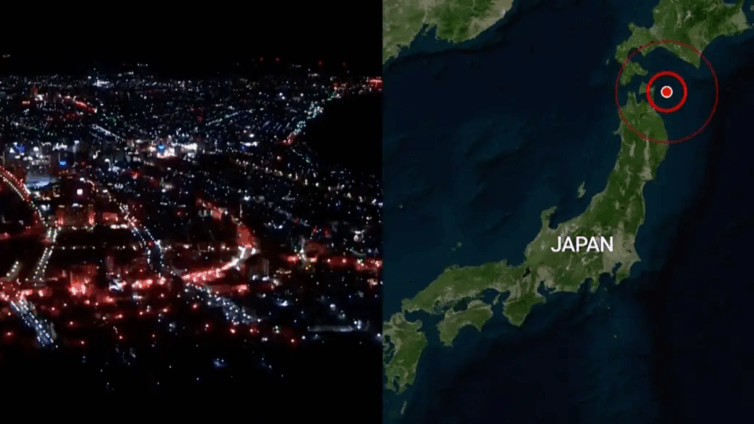
At least 30 people were injured after a magnitude 7.5 earthquake hit north-eastern Japan on Monday night, forcing thousands of people to evacuate their homes.
The quake occurred at 23:15 (14:15 GMT) at a depth of 50km (31mi), about 80km off the coast of the Aomori region, the Japan Meteorological Agency said. It prompted tsunami warnings which have now been lifted, while waves of 70cm (27in) were seen.
Some train services have been suspended and thousands of homes have been left without power as a result.
Authorities have also warned that a stronger tremor could occur in the coming days - urging the public to remain on high alert for at least a week, according to local media reports.
Addressing citizens affected by the earthquake, Japanese Prime Minister Sanae Takaichi said: "Reconfirm your daily earthquake preparedness, such as ensuring that you secure furniture, and prepare to evacuate immediately if you feel shaking."
Orders were issued for about 90,000 residents to evacuate, according to Reuters news agency.
The Aomori prefectural government said around 2,700 homes have been left without power. East Japan Railway has also suspended some services along the north-eastern coast.
The Japanese government has set up a response office within the prime minister's crisis management centre and convened an emergency team, chief cabinet secretary Minoru Kihara has said.
"We are making every effort to assess the damage and implement emergency disaster response measures, including rescue and relief operations," he added.
Following the tremors, Japanese electric company Tohoku Electric Power said no irregularities were reported at its Higashidori and Onagawa nuclear power plants as a result of the quake, Tohoku Electric Power said.
None were detected either at the disabled Fukushima nuclear power station site, the Japanese authorities told the International Atomic Energy Agency.
Fukushima was damaged when a magnitude 9.0 quake struck off the country's eastern coast on 11 March 2011.
That quake, the most powerful ever recorded in Japan, triggered a tsunami which swept over the main island of Honshu, killing more than 18,000 people and wiping entire towns off the map.

Japan is one of the world's most earthquake-prone countries.
It sits on the Ring of Fire and, as a result, experiences about 1,500 earthquakes a year.
Earlier this year, Japan's earthquake investigation panel said there was a 60-90% chance that a megaquake would occur in the Nankai Trough within the next 30 years, with worst-case scenarios suggesting it would cause trillions in damage, and potentially kill hundreds of thousands.
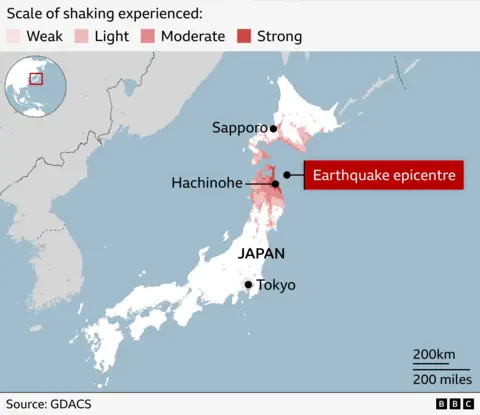
Earthquakes along the Nankai Trough - an area of seismic activity which stretches along Japan's Pacific coast - have already been responsible for thousands of deaths.
Latest Stories
-
Health Ministry engages Ga Mantse ahead of Free Primary Healthcare launch
10 minutes -
We can tackle multiple priorities – Sam George defends Anti-LGBTQ Bill push
45 minutes -
Statement: Ghana Chamber of Mines’ Response to Claims in Joe Jackson’s “Ananse Stories about the Economy of Ghana”
46 minutes -
GES opens 2026 teacher recruitment for licensed B.Ed graduates
49 minutes -
Ghana must value skilled trades, build resilient learners — Ibn Chambas
57 minutes -
Ghana must rethink education around relevance, resilience and responsibility — Ibn Chambas
60 minutes -
Prince Harry faces defamation lawsuit from charity he co-founded
1 hour -
South Korea deploys thermal cameras to track escaped zoo wolf
1 hour -
Calls for royal meeting with Epstein survivors grow ahead of US visit
1 hour -
Ibn Chambas advocates blend of technology and human values in education
1 hour -
UMA improves healthcare access in Asutifi North with GH₵700k ‘Kim Taylor Legacy’ Walkway
1 hour -
Scholarships Authority and Fanaka University offer sponsorship for procurement and supply chain studies
1 hour -
Bisa Kdei drops new single ‘Go N Look’ featuring Medikal
1 hour -
Benin facing rising terrorism in north as French military presence faces growing criticism
1 hour -
UEW Public Lecture Series 2026: Education debate ‘about the soul of Ghana’s future’ — Dr Ibn Chambas
1 hour