


Audio By Carbonatix
The Democratic Republic of Congo has moved to increase taxes on mining firms and increase government royalties from the industry despite fierce opposition from international mining companies.
President Joseph Kabila signed a new mining code into law on Friday.
The country is Africa's biggest producer of copper and cobalt, a vital component in mobile phone batteries.
Foreign mining firms strongly opposed the law, saying their operations in DR Congo would stop being profitable.
Several chief executives flew to the Congolese capital Kinshasa this week in the hopes of persuading Mr Kabila to change his mind.
They argued that the legislation would deter future investment and violate existing agreements, reported Reuters news agency.
The government however has agreed to consider their concerns on a case by case basis, and work with them in executing the new code.
DR Congo has talked for years about changing its 2002 mining code, which it believed put too many profits in the hands of foreign companies, says BBC World Service Africa editor Mary Harper.
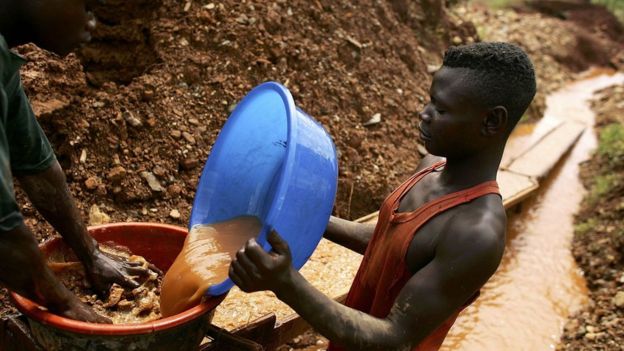 Its mining industry - which also produces diamond, tantalum, tin and gold - is the country's largest source of export income.
The law, which was passed by parliament in January, will double government royalties on all minerals.
The impoverished yet mineral-rich nation provides more than 60% of the world's cobalt. Prices for it more than doubled last year thanks to an increased demand for electric cars, which require cobalt for batteries.
Royalties on cobalt could also more than quadruple if the government labels it a "strategic substance".
Its mining industry - which also produces diamond, tantalum, tin and gold - is the country's largest source of export income.
The law, which was passed by parliament in January, will double government royalties on all minerals.
The impoverished yet mineral-rich nation provides more than 60% of the world's cobalt. Prices for it more than doubled last year thanks to an increased demand for electric cars, which require cobalt for batteries.
Royalties on cobalt could also more than quadruple if the government labels it a "strategic substance".
Its mining industry - which also produces diamond, tantalum, tin and gold - is the country's largest source of export income.
The law, which was passed by parliament in January, will double government royalties on all minerals.
The impoverished yet mineral-rich nation provides more than 60% of the world's cobalt. Prices for it more than doubled last year thanks to an increased demand for electric cars, which require cobalt for batteries.
Royalties on cobalt could also more than quadruple if the government labels it a "strategic substance".DISCLAIMER: The Views, Comments, Opinions, Contributions and Statements made by Readers and Contributors on this platform do not necessarily represent the views or policy of Multimedia Group Limited.
Tags:
DISCLAIMER: The Views, Comments, Opinions, Contributions and Statements made by Readers and Contributors on this platform do not necessarily represent the views or policy of Multimedia Group Limited.
Latest Stories
-
Germany commissions border Sheds to boost Ghana’s immigration operations at Aflao
2 minutes -
Sam Jonah’s concerns fuel IMANI’s petition to Mahama over political interference in insurance sector
3 minutes -
Absa SME Business Clinic equips entrepreneurs with practical financial management strategies
16 minutes -
Franklin Cudjoe hails ‘productive’ civil society meeting with Mahama; backs inquiry into ‘Big Push’ procurement
17 minutes -
Telecel Foundation supports safer pregnancies with ultrasound outreach in Naaha
1 hour -
AU’s 10-year reparations agenda is essential to address historic injustices – Spio-Garbrah
1 hour -
Ghana can’t remain vulnerable to global economic disruptions— Dr Tutu-Boahene
2 hours -
‘No nepotism’ – Former NSA Board Chairman demands world-class coach after Otto Addo exit
2 hours -
Volta Region seen as top choice for luxury weekend breaks — V. L. K. Djokoto
2 hours -
Halt small-scale mining for one year to fight galamsey – Hopeson Adorye
2 hours -
Sammy Gyamfi marks 37th birthday with donations to Special School and Korle Bu
2 hours -
President Mahama orders full probe into ‘Big Push’ procurement exposé
2 hours -
Weija-Gbawe MP calls for commissioning of Weija paediatric hospital
3 hours -
Ghanaians dying in Russia–Ukraine war: The danger is real
3 hours -
Player ratings: Oppong earns high marks as Sibo and Adjetey draw low scores in Germany defeat
3 hours