

Audio By Carbonatix
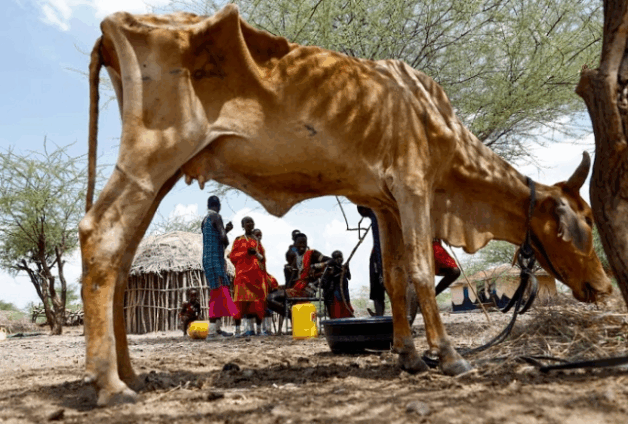
The dozens of cow and goat carcasses scattered around Maria Katanga's family compound testify to the grinding impact of an ongoing drought on Kenya's pastoralist communities who rely on livestock for survival.
Since August, the 24-year-old Maasai herder has lost more than 100 cattle and 300 goats to drought - and the animals still in her care are too emaciated to produce milk.
Kenya has been here before, most recently in 2022 when a record drought decimated livestock populations and plunged pastoralists in the East African country's arid north and northeast into a hunger crisis.
But now, as such climate disasters become more frequent, their impact is also spreading to areas that have traditionally not been deeply affected by drought such as Kajiado county, which borders the capital Nairobi and where Katanga lives.
As the animals have grown weaker, their value has also shrivelled, Katanga's stepson Emmanuel Loshipae told Reuters.
"A cow that was being sold for 60,000 or 70,000 Kenyan shillings (before the drought)... is being sold for 5,000 shillings," Loshipae, 19, said.
He added that the family had been forced into distress sales to pay for animal feed in the absence of grazing land.
Local administrator Lemaiyan Samuel Kureko said groups of herders were moving further afield, even crossing the border into Tanzania, in search of pasture and water.
"There have been droughts before in the region but this one is the worst," he told Reuters.
Kenya's National Drought Management Authority (NDMA) warned last month that recurrent droughts were increasing competition for scarce resources and raising the risk of violent conflict.
SOMALIA ALSO IN THE GRIP OF DROUGHT
The crisis has also hit countries in the Horn of Africa, with Somalia declaring a national drought emergency in November after recurrent seasons of poor rainfall.
The United Nations World Food Programme warned last month that millions of Somalis were grappling with severe hunger, even as foreign aid cuts have hamstrung NGOs' capacity to respond to skyrocketing needs.
"Malnutrition is also alarmingly high with almost half of all children malnourished and in need of urgent treatment," WFP said in a statement.
On Wednesday, the Kenya Meteorological Department released its forecast for the March-May monsoon, with Kajiado expected to receive near-average to below-average rainfall.
Last month the NDMA said it had distributed cash aid to over 130,000 households in historically arid counties - mainly in the north - to help them cope with rising hunger due to the drought. But the relief measures did not extend to Kajiado.
"No people have died yet, but the livestock are gone and the sun is getting hotter every day," administration official Kureko said. "We have been weakened to such a level that we can only pray for God’s help."
Latest Stories
-
Video: Awoshie-Anyaa Highway: Years of fatal crashes caused by faulty traffic lights
2 minutes -
No financial transactions with Ghana Card yet, says NIA
8 minutes -
Former Netherlands Fire Chief engages GNFS Tema Command on capacity building
9 minutes -
Finance Ministry defends Publican AI rollout amid stakeholder concerns
11 minutes -
Police arrest 5 in Asankrangwa robbery; cash and guns retrieved
12 minutes -
Why I joined NPP – Jeneral Ntatia
13 minutes -
Three UDS students remanded over alleged armed robbery
17 minutes -
Kudus Mohammed at risk of missing World Cup 2026 after fresh injury blow
20 minutes -
Minority urges cocoa farmers to resist pressure from galamseyers
20 minutes -
President Mahama applauds astronaut Christina Koch’s Ghana ties in Artemis II mission
22 minutes -
Ex-wife of Richard Nii Armah Quaye moves to Court of Appeal
23 minutes -
Insecurity: US orders non-emergency staff to leave embassy in Nigeria
24 minutes -
ASFC 2026: Ghana U15 girls set up Burkina Faso final after win over Zambia
28 minutes -
The passport question: Why Ghana must let its best abroad come home to serve
39 minutes -
We will be losing twice if these commodities expire at the port – CSOs Coordinator warns
47 minutes