

Audio By Carbonatix
Government has for the second time this year, failed to re-submit the E-levy Bill to Parliament for consideration.
The bill was expected to be withdrawn and reintroduced in Parliament by the government on Friday, February 11, 2022 but up until February 25, the bill was not included in the business statement of the House.
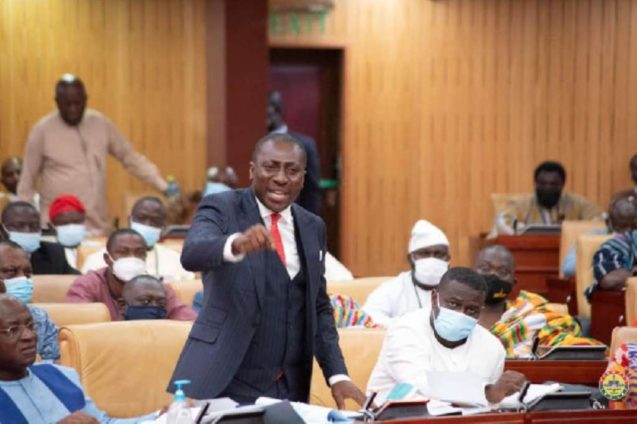
The Deputy Majority Leader, Alexander Afenyo-Markin while presenting the business statement for next week in Parliament on Friday, March 4, 2022, said the House will be notified at the appropriate time.
“The e-levy falls under the programmes that we have proposed. So, as and when it’s supposed to be taken, members will be put on notice. Road tolls are not being taken, of course. We have already passed the appropriation government should be spending in the 2022 budget.”
He added that, “Due to the delay in the passage of the E-levy, government has already lost revenue for January and February. I believe that when the time comes, we will do the needful to make Ghanaians know that we mean business.”
E-Levy
Finance Minister Ken Ofori-Atta, presenting the 2022 budget on Wednesday, November 17, 2021, announced that government intends to introduce an electronic transaction levy (e-levy).
The levy, he revealed, is being introduced to “widen the tax net and rope in the informal sector”. This followed a previous announcement that the government intends to halt the collection of road toll.
The proposed levy, which was expected to come into effect in January, 2022, charges 1.75% on the value of electronic transactions. It covers mobile money payments, bank transfers, merchant payments, and inward remittances. There is an exemption for transactions up to GH¢100 per day.
Explaining the government’s decision, the Finance Minister revealed that the total digital transactions for 2020 were estimated to be over GH¢500 billion (about $81 billion) compared to GH¢78 billion ($12.5 billion) in 2016.
Thus, the need to widen the tax net to include the informal sector.
Although the government has argued that it is an innovative way to generate revenue, scores of citizens and stakeholders have expressed varied sentiments on its appropriateness, with many standing firmly against it.
Even though others have argued in support of the levy, a section of the populace believe that the 1.75% e-levy is an insensitive tax policy that will deepen the already prevailing hardship in the country.
Latest Stories
-
Gov’t considers exploring local raw materials to stabilise production costs of sachet water prices
15 minutes -
Mahama in Paris: Turning Diplomacy into Delivery
17 minutes -
Middle East crisis shows Ghana needs to diversify energy sources – Energy expert
44 minutes -
Government of Ghana Internal Revenue Generation cannot fund Big Push in Four Years
52 minutes -
EPCG Moderator urges leaders to serve with courage and humility in Easter message
1 hour -
The Cobra at the gate: When good intentions overrun the system
1 hour -
Easter service disrupted in Nyanyano as suspected land guards storm church event
2 hours -
Price surge exposing NDC gov’ts dishonesty -Titus Glover
2 hours -
Afigya Kwabre North MP urges Finance and Energy Ministers to submit energy sector report
2 hours -
Deliver quality or face sanctions — GETFund administrator cautions contractors
2 hours -
Kwahu Easter festivities trigger condom shortages; Health teams boost awareness
3 hours -
Victims of a legend: The women Daddy Lumba left behind
3 hours -
Mahama vows to prioritise roads, social amenities in Savannah region
3 hours -
Mahama sets up 18-member panel to advance Africa-led global health reforms
3 hours -
Ghana Medical Trust Fund Administrator urges hope and compassion in Easter message
3 hours