

Audio By Carbonatix
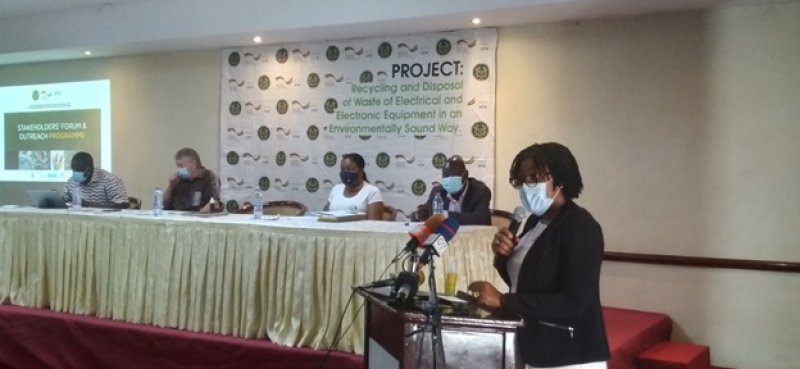
The Ministry of Environment, Science, Technology and Innovation has engaged key stakeholders within the electronic waste (e-waste) value chain on the implementation of a project aimed at managing the disposal of e-waste in a sound environment in Kumasi.
The project, which is also seeking to minimize negative environmental and human health impacts from improper management of e-waste, is a collaboration between the Ministry and the German Government through KFW.
Representatives from scrap dealers associations, electronic repairers, environmental health officers, waste management companies, and the Environmental Protection Agency (EPA) attended the forum.
It was to raise awareness of the project and to get the concerns of the participants to help inform policy and project implementation.
Under the 20-million Euro project, which started in 2018, the German government is supporting Ghana to set up an incentive mechanism for the sound collection, dismantling, recycling, and disposal of e-waste.
Consequently, a Handover Centre has been established in Accra to purchase e-waste from scrap collectors at a fee slightly above the market value as an incentive to halt the burning of e-waste to obtain copper.
The Chief Director of the Ministry, Mrs. Cynthia Asare Bediako, in a speech read on her behalf, said the project was modeled to align with provisions of Act 917 and provided the government the opportunity of identifying challenges and lessons learnt to improve upon national systems once it fully took off.
According to her, over 50 tonnes of e-waste cables were purchased by the Handover Centre at Agbogloshie since the incentive payment system was launched in June, last year.
“The project hopes by mid-April 2021, to commence the purchase of mixed batteries at Agbogbloshie. These e-waste fractions when collected will be offloaded to licensed recycling companies to handle them in an environmentally sound manner”, she stated.
She said it was important to sensitize all stakeholders on the Regulatory Framework on e-waste management in Ghana and outline the roles each of them could play for a successful implementation of the project.
The Director, Policy Planning, Monitoring and Evaluation, and the Project Coordinator, Mrs. Lydia Essuah, said Ghana’s e-waste management was largely controlled by the informal sector with close to 97 percent dominance.
She said they employed crude, rude and unconventional methods to recover the valuable component and indiscriminately disposed of the hazardous component at the detriment of the environment and human health.
The current system, she said, was not sustainable and that was why the government has taken steps including policy direction, legislation, business models, and funding to address the problem.
Latest Stories
-
From Golgotha to Kwahu: The Easter Migration of the Faithful and the Faithless
1 hour -
How the Ghanaian onion traders’ standoff with Nigeria unfolded and threatened local supply
1 hour -
No compensation for demolished structures on 24-Hour Economy market lands — Gov’t to structure owners
1 hour -
Financial Institutions must back local enterprises to spur growth – Deputy Minority Whip
2 hours -
Photos: Gomoa Easter Carnival 2026 ends in a burst of colour and celebration
2 hours -
Gomoa Easter carnival ends in colour as fashion, music and celebrity appearances light up final night
2 hours -
Families pick Luv Fm Family Party to celebrate Easter Monday with music and more
2 hours -
IMANI flags procurement issues in Ghana Gas insurance switch
3 hours -
Kaneshie footbridge rehabilitation to take up to 9 months — AMA
3 hours -
AMA confirms trading will be banned on Kaneshie footbridge after rehabilitation
3 hours -
IMANI flags procurement concerns in state insurance placements
3 hours -
Mahama’s push for visa-free Africa reflects Nkrumah’s Pan-African vision – Rashid Tanko-Computer
3 hours -
Redefining sweetness: Why our celebrations must heal, not harm
3 hours -
IMANI urges Mahama to reaffirm his 2014 directive on competitive state insurance placements
3 hours -
Maiden Katon Praise comes off at Accra Sports Stadium on April 17
4 hours