

Audio By Carbonatix
Humans settled in the Americas much earlier than previously thought, according to new finds from Mexico.
They suggest people were living there 33,000 years ago, twice the widely accepted age for the earliest settlement of the Americas.
The results are based on work at Chiquihuite Cave, a high-altitude rock shelter in central Mexico.
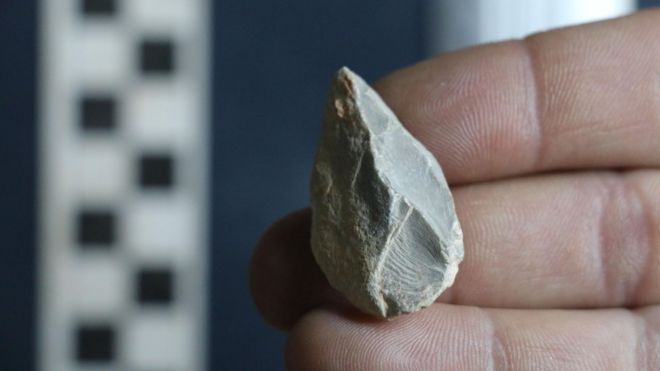
Archaeologists found thousands of stone tools suggesting the cave was used by people for at least 20,000 years.
Ice age
During the second half of the 20th Century, a consensus emerged among North American archaeologists the Clovis people had been the first to reach the Americas, about 11,500 years ago.
The Clovis were thought to have crossed a land bridge linking Siberia to Alaska during the last ice age.
This land bridge subsequently disappeared underwater as the ice melted.
And these big-game hunters were thought to have contributed to the extinction of the megafauna - large mammals such as mammoth, mastodon and various species of bear that roamed the region until the end of the last ice age.
Break down
As the "Clovis First" idea took hold, reports of earlier human settlement were dismissed as unreliable and archaeologists stopped looking for signs of earlier occupation.
But in the 1970s, this orthodoxy started to break down.
In the 1980s, solid evidence for a 14,500-year-old human presence at Monte Verde, Chile, emerged.
And since the 2000s, other pre-Clovis sites have become widely accepted - including the 15,500-year-old Buttermilk Creek site in central Texas.
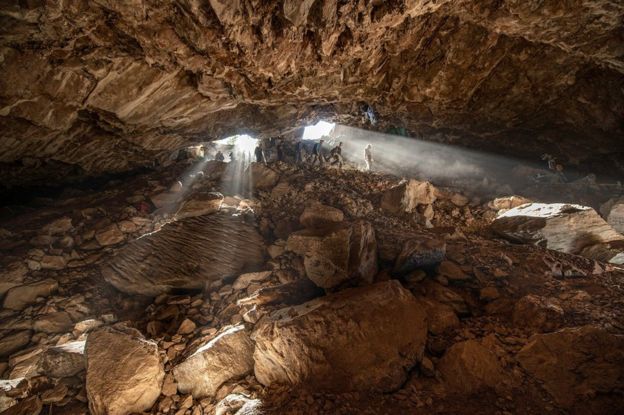
Now, Ciprian Ardelean, from the Universidad Autónoma de Zacatecas, Mexico, Tom Higham, from the University of Oxford, and colleagues have found evidence of human occupation stretching back far beyond that date, at the Chiquihuite site in the central-northern Mexican Highlands.
"This is a unique site, we've never seen anything like it before," Prof Higham said.
"The stone-tool evidence is very, very compelling.
"Anyone can see that these are deliberately manufactured stone tools and there are lots of them.
"The dating - which is my job - is robust.
"And so, it's a very exciting site to have been involved in."
Dating techniques
The team excavated a 3m-deep (10ft) stratigraphic section - a sequence of soil layers arranged in the order they were deposited - and found some 1,900 stone artefacts made over thousands of years.
Researchers were able to date bone, charcoal and sediment associated with the stone tools, using two scientific dating techniques.
The first, radiocarbon dating, relies on the way a radioactive form of the element carbon (carbon-14) is known to decay over time.
The second, optically stimulated luminescence (OSL), works by measuring the last time sediments were exposed to light.
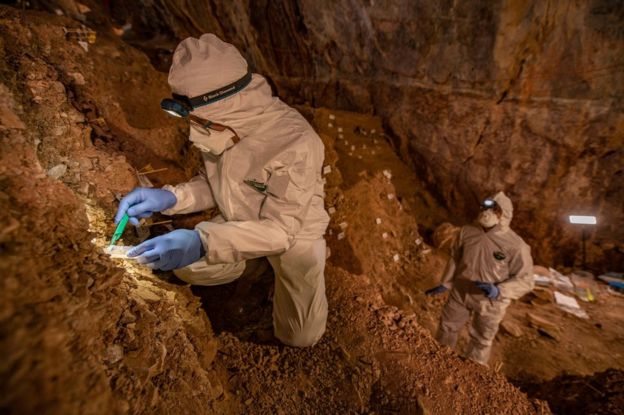
Using two different techniques "added a lot of credibility and strength, particularly to the older part of the chronology", Prof Higham said.
"The optical dates and [radiocarbon] dates are in good agreement," he said.
And the findings could lead scientists to take a fresh look at controversial early occupation sites elsewhere in the Americas.
"In Brazil, there are several sites where you have stone tools that look robust to me and are dated 26-30,000, similar dates to the Chiquihuite site," Prof Higham said.
"This could be an important discovery that could stimulate new work to find other sites in the Americas that date to this period."
Native Americans
The scientists also used "environmental DNA" techniques to look for human genetic material in the cave sediments.
But they could not find a strong enough signal.
Previous DNA evidence has shown the Clovis settlers shared many similarities with modern Native Americans.
And scientists will now want to understand how these older populations relate to later human groups who inhabited the continent.
Latest Stories
-
NPP leaders converge at party headquarters ahead of NEC meeting on polling station elections
5 minutes -
Fuel prices may rise in Ghana despite global drops – Duncan Amoah
8 minutes -
‘No one is above the law’- Volta Chiefs condemn EOCO over handling of Council of State member case
9 minutes -
AMA creates alternative pedestrian routes at Kaneshie after footbridge closure
13 minutes -
Ghanaians were misled- NPP accuses NDC of politicising Anti-LGBTQ bill
13 minutes -
Photos: Mahama receives full state welcome in Paris ahead of talks with French President Macron
35 minutes -
Deputy Health Minister endorses Women in Medicine Fellowship
35 minutes -
Duncan Amoah pushes for Consumer Protection Bill amid VIP fare hike
48 minutes -
LMWG backs Damang lease award to E&P, demands transparency and results
53 minutes -
Volta Chiefs condemns EOCO over alleged disregard for court ruling in Council of State member case
53 minutes -
Matthew Perry’s stepmother says ‘Ketamine Queen’ should get maximum sentence
53 minutes -
Northern Regional Police Command intensifies anti-drug operations, arrests 217 suspects
55 minutes -
The architect of a healthier Ghana: Mahama’s vision and legacy in primary healthcare
57 minutes -
Israel carries out large wave of air strikes across Lebanon
1 hour -
BBC upholds complaints over racial slur in Baftas broadcast
1 hour