


Audio By Carbonatix
The World Meteorological Organisation (WMO) has formally acknowledged the trailblazing multinational campaign to ensure that everyone on Earth is safeguarded against hazardous weather by life-saving early warning systems by the end of 2027.
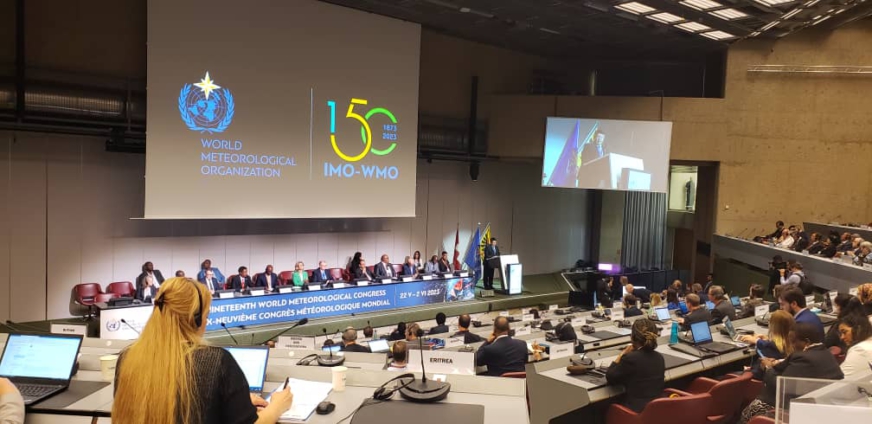
At WMO's 19th Congress in Geneva, which ends June 2, member states agreed that ensuring the successful implementation of the Early Warnings for All Initiative will be given top priority in the WMO Strategic Plan 2024-2027.
"This resolution agrees that the fulfilment of the WMO contribution to the successful implementation of the Early Warnings For All Initiative shall be accorded the highest priority in the WMO Strategic Plan 2024–2027, " said the World Meteorological Congress resolution.
According to the World Meteorological Congress resolution, the Early Warnings for All project is fully consistent with the objective of the National Meteorological and Hydrological Services (NMHSs), which is to provide meteorological, hydrological, and related services to protect life and property.
It stated that it "would provide a new opportunity and momentum of achieving this mission through global partnership and robust resource mobilization."
The resolution stressed the need for an inclusive, multisector approach to planning and implementation of EW4All.
That National government ownership and leadership, coordination to avoid duplication, strategic partnerships, including with development and funding agencies, increased capacity development including mobilisation of technical experts and engagement with the private sector and twinning arrangements.
It stated that existing initiatives, such as the Climate Risk and Early Warning Systems (CREWS) and the Systematic Observations Financing Facility (SOFF), in which WMO is a lead agency, should play a key financing and implementation role in the EW4All Executive Action Plan and any Regional Action Plans that may be developed.
The resolution invites development partners and funding agencies to contribute and align their operations with the UN goal.
The WMO's main decision-making body, the 193-member Congress, stated that it was cognizant of the "ambitious time frame, the complexity of the technological, social, and economic aspects, and the urgency implied by the increasing threats and risks from natural hazards."
"Multi-hazard early warning systems are an international success story and have saved countless lives. They are widely regarded as the low-hanging fruit of climate adaptation. They are efficient and cost-effective, providing an estimated tenfold return on investment," said WMO Secretary-General Prof. Petteri Taalas.
According to him, just half of the countries have early warning systems in place, with coverage particularly poor in Small Island Developing States (SIDS), Least Developed Countries (LDCs), and Africa. In these countries, the mortality toll is disproportionately high.
New updated figures released for the quadrennial session of Congress show that extreme weather, climate, and water-related events produced 11,778 documented catastrophes between 1970 and 2021, resulting in little over 2 million deaths and 4.3 trillion in economic losses.
On World Meteorological Day 2022, UN Secretary-General António Guterres launched the campaign to ensure that by the end of 2027, every person on Earth is safeguarded by early warning systems.
WMO, the UN Office for Disaster Risk Reduction, the International Telecommunications Union, and the International Federation of Red Cross and Red Crescent Societies are spearheading the initiative, which has the support of more than twenty other UN agencies as well as a diverse range of stakeholders ranging from financial institutions to private sectors.
The Executive Action Plan is organized along the four pillars of a multi-hazard early warning system (MHEWS): pillar 1 – Disaster risk knowledge, pillar 2 – Observations and forecasting, pillar 3 – Dissemination and communication and pillar 4 – Preparedness and response
Pillar 2 is led by WMO, and Pillars 1, 3, and 4 are supported.
WMO stated that, in the next months, coordinated effort will be pushed up, initially in 30 highly vulnerable nations, including Small Island Developing States and Least Developed nations.
It said that more countries are likely to join as this critical collaboration with partners gains momentum, scale, and funding.
Latest Stories
-
Gomoa Easter Carnival: Sarkodie, Kuami Eugene, Tinny, set festival ablaze as Day 3 ends on high note
15 minutes -
“Feels amazing” – Antoine Semenyo reveals after Manchester City dismantle Liverpool
41 minutes -
Mahama calls for emergency cabinet meeting over rising fuel prices
1 hour -
Asante Gold reports US$345million loss for 2025
2 hours -
Gov’t making progress in clearing $1.7bn power debt – Mahama
3 hours -
Justice is the engine of growth – Chief Justice
4 hours -
Meet us halfway – Trade Minister tasks private sector with AfCFTA success
4 hours -
After more than 14 years at Atletico Madrid, what next for Simeone?
5 hours -
Conquering the World – Building on the foundations laid by Otto Addo
5 hours -
[Playback] Sarkodie, Kwami Eugene, Tinny, Keche and others thrill fans at Gomoa Easter Carnival
5 hours -
Gomoa Easter Carnival: Experts charge indigenes to own festival to ensure sustainability
6 hours -
Gomoa Easter Carnival: Edem Agbana and Joy Prime fans shower festival with huge endorsements
7 hours -
Gathering of Royals 2026: Empowering women, boosting tomato production
8 hours -
Gov’t to overhaul free zones into manufacturing hubs for local production – Trade Minister
8 hours -
Ghana losing $2.5bn yearly from raw exports – Trade Minister reveals
9 hours