

Audio By Carbonatix
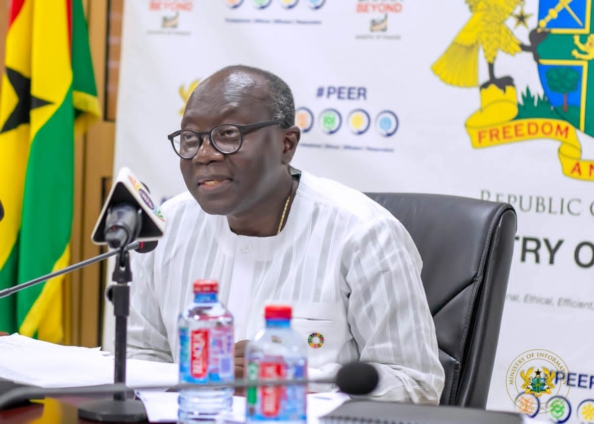
Finance Minister, Ken Ofori-Atta has described the Economic Enclave Project (EEP) as a watershed moment in Ghana’s economic history.
According to him, the EPP through the Ghana CARES programme would provide a catalytic framework to holistically address the structural challenges in the economy by shifting Ghana from import-driven to a self-sufficient and export-oriented economy.
The Economic Enclave Project under the Ghana CARES programme is a 10,000-acre mixed-use economic space which seeks to create a viable ecosystem for the private sector to engage in commercial farming.
The objective is to significantly expand Ghana’s productive capacity in rice, tomato, maize, soya, vegetables, and poultry. The EEP complements existing government agriculture initiatives (e.g. Planting for Food and Jobs and Rearing for Food and Jobs) as a targeted effort to assist the private sector to engage in commercial agriculture.
About 200,000 jobs (105,000 direct and 95,000 indirect jobs) are expected to be created by the EPP for unemployed youth, which would also provide them with a decent source of income, with beneficiaries undergoing mandatory training on good agronomic practices in rice production, group dynamics and entrepreneurship.
Mr. Ofori-Atta extended government’s invitation to individuals, private sector actors, organised groups, churches, traditional leaders, and financial institutions who could secure or own 1000 acres and above, to come on board.
“We will provide support such as land development and facilitate access to credit, including the recently approved 500million from the Development Bank Ghana” he assured.
“This is a real and collective effort to replicate the images of the mass land of cultivated fields we see while flying over other countries that are characterized as the “food baskets” of the world”, he added.
He further pointed out that the project would also help the country improve its food security and enable it to eventually optimize the single market opportunities that the African Continental Free Trade Area (AfCFTA) offered.
The implementation of the EEP is led by the Millennium Development Authority together with the key partnership of the Ministry of Finance, Ministry of Food and Agriculture, Ministry of Defence, Ministry of Energy, Ministry of Roads and Highways, Ministry of Lands and Natural Resources and the Ghana Irrigation Development Authority.
The rest are National Entrepreneurship and Innovation Programme; Ghana Incentive-based Risk-Sharing System for Agricultural Lending, Private Agriculture Value Chain Actors, MasterCard Foundation and the Youth.
The project is expected to be extended to the Greater Accra, Ashanti, Central, Western North, Savannah and Oti regions.
Latest Stories
-
Netherlands Fire Chief in Ghana to support fire safety reforms and market fire prevention efforts
3 hours -
Mason goes on remand for stealing
3 hours -
Gov’t cuts fuel taxes, deploys buses to curb impact of rising fuel prices
3 hours -
Interior Minister calls for intelligence-driven strategy as Ghana strengthens counter-terrorism efforts
3 hours -
Adenta Circuit Court remands Pastor William Gyimah over viral threats against Vice President
4 hours -
“We’ve implemented changes to prevent a repeat of the AFCON final” – CAF President Motsepe
4 hours -
Gov’t orders deployment of Metro Mass buses to cushion commuters amid fuel price hike
5 hours -
Key Indian state polls begin in test for Modi’s party
5 hours -
Playback: Gomoa Easter Carnival in photos
5 hours -
Gov’t orders removal of fuel taxes to ease pump price hikes
5 hours -
“Whatever the decision of CAS, we will respect it” – CAF President Motsepe after AFCON final meetings in Morocco
6 hours -
Emma Ankrah: When waiting becomes part of treatment – Reflections on hospital care
6 hours -
Ghana urges travellers to prepare for new EU border system roll-out
6 hours -
Mahama enforces fuel coupon ban for ministers as cabinet moves to slash fuel taxes
6 hours -
Task force probes strange fish deaths in Tema
6 hours