

Audio By Carbonatix
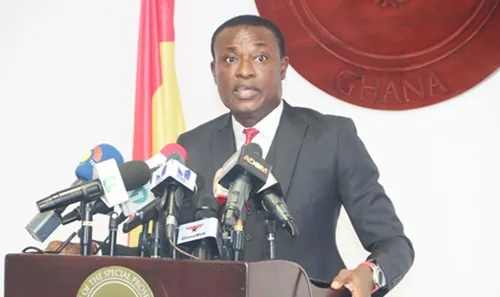
The Special Prosecutor Kissi Agyebeng has called for a fundamental rethinking of Ghana’s education system, urging policymakers and educators to reposition it as a tool for preserving national identity, fostering innovation, and shaping future leadership.
Delivering a keynote address at the 95th Anniversary Speech and Prize-Giving Day of Accra Academy on Saturday, March 28, Mr Agyebeng warned that Ghana risks losing its cultural identity if its educational model continues to prioritise foreign constructs over indigenous values.
Speaking on the theme “Education as the Catalyst for Preserving Heritage, Driving Innovation, and Empowering Future Leadership", he challenged students, educators, and national leaders to rethink the purpose of schooling beyond academic success.
“Why do we go to school? Why do we educate ourselves?” he asked, noting that while many pursue education to “secure a decent existence", the broader national objective must be to build a resilient and self-sustaining society.
Warning Against Cultural Erosion
The Special Prosecutor expressed concern about what he described as a gradual erosion of Ghana’s cultural identity, linking it partly to the country’s colonial educational legacy.
He argued that Ghana’s schooling system, inherited from colonial rule, was originally designed to produce a workforce for administrative convenience rather than to drive indigenous development.
“Our own languages were banished from schools as uncultured vernacular,” he said, recalling how generations of students were punished for speaking local languages.
He further criticised the continued use of colonial-era place names and spellings, questioning why Indigenous identities remain sidelined decades after independence.
“My point is this: We are losing ourselves – and with ourselves, our aspirations. We are not recognisable," he stressed.
According to him, this identity crisis has left many Ghanaians “caught in the in-between", unable to fully embrace either their heritage or the foreign ideals they seek to emulate.
Education as a Tool for National Strength
Mr Agyebeng emphasised that education must be deliberately structured to strengthen national identity and competitiveness in a globalised world.
“The lesson history teaches us is brutally simple: Do not be weak… lest you be swallowed up by others,” he cautioned, drawing parallels between historical conflicts and modern socio-economic competition among nations.
He noted that without a strong educational foundation rooted in local context, Ghana risks remaining dependent and vulnerable in an increasingly competitive global landscape.
“A major assured way by which we may forge decent existence for ourselves is our educational model,” he stated.
The Special Prosecutor highlighted the founding philosophy of Accra Academy as a model worth emulating nationwide.
Established in 1931 by four young Ghanaian visionaries without state or church support, the institution was designed to promote holistic development rooted in African identity.
He praised the school’s guiding principles, including its Latin motto “Esse Quam Videri” (to be, rather than to seem), as well as its emphasis on integrity, selflessness, and practical learning.
He also referenced the school’s additional maxims—“Non Sibi Sed Aliis” (not for self, but for others) and “Non Scholæ Sed Vitæ Discimus” (we do not learn for school, but for life)—as critical pillars for nurturing responsible and innovative citizens.
“These principles together account for the sheer forcefulness of the school and its products,” he said.
Call for Balanced Global Integration
While advocating for a stronger focus on local identity, Mr Agyebeng clarified that he was not calling for isolationism.
“I am not suggesting in the least that we should not adopt and assimilate aspects of foreign experiences and knowledge which would work for us,” he explained.
Rather, he urged Ghana to selectively integrate global ideas while maintaining its cultural essence.
“We should absorb same into our systems while projecting our very essence,” he added.
The Special Prosecutor concluded that Ghana’s future prosperity depends on an education system that nurtures the “heart, head, and hand”—developing character, intellect, and practical skills.
He stressed that such a system would enable the country to achieve sustainable development, innovation, and effective leadership.
“Our education module should nurture our hearts to discard stubborn will and to take wise counsel; steady our heads to ride all storms; and train our hands to excel,” he said.
The anniversary celebration brought together alumni, students, educators, and dignitaries, reflecting on the institution’s legacy and its contribution to national development.
Mr Agyebeng’s address is expected to reignite national debate on education reform, particularly as Ghana continues to grapple with balancing global competitiveness and cultural preservation.
Latest Stories
-
Young girls demand climate action, stronger protection against child marriage
3 minutes -
Ex-gang boss sentenced to 40 years for orchestrating Tupac Shakur’s murder
3 minutes -
From near-deferral to three awards: UMaT graduate’s academic journey
5 minutes -
Atta Akyea denies seeking presidential pardon for Wontumi in galamsey case
43 minutes -
Photos: Mahama commissions 85-bed Police Hospital ward, donates two ambulances
52 minutes -
GTEC directs Ghana’s public universities to reopen by October 16 and begin lectures on October 19
53 minutes -
Star Oil donates GH¢1million towards construction of new CID facility
57 minutes -
Court hands Adjetey Sowah, two others lifetime bans after Amputee Football legal dispute
1 hour -
NDC appoints Julius Kwame Anthony as a Deputy Communications Director
1 hour -
Ghana repatriates 120 Nigerians rescued from suspected cybercrime centres
1 hour -
NPP rejects Emelia Agbenyo’s appointment as Deputy EC Chair, demands withdrawal
1 hour -
EOCO grants Suame MP John Darko enquiry bail in GH¢27m SIC investigation
1 hour -
NPP cannot question EC appointment after appointing own people to Commission – Kwakye Ofosu
1 hour -
BoG deepens public trust with regional stakeholder forum in Techiman
2 hours -
‘We have turned the tide’ – Ato Forson says Ghana is ready to take off
2 hours