

Audio By Carbonatix
1. How does the NDC's 2024 Manifesto address the long-standing issue of post-harvest losses in Ghana's agricultural sector?
The NDC's manifesto proposes establishing Farmers' Service Centres and Agricultural Industrial Zones in all agricultural districts to support post-harvest activities. The goal is to modernise farming practices and reduce food losses through agro processing and investments in warehousing and cold storage facilities integrated with the Ghana Commodity Exchange.
2. What innovative strategies does the NDC propose to increase access to credit facilities for smallholder farmers in Ghana?
The NDC plans to encourage commercial banks to devote more of their deposits to support agriculture and agribusiness. We also aim to introduce Farm Banks as part of the FaSCs to provide easier access to land and irrigation facilities. Additionally, we will promote the consolidation of SHF under Farmers' Cooperatives to enhance their ability to access financing, along with introducing a Government Agriculture Insurance Subsidy to de-risk agricultural loans. We will also resource GIRSAL.
3. How does the NDC's manifesto plan to revamp the extension services system to better support farmers in adopting modern farmersagricultural practices?
The NDC manifesto outlines the establishment of Farmers’ Service Centres to provide with modern equipment, technologies, and inputs. These centres are intended to enhance agricultural extension services, making it easier for farmers, youth and women to adopt modern farming methods in grains, tubers, poultry, livestock, cocoa and other strategic products, Agric/Cocoa colleges to teach farmers.
4. What measures does the NDC propose to address the impact of climate change on Ghana's agricultural sector?
To address climate change, the NDC plans to resource research institutions focused on water harvesting, conservation, seeds and climate adaptation. Their manifesto also includes expanding irrigation and improving climate resilience through strategic research in plant production and climate adaptation techniques.
5. How does the NDC plan to increase Ghana's agricultural exports and reduce reliance on imported food products?
The NDC will revitalise the agro-processing sector by partnering with the private sector to establish processing plants for rice, cassava, cocoa, and other commodities. This initiative is designed to boost local food production and reduce reliance on imported goods, while also increasing agricultural exports. PPP. 40% export-ready. AfCFTA.
6. What role does the NDC see for technology in transforming Ghana's agricultural sector, and how do they plan to support its adoption?
The NDC intends to promote SMART agriculture, emphasising digital platforms and technology for increased efficiency. Our manifesto includes the use of greenhouse farming, improved irrigation systems, and digital platforms for farmer support and training.
7. How does the NDC's manifesto address the issue of land tenure and ownership, particularly for smallholder farmers?
The NDC will formalise land access by establishing Farm Banks to ease land acquisition for agricultural purposes. We also plan to support land tenure reforms, ensuring that smallholder farmers have improved access to land.
8. What social safety nets does the NDC propose to protect farmers from market fluctuations and price volatility?
To protect farmers from market fluctuations, the NDC will reintroduce the Cocoa Price Stabilisation Fund to provide a financial cushion. We also propose GIRSAL, the establishment of insurance systems (GAIS) and financial programmes to support farmers during times of price volatility.
9. How does the NDC plan to support agricultural research and development to improve crop yields and disease resistance?
The NDC’s manifesto commits to increased investments in agricultural research institutions, focusing on improving crop yields (seed, livestock, fingerlings) and disease resistance. They will prioritise research in plant breeding, pest control, and the adoption of new agricultural technologies. AGRIC COLLEGES
10. What timelines and benchmarks has the NDC set for achieving their agricultural policy objectives, and how will progress be measured?
While specific timelines were not detailed in the document, the NDC emphasises their commitment to coordinated strategies under the Agriculture for Economic Transformation Agenda (AETA). We aim to modernise the agricultural sector through ongoing investments and support, with progress measured by food security improvements, export increases, and job creation.
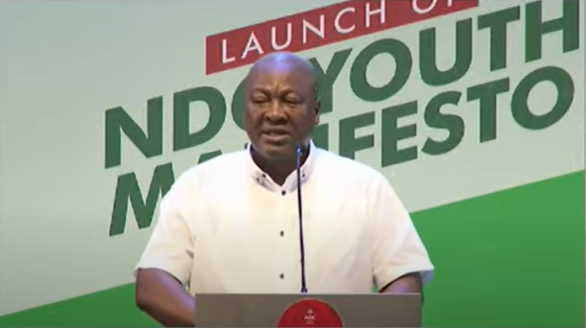
Watch: Playback: NDC launches ‘People’s Manifesto: Jobs, Prosperity and more’
Latest Stories
-
Photos: Speaker Bagbin Commissions MPs constituency office under parliamentary decentralisation programme
10 minutes -
Black Stars technical advisor Winfried Schäfer sacked as GFA shakes up backroom staff
15 minutes -
Wenchi water project almost complete, critical to gov’t agenda – GWL MD
31 minutes -
Anti-LGBTQ+ bill not part of government’s legislative agenda – Inusah Fuseini
33 minutes -
Anti-LGBTQ Bill: Forget the rumour mongers, I’m a man of action, and will pass the bill – Speaker
1 hour -
Women and children among those killed in Sudanese army shelling of wedding celebration
1 hour -
President Mahama is not sincere with Ghanaians on LGBTQ bill matter – Hassan Tampuli
2 hours -
Gov’t to establish Prison Industrial Hub to equip inmates with income-generating skills – Prison Service boss
2 hours -
Alhassan Tampuli donates cement, roofing sheets to support storm victims in Gushegu
2 hours -
Alhassan Tampuli appeals for urgent support for storm victims in Gushegu
2 hours -
The hypocrisy must stop; pass Anti-LGBTQ+ Bill now – Alhassan Tampuli to Mahama
2 hours -
Imprisonment should be rehabilitative, not punitive – Ghana Prisons boss at UNGA
2 hours -
Ga Adangbe traditional priests petition Mahama over McDan aviation licence revocation
3 hours -
Anti-LGBTQ Bill: NDC’s arrogance is worrying – Hassan Tampuli
3 hours -
Let’s give OSP time to mature, not to scrap it – Hassan Tampuli
3 hours