

Audio By Carbonatix
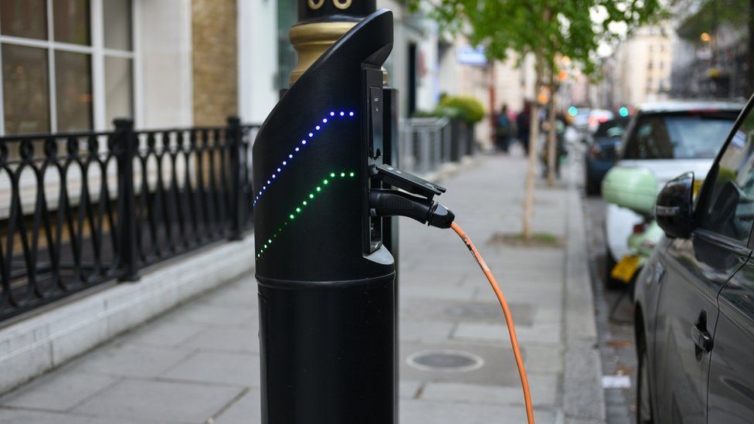
The rollout of electric vehicle charging points has fallen behind what is needed to meet a planned ban on new petrol and diesel cars, the Policy Exchange think-tank says.
There's a risk of "charging blackspots" in small towns and rural areas unless the rollout speeds up, it says.
The report says the UK will need 400,000 public chargers by 2030, up from 35,000 currently.
Transport Secretary Grant Shapps said the UK's network is "world-leading".
But the influential think-tank said that to meet demand when new conventionally-fuelled cars and vans are prohibited in 2030, the annual rate at which charge-points are being installed must increase from about 7,000 over the past three years to 35,000 over the next decade.
Researchers recommended that the government should issue contracts to private firms to install charge-points in areas where they are sparse.
This would mark a switch from the existing policy of offering grants, and would be similar to offshore wind farm auctions.
Under the proposal, a price cap would be introduced for charge-points that received government support, to avoid operators exploiting local monopolies.
The report called for local authorities to be given Department for Transport funding for dedicated teams tasked with boosting rollout in residential areas.
In the foreword to the report, Simon Clarke, a Conservative MP and former minister for regional growth and local government, wrote: "Whereas a driver of a petrol car can travel confidently from Land's End to John O'Groats, knowing that they can refill the tank every few miles, that is not yet the case for EVs (electric vehicles).
"Some areas have naturally built up impressive coverage, such as central London, but vast swathes of the country have not.
"This important report sets out a way to meet the challenge," he said.
The report said the government should focus on areas where it isn't delivering enough public charge-points, including the north west of England, Yorkshire and Northern Ireland".
Policy Exchange senior research fellow Ed Birkett said: "Companies are rolling out charge-points at a record rate, but there's a risk that some areas of the country won't get enough charge-points and will be left behind.
"We're concerned about patchy deployment of charge-points, which runs against the government's plans for levelling up and a strong and connected Union."
£1.5bn investment
Transport Secretary Grant Shapps insisted the UK's charging network is "world-leading", adding: "From Cumbria to Cornwall, drivers across the country should benefit from the electric vehicle revolution we're seeing right now."
He announced a further £20m of funding for local authorities to install 4,000 more on-street charge-points across the UK. These will allow residents without access to off-street parking to charge their vehicles.
In November, Prime Minister Boris Johnson brought forward the ban on sales of new petrol and diesel cars and vans from 2040 to 2030 as part of his "green industrial revolution".
He also pledged to pump £1.3bn towards charging infrastructure over the next four years.
Data from the Society of Motor Manufacturers and Traders shows battery electric models took 17% of the new car market in 2020, up from 3% during the previous 12 months.
RAC motoring group spokesman Rod Dennis agreed that parts of the country risked being left behind
"Without a big increase in the number of charge points right across the UK, certain parts of the country risk getting left behind as 2030 approaches. Everyone remembers what happened when broadband started to be rolled out and some areas were left with poor connections.
"It would be a major policy failure if something similar happened in the next few years with communities missing out on good charging provision."
Latest Stories
-
Catholic Bishops say moral values must match economic priorities in Anti-LGBTQ+ debate
5 minutes -
IGP Yohuno urges merit and hard work ahead of Police Academy exams
18 minutes -
Queendalyn Yurglee releases debut album ‘Clouds of Glory’
51 minutes -
UDS moves to clear MPhil student wrongly linked to robbery case
1 hour -
Vodza Regatta 2026: Prof Audrey Gadzekpo rallies investors for coastal tourism growth
1 hour -
Introduction of 100 new Metro Mass buses won’t affect transport unions – GPRTU
1 hour -
Deputy Transport Minister backs Yellow Line traffic initiative
1 hour -
MTN Ashanti-Fest music concert set to hit Kumasi on Saturday
2 hours -
Authorities probe discovery of dead fish at Tema shipyard
2 hours -
Minority welcomes fuel tax cuts, demands accountability for GH¢1 levy
2 hours -
It remains a priority — Sam George on Anti-LGBTQ bill
2 hours -
Police arrest Nigerian national seen in viral videos wearing police uniforms
2 hours -
Free golf training empowers underprivileged girls in Accra
2 hours -
Why SIGA’s reset is not a market sin, but a national necessity
2 hours -
SIGA Directive: Beyond the theatre of institutional displacement
2 hours