

Audio By Carbonatix
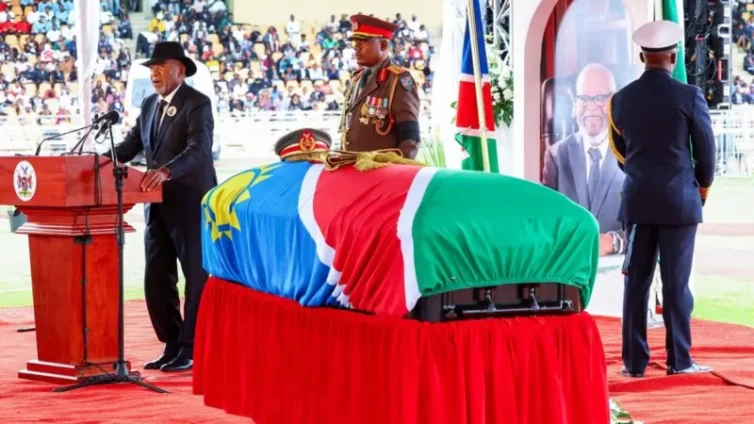
Namibia's founding father Sam Nujoma was "a giant among leaders" and left behind "the most precious gift of… freedom", the country's President, Nangolo Mbumba, has said.
He was speaking in front of the large crowd at Heroes' Acre, where the country's most revered citizens are buried, before Nujoma was laid to rest in a mausoleum.
The leader of Namibia's independence struggle against apartheid South Africa died last month at the age of 95.
Nujoma was seen as the last of a generation of African figures who headed anti-colonial movements and fought for freedom.
"Therefore his departure signals an end of an era, a founding father of Africa," President Mbumba said in an earlier speech at a national memorial service on Friday.
"We are not only mourning today, we are celebrating an extraordinary leader who has contributed significantly to our country's independence, who will continue to inspire us for many more years to come," Namibian Given Shiyukifein told the Reuters news agency.
On Saturday, Nujoma's coffin, draped in the Namibian flag, was driven by a military gun carriage from the centre of the capital, Windhoek, where the body was lying in state, to the burial ground on the outskirts of the city.
Mourners had been arriving since the early hours, the independent Namibian newspaper reported.
It added that they waved flags and sang songs in his memory, including Sam Ouli Peni? (Sam, Where are you?) – a popular anthem from the period after independence in 1990.
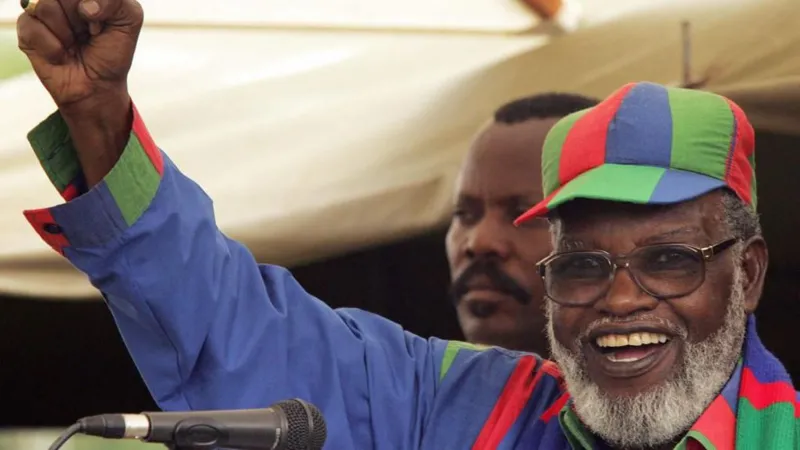
Among the dignitaries present were the presidents of neighbouring countries Angola, South Africa and Zimbabwe.
Nujoma, one of 10 children from a peasant family, was working on the railway in the late 1940s when he got a political education. He developed a passion for politics and yearned to see his people free from the injustice and indignity of colonialism.
He led the long fight for freedom from South Africa, which was then under white-minority rule, and helped found the liberation movement known as the South West Africa People's Organisation (Swapo) in the 1960s.
As the country's first president – a position he held for 15 years until 2005 - Nujoma is widely credited for ensuring peace and stability. His policy of national reconciliation encouraged the country's white community to remain, and they still play a major role in farming and other sectors of the economy.
He also championed the rights of women and children, including making fathers pay for the maintenance of children born out of wedlock.
Namibia, then known as South West Africa, was under German occupation from 1884 until 1915, when Germany lost its colony in World War One.
It then fell under the rule of white South Africa, which extended its racist laws to the country, denying black Namibians any political rights, as well as restricting social and economic freedoms.
The introduction of sweeping apartheid legislation led to a guerrilla war of independence breaking out in 1966.
Latest Stories
-
Anti-LGBTQ+ Bill: Ghanaians demand expedited passage, not dialogue – Ntim Fordjour to Mahama
4 minutes -
EU airline industry warns of fuel shortages if Strait of Hormuz stays closed
7 minutes -
White House staff told not to place bets on prediction markets
14 minutes -
Auctioneers petition Prez Mahama over ‘interference’ in public auctions
21 minutes -
GEA, Mastercard Foundation drive market access for MSMEs at Kwahu Business Forum
23 minutes -
Education Ministry begins review of Ghana Library Authority law
32 minutes -
Ghana U-15 girls clinch back-to-back CAF Schools titles
37 minutes -
Rev. Ntim Fordjour urges Mahama to issue directive to fast-track anti-LGBTQ+ bill
39 minutes -
GPL 2025/26: Stoppage-time penalty hands Aduana FC win over leaders GoldStars
41 minutes -
Ntim Fordjour rejects call for more dialogue, says anti-LGBTQ+ bill has faced a decade of debate and delay
43 minutes -
Catholic Bishops say moral values must match economic priorities in Anti-LGBTQ+ debate
1 hour -
IGP Yohuno urges merit and hard work ahead of Police Academy exams
1 hour -
Queendalyn Yurglee releases debut album ‘Clouds of Glory’
2 hours -
UDS moves to clear MPhil student wrongly linked to robbery case
2 hours -
Vodza Regatta 2026: Prof Audrey Gadzekpo rallies investors for coastal tourism growth
2 hours