


Audio By Carbonatix
In an unprecedented move, Eritrean bishops in the Orthodox church have expelled their former patriarch, Abune Antonios.
Antonios, who was the head of the church until 2006, was accused of heresy in a statement signed by a group of top bishops.
He has for a long time been a critic of the government and was deposed and put under house arrest 13 years ago.
His followers accuse the government of interfering in church affairs.
He was deposed in 2006 after he refused to excommunicate 3,000 members of a Sunday school movement.
But analysts believe he was deposed so the Eritrean government could have full control of the Eritrean Orthodox Church, reports BBC Tigrinya's Teklemariam Bekit.
When he was deposed he was put under house arrest, where he remains.
In April he secretly filmed a video where he objected to the church being led by layman Yoftahe Dimetros.
The letter from the bishops said that his recent activities made the church realise that "his repentance was not genuine" and that the church was "becoming a congregation of heretics" so they decided to expel him.
"His name should never be mentioned and remembered and those who do will be punished severely," the letter added.
Five of the six most powerful bishops in the country signed the letter. It is not clear why one signature is absent.
Although he was expelled from being a member of the church, the bishops promised he could still live in a church building.

What is heresy?
The Oxford English Dictionary defines heresy as "religious opinion or doctrine maintained in opposition, or held to be contrary, to the 'catholic' or orthodox doctrine of the Christian Church".
It's a controversial term with negative connotations as critics say it is an example of religious intolerance and repression and used to silence free discussion.
Orthodox Christians make up one of the main religious groups within Eritrea.
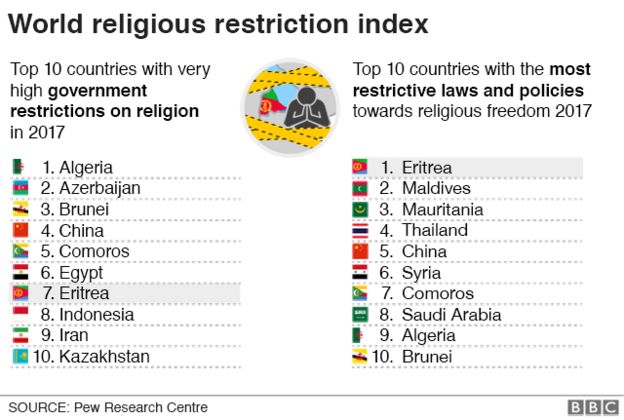
Only four religious groups are allowed to operate in the country; the Eritrean Orthodox, Evangelical Lutheran and Catholic churches, and Sunni Islam.
In June the Catholic church said that the government had closed down all their health centres after the church called for reforms to stem the tide of migration to Europe.
Eritrea became an independent state in 1993, and has been under President Isaias Afwerki's rule ever since.
His critics accuse him of leading a repressive state, but his supporters deny this.
Latest Stories
-
Atletico Madrid stun 10-man Barcelona to seize Champions League semi-final advantage
3 minutes -
Black Stars coach to be announced by next week – Sports Minister
13 minutes -
Chiefs, queen mothers and principal elders of Odau group denounce ‘rebellious Etweresohene’, pledges allegiance to Okyenhene
20 minutes -
KNUST library dress code sparks online backlash over strict rules
29 minutes -
Cultural Diplomacy in Action: Ghanaian youth leaders present symbolic smock to U.S. Chargé d’Affaires
30 minutes -
Ghana Card payment activation under review – NIA breaks silence on financial integration
54 minutes -
Ofori-Atta’s ICE release on bail positive; he poses no risk – Amanda Clinton
56 minutes -
Ken Ofori-Atta’s passport seized after bail, set to reappear in US Court on April 27
59 minutes -
Stuck contraceptives risk HIV surge – Ghana HIV/AIDS Network President warns
1 hour -
Edmond Boateng elected Secretary of Honorary Consular Corps of Ghana
2 hours -
Omanhene Kwabena Asante slams GIADEC CEO over alleged discrimination in mining concessions
2 hours -
Majority of Ghanaian importers lack awareness of cargo insurance – Gyampo
2 hours -
GJA Ashanti applauds Asantehene for securing land for new press centre
2 hours -
CIMAF Ghana donates cement to Afua Kobi SHS
2 hours -
Ghana to benefit from France’s National health platform following Paris talks
2 hours