


Audio By Carbonatix
Ethiopia has detained 1,200 people over the deadly political violence that broke out a fortnight ago, police say.
These are the first mass arrests since reformist Prime Minister Abiy Ahmed came to power in April.
At least 28 people died in clashes near the capital, Addis Ababa, following the return of exiled leaders of a former rebel group, the Oromo Liberation Front (OLF) on 15 September.
Rights group Amnesty International has called for the prisoners' release.
In addition to those held in connection with the violence, a further 1,400 people were taken into custody following raids on places where people gamble, smoke shisha or chew the narcotic leaf khat
Most of those have been released, Addis Ababa police chief Maj Gen Degfie Bedi is quoted as saying by the state-linked Fana Broadcasting Corporate (FBC).
Those arrested for the violence have been sent to Tolay military camp, which is known for providing what is called "rehabilitation training", reports the BBC's Habtamu Tibebu from Addis Ababa.
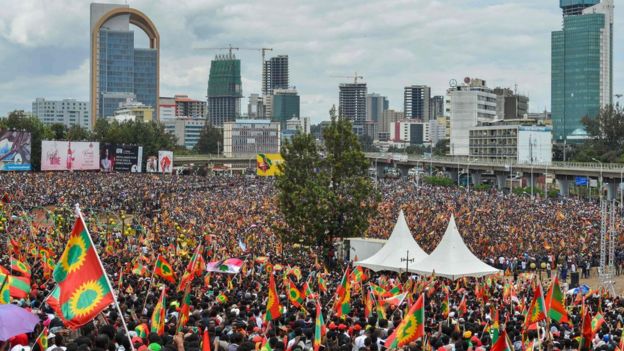
The rally to welcome back the exiled leaders of the OLF passed off peacefully
The trouble began on 13 September as OLF supporters placed their flag in parts of the capital. The move was interpreted by some residents as an attempt by the OLF to take control of Addis Ababa.
Rival supporters then clashed leading to the closure of parts of the commercial centre of Addis Ababa.
The violence escalated two days later, leaving 28 people dead, FBC quotes Maj Degfie as saying.
'Do not fill prisons again'
Most of them died through beating with sticks and stones as rival groups clashed and seven were killed by security officers, Maj Degfie said.
Amnesty International put the number of dead at 58.
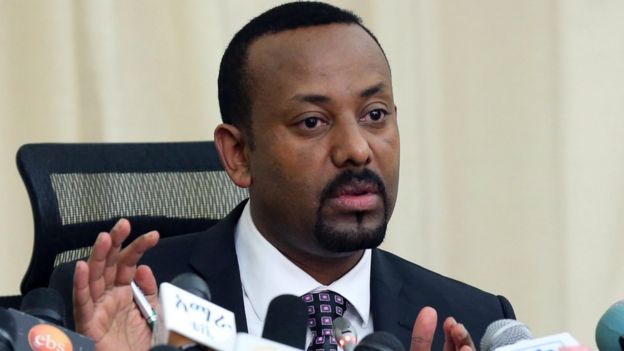
Prime Minister Abiy Ahmed has made changes that have transformed the country
It condemned the arrests, saying the government had made a "commendable attempt to empty" prisons and it should not "fill them up again" by detaining people without charge.
"The government must renew its commitment to a new era of respecting and upholding human rights," Amnesty added in a statement.
Since coming to power in April, Prime Minister Abiy has introduced a series of reforms that have been widely welcomed.
He has released thousands of political prisoners and unbanned groups, including the OLF, which had been labelled as terrorist organisations.
Mr Abiy who is from the Oromo ethnic group, has been seen as the person who could resolve political and ethnic divisions in the country.
In recent years, Ethiopia has been hit by a wave of protests led by Oromos, who have been complaining about political and economic marginalisation.
The Oromos are the largest ethnic group in Ethiopia.
Latest Stories
-
UDS moves to clear MPhil student wrongly linked to robbery case
15 minutes -
Vodza Regatta 2026: Prof Audrey Gadzekpo rallies investors for coastal tourism growth
17 minutes -
Introduction of 100 new Metro Mass buses won’t affect transport unions – GPRTU
20 minutes -
Deputy Transport Minister backs Yellow Line traffic initiative
24 minutes -
MTN Ashanti-Fest music concert set to hit Kumasi on Saturday
41 minutes -
Authorities probe discovery of dead fish at Tema shipyard
44 minutes -
Minority welcomes fuel tax cuts, demands accountability for GH¢1 levy
53 minutes -
It remains a priority — Sam George on Anti-LGBTQ bill
59 minutes -
Police arrest Nigerian national seen in viral videos wearing police uniforms
1 hour -
Free golf training empowers underprivileged girls in Accra
1 hour -
Why SIGA’s reset is not a market sin, but a national necessity
1 hour -
SIGA Directive: Beyond the theatre of institutional displacement
1 hour -
Boso Odweegyi Festival 2026 launched with call for unity, cultural preservation
1 hour -
YEA clears majority of beneficiary arrears, assures completion of outstanding payments
2 hours -
AfCFTA key to building globally competitive African businesses – Zambia envoy urges Ghanaian CEOs
2 hours