


Audio By Carbonatix
Eritrean human rights activists have accused the EU of funding a scheme in Eritrea that uses "forced labour".
The EU is backing a road-building project as part of its programme to stem migration from Africa into Europe.
National service recruits will be used and the Foundation Human Rights for Eritreans (FHRE) says conscripts are "trapped for an indefinite period within the service".
FHRE has threatened to sue the EU over violating its human rights charter.
FHRE director Mulueberhan Temelso has called Eritrea an "open-air prison [where] every person in national service is trapped in extremely harsh conditions".
What's the issue with national service in Eritrea?
Officially, Eritrea requires people to undertake 18 months of national service, but this period was extended indefinitely in the wake of the Ethiopia-Eritrea war that ended in 2000.
A 2016 UN human rights investigation said conscripts were used as "forced labour".
The "widely-criticised practice... has robbed the country's youth of their dreams creating a generation of Eritrean refugees", rights group Amnesty International said in 2018.
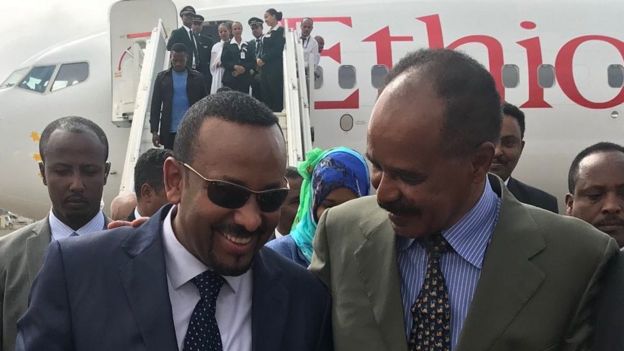
Ethiopia-Eritrea relations thawed after Ethiopia's Prime Minister Abiy Ahmed (left) met Eritrean President Isaias Afwerki last year
Eritrea has said that this is a distorted picture of what is going on and has denied that there is indefinite national service. The government has not commented on what the FHRE is saying.
There was hope that it would return to its original 18-month period following the signing of a peace deal with Ethiopia last year, but this has not yet happened.
What is the EU doing?
The EU has pledged to spend €20m ($22m; £17m) in Eritrea as part of its Emergency Trust Fund for Africa, which is aimed at tackling what the EU calls "irregular migration" by funding job creation schemes in various African countries.
The money will be spent on improving the road network in Eritrea.
In its explanation of the project, the EU acknowledges that people on national service will be used but it says they will be paid and the pay rates have recently been increased.
It adds that the issue is the subject of "heightened dialogue" with Eritrea.
Sources in Eritrea have told the BBC that since 2016 soldiers have nominally received $120 a month, but after deductions, including paying for rations, they personally get paid just $17 a month and their family gets $40.
There has been no recent pay increase, the BBC understands.
The EU has not responded to a request for comment.
What will the rights activists do?
FHRE has sent a letter to the EU warning that it will take the organisation to court for violating its own Charter of Fundamental Rights if it does not withdraw from the road-building project.
The charter states that "no-one shall be required to perform forced or compulsory labour".
"I'm very interested to hear what the EU has to say for itself because whatever you say it will amount to a defence of using forced labour," the lawyer acting on behalf of the FHRE told the BBC's Focus on Africa programme.
"I find it hard to understand, and I'm hoping a lot of people within the EU will find it hard to understand," he added.
Latest Stories
-
Edmond Boateng takes up secretary role at Honorary Consular Corps of Ghana
20 minutes -
Gambia appoints British barrister to prosecute gruesome Jammeh-era crimes
36 minutes -
Girl group Flo on entering into their ‘bombastic, confident, strong’ era
47 minutes -
Germany suspends military approval for long stays abroad for men under 45
1 hour -
Liverpool face uphill Champions League task after PSG thrashing in Paris
1 hour -
‘Ketamine Queen’ sentenced to 15 years in Matthew Perry overdose death
1 hour -
Nigeria begins mass trial of 500 terrorism suspects
1 hour -
Atletico Madrid stun 10-man Barcelona to seize Champions League semi-final advantage
2 hours -
Black Stars coach to be announced by next week – Sports Minister
2 hours -
Chiefs, queen mothers and principal elders of Odau group denounce ‘rebellious Etweresohene’, pledges allegiance to Okyenhene
2 hours -
KNUST library dress code sparks online backlash over strict rules
2 hours -
Cultural Diplomacy in Action: Ghanaian youth leaders present symbolic smock to U.S. Chargé d’Affaires
2 hours -
Ghana Card payment activation under review – NIA breaks silence on financial integration
3 hours -
Ofori-Atta’s ICE release on bail positive; he poses no risk – Amanda Clinton
3 hours -
Ken Ofori-Atta’s passport seized after bail, set to reappear in US Court on April 27
3 hours