


Audio By Carbonatix
Facebook is introducing new tools in Germany to help combat the spread of fabricated news stories.
The world's largest social network said it would enable German users to flag potentially false stories.
The stories will then be passed to third-party fact-checkers and if found to be unreliable, will be marked in users' news feeds as "disputed".
It is the first major expansion of the fake news features since Facebook announced tests in the US in December.
"Last month we announced measures to tackle the challenge of fake news on Facebook," the company said on Sunday in a German-language statement.
"We will put these updates in place in Germany in the coming weeks."
Facebook has been widely criticised after some users complained that fake news had influenced the US presidential election.
German government officials have expressed concern that misinformation on the internet could influence the country's parliamentary election this year.
Last week, the social news site Buzzfeed found Facebook pages were publishing false stories about German Chancellor Angela Merkel, who is seeking re-election.
German Justice Minister Heiko Maas has also repeatedly warned about fake news on Facebook, and called on the firm to respect the country's defamation laws, which are stricter than in the US.
In the UK, MPs are set to question executives from Facebook, Google and Twitter about fake news amid fears it is undermining democracy, according to a report in the Sunday Telegraph.
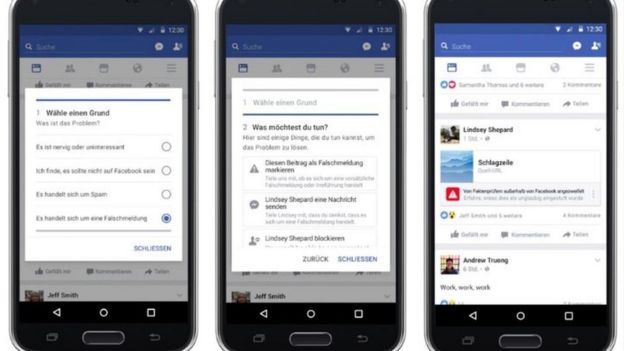
Facebook released screenshots of the German reporting tools
Under the new measures, users in Germany will be able to select "It's a fake news story" as an option when reporting another user's post.
They can then mark the post as fake news, let the other user know they think it is fake, or block that user.
Facebook will send potentially fake stories to Correctiv, a German non-profit body of investigative journalists, to check the facts.
If they find a story to be false, it will be marked on Facebook as "disputed" and will appear lower in users' news feeds.
Facebook is already testing the system with certain fact-checkers in the US to verify news on its platform.
The fact-checkers must sign up to a code of principles to take part. There are currently 43 signatories, including news organisations in several different countries.
As in the US, Facebook Germany said it was looking into penalising websites, which tried to mimic major publishers or misled readers into thinking they were a well-known news source.
Last week, Facebook announced new training and tools that would be made available for journalists on its platform.
On Thursday, BBC News said it would expand its Reality Check series to target false stories or facts being shared widely on social media.
Latest Stories
-
Police hunt suspects after gunfire triggers chaos at Kotoku Onion Market
49 seconds -
Health Ministry partners private sector to boost public education on safe healthcare practices
12 minutes -
GhIE demands independent audit of GH¢110bn Big Push road programme
13 minutes -
Heavy rainstorm causes power outages in Ashanti Region – ECG
13 minutes -
Abuakwa MP supports constituents to mark Easter celebration
15 minutes -
CAF U-17 AFCON: Ghana handed tricky opponents in Group D
17 minutes -
Manhyia South MP decries unchecked commercialisation of residential areas, warns of extinction
18 minutes -
U-17 AFCON 2026: Ghana drawn in tough group as Black Starlets eye World Cup return
19 minutes -
NRSA recommends strict enforcement of laws banning right-hand drive imports
27 minutes -
‘Don’t belittle our intelligence’ – Methodist Bishop criticises Kwakye Ofosu over LGBTQ comment
27 minutes -
Ghana’s crude oil output declines for 6th consecutive year – PIAC
30 minutes -
$434m in oil revenue allocated to Big Push Programme — PIAC
31 minutes -
Ghana’s oil production hits 694 million barrels since 2010 – PIAC report
39 minutes -
Ghana records 7.5% economic growth in January 2026, services sector leads expansion
43 minutes -
One-cedi levy essential to keep power sector afloat- Ben Boakye
45 minutes