

Audio By Carbonatix
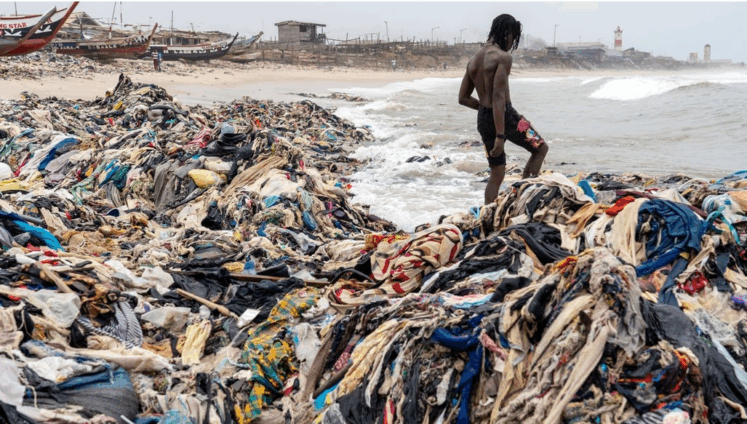
Every week, over 4.3 million kilograms of the Global North’s fashion waste enters Ghana under the guise of charitable donation.
In fact, if every piece of clothing arriving each week were stacked into a single tower, it would reach the International Space Station and return almost three times.
This immense column of waste, at full length, would rise to about 115 times higher than the maximum altitude permitted for commercial aircraft.
Ghana’s waste management system is already stretched to its breaking point. Plastic waste is choking the environment, and even more dangerously, fashion waste continues to accumulate silently under the relentless pressure created by global fast fashion consumption
The story behind this grim picture begins several thousand kilometres away from Ghana’s shores, across the Atlantic Ocean in America and Europe. While today’s scale of fashion waste pollution is relatively new, the importation of garments dates back to the mid-1900s. Fresh from independence, Ghana imported clothing both as an affordable option for citizens and as a way to support the growing economy.
However, the situation became catastrophic with the rise of fast fashion over the last two decades. The fashion industry’s rampant overproduction has caused an explosive increase in waste, culminating in Ghana becoming the world’s largest importer of used clothing by 2021.
Back home, just 2.5 kilometres inland from the coast, lies Kantamanto Market, the largest secondhand clothing market in West Africa. Here, traders purchase tightly packed bales, often weighing up to 56 kilograms, for anywhere between $100 and $300, without knowing the exact contents. They are betting that the quality inside will be good enough to turn a profit.
Unfortunately, the declining quality of fast fashion makes this gamble increasingly risky. Vendors frequently open bales to find that a huge portion of the clothes are completely unsellable: torn, stained, faded or simply too poorly made to be worn.
Some vendors report having to discard up to half of the clothes they purchase, a devastating loss that pushes them deeper into financial precarity. It is important to understand that the secondhand trade itself is not the problem. For decades, it was a sustainable and dependable system. Ghanaians could buy high-quality secondhand garments that lasted for years. This was a true circular economy.
Despite being on the receiving end of the world’s fashion waste, Ghana is not a passive victim. Accra has become a hub of innovation and resilience, driven by a community determined to reclaim its narrative and build solutions.
A powerful example is the annual Obroni Wawu October (OWO) Festival. The name reclaims the term for secondhand clothes, meaning “dead white man’s clothes,” and transforms it into a celebration of Kantamanto’s legacy of reuse, repair and upcycling. Held under the theme “I Kant, U Kant, We Kant,” the festival brings together designers, artists and sustainability advocates to showcase refurbished clothing and promote circular fashion.
Aside from the OWO Festival, there is UpcycleIt Ghana, which teaches people how to extend the lifespan of their garments by turning them into art. Even closer to the youth, who are the primary consumers of fast fashion, are the University of Ghana Enactus projects: Refab and Upcrafts. These initiatives repurpose scrap fabric, used clothes and plastic into bags, scrunchies, tote bags, throw pillows and more.
These endeavours demonstrate how Ghana is taking the narrative into its own hands, but in reality the situation is akin to ladling water out of a sinking ship in hopes that it will float again. What Ghana needs is a concerted change in attitude toward second-hand garments, starting at the basic school level. Young people should be taught how to repurpose these garments so that a new generation develops a widespread sense of responsibility toward fashion waste.
Ghana’s Extended Producer Responsibility (EPR) scheme also needs to be revamped and expanded. As mentioned in the second session of the YouthOvaFashionWaste webinar, there is currently no mandatory EPR policy for textiles, even though one is being developed for plastics. Textile policies are not far-fetched, especially considering the Government’s recent launch of Kente as the country’s first geographic indication, protecting it from exploitation by the fast fashion industry.
The country is already taking steps in the right direction by recognising the wealth within the waste. Communities and groups are coming together to repurpose, reuse and upcycle. What is needed now is a shift from being unconcerned consumers moving up and down retail markets,
focused only on what fits us, to becoming invested citizens ready to give their all to protect the dignity of our country and its fashion heritage.
-
This article is by Samuel-John Brew Acquaisie, the first-place winner for the #YouthOvaFashionWaste Webinar and Digital Contest, organised by the Ghana Youth Environmental Movement (GYEM) with support from the Pulitzer Center.
Latest Stories
-
UMA improves healthcare access in Asutifi North with GH₵700k ‘Kim Taylor Legacy’ Walkway
3 minutes -
Scholarships Authority and Fanaka University offer sponsorship for procurement and supply chain studies
6 minutes -
Bisa Kdei drops new single ‘Go N Look’ featuring Medikal
13 minutes -
Benin facing rising terrorism in north as French military presence faces growing criticism
14 minutes -
UEW Public Lecture Series 2026: Education debate ‘about the soul of Ghana’s future’ — Dr Ibn Chambas
15 minutes -
EU fingerprint and photo travel rules come into force from today
42 minutes -
Anti-LGBTQ+ Bill: Ghanaians demand expedited passage, not dialogue – Ntim Fordjour to Mahama
50 minutes -
EU airline industry warns of fuel shortages if Strait of Hormuz stays closed
53 minutes -
White House staff told not to place bets on prediction markets
1 hour -
Auctioneers petition Prez Mahama over ‘interference’ in public auctions
1 hour -
GEA, Mastercard Foundation drive market access for MSMEs at Kwahu Business Forum
1 hour -
Education Ministry begins review of Ghana Library Authority law
1 hour -
Ghana U-15 girls clinch back-to-back CAF Schools titles
1 hour -
Rev. Ntim Fordjour urges Mahama to issue directive to fast-track anti-LGBTQ+ bill
1 hour -
GPL 2025/26: Stoppage-time penalty hands Aduana FC win over leaders GoldStars
1 hour