

Audio By Carbonatix
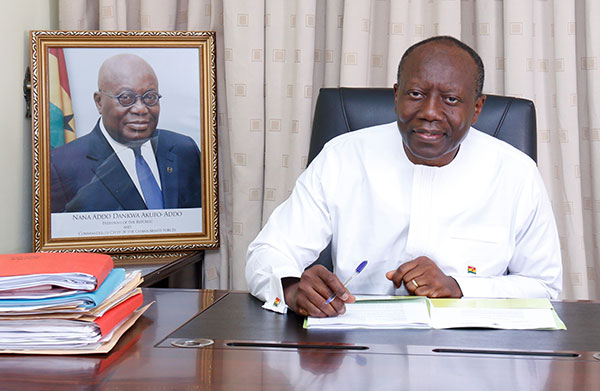
The Finance Minister, Ken Ofori-Atta, is in Washington, DC, to attend the 2022 IMF and World Bank Annual meetings and advance negotiations with the IMF on a Programme that addresses Ghana’s macroeconomic and structural challenges.
As part of the Annual Meetings Programme, the Finance Minister, on October 11, 2022, attended the 108th Meeting of Ministers and Governors of the Group of 24 on the theme: “Securing a Sustained Post-Pandemic Recovery”.
The meeting provided a platform to discuss critical areas where the international community and international financial institutions such as the IMF and the World Bank Group could scale up their support for emerging economies.
This forum comes against the backdrop of a confluence of external shocks – in particular, the Covid-19 pandemic, the continuing consequences of the Russia-Ukraine war and deepening concern about the imminent impact of climate change.
“There is the need to put a spotlight on the economic consequences of climate change, particularly as it relates to developing countries who are the least contributors to climate change,” Mr. Ofori-Atta told the G-24 Ministers and Governors meeting.
Climate change has wiped out a fifth of the wealth of climate vulnerable countries over the last two decades alone, meaning that vulnerable countries have lost approximately US$525 billion because of global warming induced by human – or anthropogenic – activity, as opposed to the natural climate cycle.
“This has horrific effects on lives and livelihoods. The time to act is now.” Mr. Ofori-Atta said.
The Finance Minister, subsequently, met with the Director for the Africa Department of the IMF, Abebe Aemro Selassie, to press on with negotiations with the IMF.
Formal negotiations will continue after the Annual Meetings, between the Government of Ghana team, led by Mr. Ofori-Atta; and the IMF team, led by the IMF Mission Chief, Stéphane Roudet.
The negotiations will prioritise the implementation of policies that create the conditions for a stable macroeconomic environment, sustainable growth and debt sustainability.
Mr. Ofori-Atta told the G-24 to "champion the rollout of more debt for climate swaps in order to address the dual crisis of climate change and rising debt in order to build economic resilience amongst climate vulnerable countries.”
Debt for Climate (DFC) swaps enable countries to make external debt payments in local currency instead of a foreign one, to finance climate projects domestically on agreed terms.
DFC swaps can reduce the level of indebtedness as well as free up fiscal resources to be spent on green investments.
Latest Stories
-
We can tackle multiple priorities – Sam George defends Anti-LGBTQ Bill push
26 minutes -
Statement: Ghana Chamber of Mines’ Response to Claims in Joe Jackson’s “Ananse Stories about the Economy of Ghana”
28 minutes -
GES opens 2026 teacher recruitment for licensed B.Ed graduates
30 minutes -
Ghana must value skilled trades, build resilient learners — Ibn Chambas
38 minutes -
Ghana must rethink education around relevance, resilience and responsibility — Ibn Chambas
41 minutes -
Prince Harry faces defamation lawsuit from charity he co-founded
43 minutes -
South Korea deploys thermal cameras to track escaped zoo wolf
45 minutes -
Calls for royal meeting with Epstein survivors grow ahead of US visit
48 minutes -
Ibn Chambas advocates blend of technology and human values in education
49 minutes -
UMA improves healthcare access in Asutifi North with GH₵700k ‘Kim Taylor Legacy’ Walkway
54 minutes -
Scholarships Authority and Fanaka University offer sponsorship for procurement and supply chain studies
58 minutes -
Bisa Kdei drops new single ‘Go N Look’ featuring Medikal
1 hour -
Benin facing rising terrorism in north as French military presence faces growing criticism
1 hour -
UEW Public Lecture Series 2026: Education debate ‘about the soul of Ghana’s future’ — Dr Ibn Chambas
1 hour -
EU fingerprint and photo travel rules come into force from today
2 hours