

Audio By Carbonatix
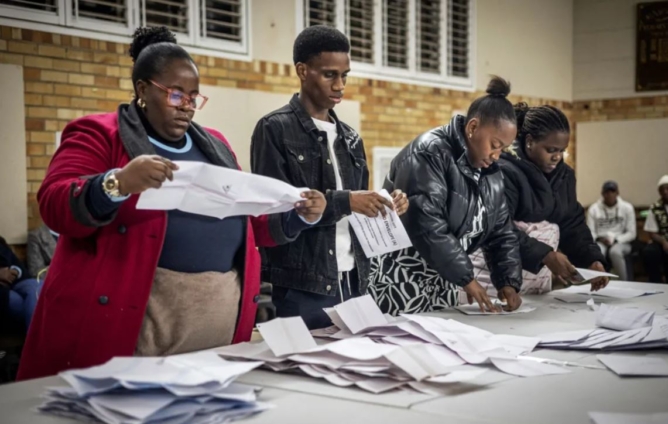
The first results have been announced from what is seen as South Africa's most closely fought elections since the African National Congress (ANC) came to power 30 years ago.
With results from around 14% voting districts counted so far, the ANC is leading with 43%, followed by the DA with 26%.
The radical EFF and the uMkhonto weSizwe Party (MK Party) of former President Jacob Zuma are both on around 8%.
Final results are expected over the weekend.
Opinion polls suggest the ANC could lose its majority in parliament for the first time in 30 years, forcing it into a coalition.
The ANC has lost support due to anger over high levels of corruption, crime and unemployment.
But it is too early to predict the final outcome.
Wednesday's election saw long lines of voters outside polling stations late into the night across the country.
One electoral official in Johannesburg told the BBC the queues were reminiscent of the historic 1994 election, when black people could vote for the first time, and which saw Nelson Mandela become president.
Many thousands of people were still waiting to vote when polls officially closed at 21:00 local time (19:00 GMT) but the electoral commission said they would all be allowed to cast their ballots.
Sifiso Buthelezi, who voted in Johannesburg's Joubert Park - the biggest polling station in South Africa - told the BBC: "Freedom is great but we need to tackle corruption."
Change has been a recurring sentiment, especially among young voters.
Ayanda Hlekwane, one of South Africa's "born-free" generation, meaning he was born after 1994, said despite having three degrees he still doesn't have a job.
“I’m working on my PhD proposal so that I go back to study in case I don’t get a job,” he tells the BBC in Durban.
But Mr Hlekwane said he was optimistic that things would change.
A record 70 parties and 11 independents were running, with South Africans voting for a new parliament and nine provincial legislatures.
Analysts say this shows that many people are disillusioned with the ANC.
"We are entering the next phase of our democracy, and it is going to be a big transition," political analyst Richard Calland told the BBC.
"We will either become a more competitive and mature democracy, or our politics will become more fractured."
The main opposition party, the Democratic Alliance (DA), has signed a pact with 10 other parties, agreeing to form a coalition government if they get enough votes to dislodge the ANC from power.
But this is highly unlikely, with the ANC expected to remain the biggest party, putting it in pole position to lead a coalition if its support does drop below 50%.
It got 57.5% of the vote in the last election compared to the DA's 21%.
South Africans do not directly vote for a president. Instead they vote for members of parliament who will then go on to elect the president.
So current President Cyril Ramaphosa is likely to remain in power.
Former President Jacob Zuma caused a major shock when he announced in December that he was abandoning the ANC to campaign for the new uMkhonto weSizwe (MK), which translates as Spear of the Nation.
Although he has been barred from running for parliament because of a conviction for contempt of court, his name still appeared on the ballot paper as MK leader.
The MK is expected to do especially well in Mr Zuma's home province of KwaZulu-Natal, where tensions have been high, with some incidents of violence reported during the campaign.
Police and the army have been deployed to polling stations across the country to ensure that voting takes place peacefully, and that ballot papers are not stolen.
More than 27 million people were registered to cast their ballots, including a high percentage of young voters, who could prove decisive.
Artist Njabulo Hlophe, 28, said young people in South Africa tend to get marginalised but, "this is as much our country as our parents… they're leaving it to us, so someone that really cares about the young people is someone I’m really looking at".
Support for the ANC is expected to be higher among the older generation.
One 89-year-old woman, Elayne Dykman, told the BBC in Durban she hoped that young people in South Africa did not take their vote for granted.
Latest Stories
-
Asanko Gold supports road rehabilitation to ease transport challenges in Amansie West
11 minutes -
Serial killer pleads guilty to eight murders in case that haunted Long Island, New York
15 minutes -
NPP used Bosomtwe road as ‘election machine’ but failed to dedicate funds for its completion – Dr Amoakohene
21 minutes -
CSOs warns of contraceptive crisis as $500k UNFPA supplies stall at port
26 minutes -
Africa’s youth bulge a ‘defining moment’ that requires urgent action – NYA CEO Osman Ayariga
34 minutes -
No looming power crisis; Ghana’s electricity supply remains stable – Energy Ministry PRO insists
49 minutes -
Mahama should reset his stance on LGBTQ -Clinton Baffour
55 minutes -
Rising sachet water costs should spark a bigger conversation on plastic waste
59 minutes -
Two-week ceasefire takes effect as US and Iran prepare for talks in Pakistan
1 hour -
Dr. Amoakohene debunks claims Sewua and other Agenda 111 hospitals are ready for operationalisation
1 hour -
AMA rolls out new shift system for street sweepers to improve sanitation
1 hour -
Focus on capacity, not connections in Damang lease decision – Paa Kwesi Schandorf
1 hour -
Teen defender Eric Mensah undergoes trial at Malaga CF after standout ROC Cup display
1 hour -
Journalism out loud: Why silence is no longer an option
1 hour -
NYA boss identifies unemployability as Africa’s core youth challenge
2 hours