

Audio By Carbonatix
The history of writing down thoughts and feelings could be tens of thousands of years older than previously believed, surprising archaeologists who made the discovery.
The researchers discerned patterns of meaning in lines, notches, dots, and crosses on objects such as mammoth tusks, as old as 45,000 years, found in caves in Germany.
Traditionally, historians date the first written words to proto-cuneiform scripts from around 5,000 years ago in ancient Iraq (Mesopotamia).
The precise meaning of the symbols in Germany remains a mystery.
The objects are from just before Homo sapiens moved from Africa to Europe, where they interacted with Neanderthals.
Until now, it was thought that writing developed in Mesopotamia around 3,000 BCE, followed by hieroglyphics in Egypt and later in China and Mesoamerica.
"The Stone Age sign sequences are an early alternative to writing," says Prof Christian Bentz from Saarland University, an author of the new research.
The work suggests that Stone Age people were as clever as modern-day humans, according to researcher Ewa Dutkiewicz from Berlin's Museum of Prehistory and Early History.
"So far, we've only scratched the surface of what can be found in terms of symbol sequences on a wide variety of artefacts," she says.
The team analysed more than 3,000 characters on 260 objects to uncover what they call the DNA of writing.
Some of the objects are from a 37-km-long cave system called the Lonetal in Baden-Württemberg, southern Germany.
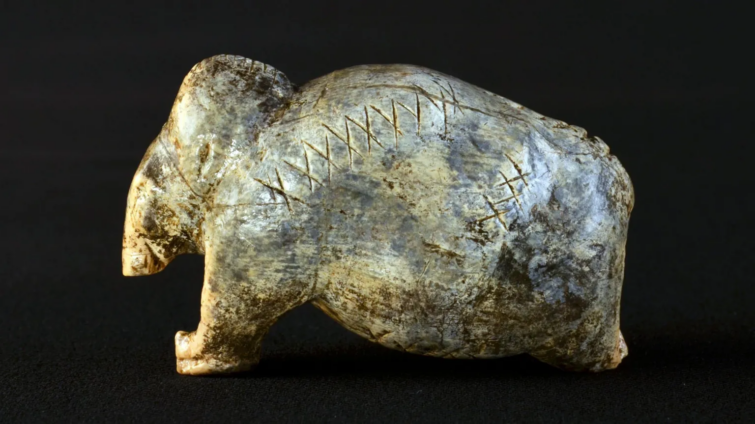
On a small mammoth carved from tusk, the researchers analysed carefully engraved rows of crosses and dots.
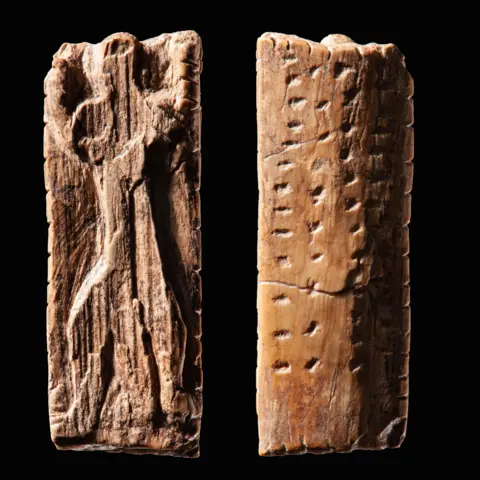
And on an artefact called "adorant" from the Geißenklösterle cave in the Achtal valley, they identified rows of dots and notches on an ivory plaque showing a lion-human creature.
They believe the arrangement of the marks, in particular the dots on the back, show the patterns acted as communication.
The researchers believe that Stone Age people deliberately carved these symbols to communicate messages, meaning, and convey thoughts.
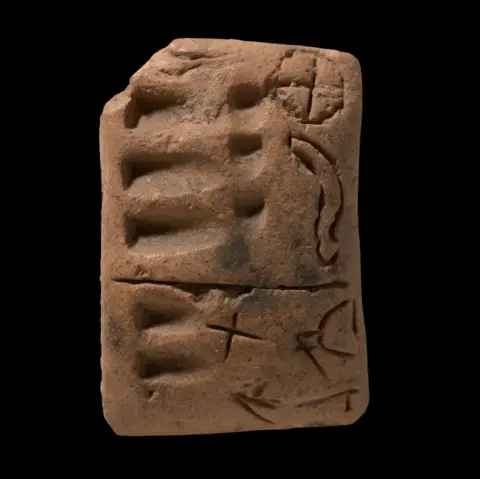
"Our results also show that the hunter-gatherers of the Palaeolithic era developed a symbol system with a statistically comparable information density to the earliest proto-cuneiform tablets from ancient Mesopotamia – a full 40,000 years later," says Bentz.
The clue to finding meaning is in the density of the symbols. They found high repetition of the signs and predictability in the subsequent symbols that is "comparable to much later proto-cuneiform," according to Bentz.
They found denser patterns on figurines than on tools.
The team say that it shows that communicating information was very important for Palaeolithic people.
"They were skilled craftspeople. You can tell they carried the objects with them. Many of them fit very well in the hand, just the right size to fit in the palm," says Dutkiewicz.
The research is published in the journal PNAS.
Latest Stories
-
Spain’s huge pork industry seeks salvation from swine fever threat
38 minutes -
Trump declares victory after rescue but threats to US operation in Iran still loom
1 hour -
US Secret Service investigates reports of gunfire near White House
1 hour -
Current account stability to mitigate pressure on cedi; currency to end year at GH¢11.40 to a dollar
1 hour -
Oil back above $110 after expletive-laden Trump threat to Iran
1 hour -
T-bills auction: Government records 32% undersubscription; interest rates rise again
1 hour -
Economy to remain relatively insulated from fallout of US–Iran conflict – Fitch Solutions
1 hour -
[Watch Live] Shatta Wale, Kofi Kinaata, and others ignite the grand finale of Gomoa Easter Carnival
4 hours -
Burkina Faso military leader Traore says ‘forget democracy’
4 hours -
DR Congo to receive ‘third-country’ deportees from the US under new deal
4 hours -
Four injured in robbery attack on Elshadai Enterprise at Akatsi
4 hours -
Two remanded for alleged attack, robbery at jewellery shop
5 hours -
Royals attend Windsor Easter Sunday service
5 hours -
Trump issues expletive-laden threat to Iran over Hormuz Strait blockage
5 hours -
Berekum Chelsea edge Aduana FC in Bono derby to boost survival hopes
7 hours