

Audio By Carbonatix
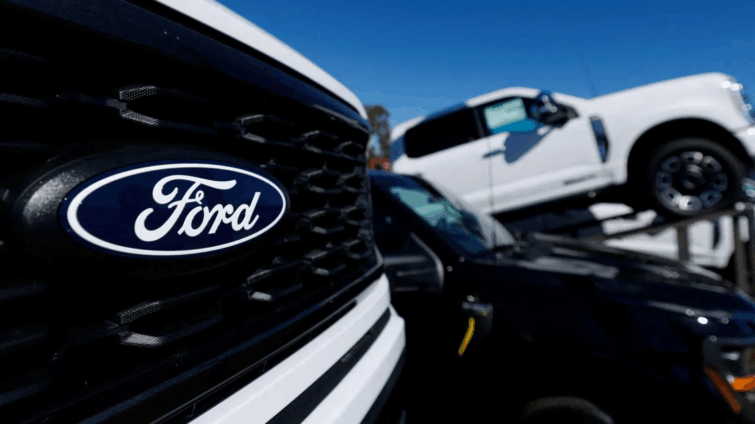
Ford is backing away from plans to manufacture large electric vehicles, the US carmaker said on Monday, citing lacklustre demand and recent regulatory changes under US President Donald Trump.
The company will instead invest in producing profitable hybrid and gas-powered vehicles and smaller, more affordable EV models.
Ford said it expects its profits to take a $19.5bn (£14.6bn) hit as a result of the strategic shift, which comes as the Trump administration eases fuel economy rules.
The business case for leaning heavily into EV production, specifically large-sized EV models, has "eroded", Ford said in a statement, "due to lower-than-expected demand, high costs and regulatory changes".
"This is a customer-driven shift to create a stronger, more resilient and more profitable Ford," Jim Farley, Ford's chief executive, said in a statement.
"The operating reality has changed, and we are redeploying capital into higher-return growth opportunities," Mr Farley added, pointing to trucks, vans, hybrid vehicles and the company's energy storage business.
As part of Ford's changes to its EV plans, the company said it will no longer produce a purely electric version of its popular F-150 pickup truck. The F-150 Lightening will instead be redesigned as a hybrid vehicle, with a gas-powered generator.
Ford also said it will cancel its new electric van to focus on manufacturing gas and hybrid models.
The carmaker's decision to alter its EV plans follows a similar announcement from General Motors in October. General Motors said it would take a $1.6bn hit as it rolls back its EV ambitions amid weakening demand.
EV adoption in the US has lagged behind the industry in places such as China, the UK and Europe. Analysts point to comparatively weak government support for the sector.
The Trump administration has taken steps in recent months to roll back incentives and regulations that had been expected to lead to increased take-up of electric cars.
A government subsidy previously helped knock as much as $7,500 (£5,608) off the price of certain battery electric, plug-in hybrid or fuel cell vehicles. But that tax credit ended in September.
Carmakers had expected EV momentum to slow with the end of the tax credit. At the time, Mr Farley said the EV industry would be "smaller, way smaller than we thought".
And earlier this month, Trump announced plans to loosen fuel economy rules, reversing another Biden-era policy that had raised hopes of an EV boom. The Biden administration's standards were expected to prevent more than 700 million metric tons of carbon dioxide emissions by 2050.
Farley celebrated the loosened rules alongside other car industry leaders. He called the change a "victory of common sense", through environmental groups criticised it as a step backwards for the industry and public health.
The new fuel economy standards, he added, were "aligned with customer demand".
The US changes come as the European Union is expected to water down its plan to ban new combustion-engine cars by 2035 effectively.
Germany has lobbied on behalf of its car manufacturers for changes to the plan, arguing they were facing stiff competition from rivals in China.
The European Commission it set to make an announcement on the scheme on Tuesday.
Latest Stories
-
One dead as train travelling 99mph collides with lorry in France
6 minutes -
Airlines cut flights and hike fares as fuel prices surge
23 minutes -
Kane inspires Bayern to first-leg advantage over Real Madrid at Bernabéu
34 minutes -
Wireless Festival cancelled after Kanye West blocked from coming to UK
42 minutes -
Wa West MP commissions five boreholes for the benefit of his constituents
42 minutes -
Havertz’s late strike hands Arsenal narrow first-leg advantage over Sporting
44 minutes -
Damang mine award: Minority not against Ghanaian participation; we’re asking for fair process – Konadu
1 hour -
NPA to enforce stricter registration rules for petroleum tankers
2 hours -
Manhyia South MP laments decline in hospitality operations in his constituency
2 hours -
How a simple clean charcoal innovation could benefit Ghana’s climate future
2 hours -
NPA, COMAC launch Safety Week 2026 to promote risk management in petroleum sector
2 hours -
Stakeholder engagement resolves onion trade impasse
2 hours -
Gender Ministry holds staff durbar, welcomes new Chief Director
2 hours -
Unexpected illness sparked my radio career – Tommy Annan-Forson
2 hours -
Bolt Ghana awards GH¢50,000 to women entrepreneurs through “She Moves to Win” campaign
2 hours