

Audio By Carbonatix
The Conference of Heads of Assisted Senior High Schools (CHASS) has urged parents and guardians to assist with the feeding challenges in senior high schools.
CHASS had earlier appealed to the Ghana Education Service (GES) to reconsider the reopening of high schools, citing unresolved financial issues, including the government's non-payment for perishable foods provided for students last year. However, the GES rejected this appeal.
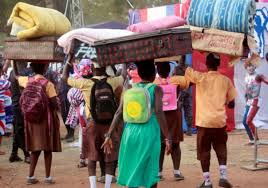
Five days after schools reopened, the National Secretary of CHASS, Primus Baro, told JoyNews that the situation in high schools is dire, with many institutions having to ration food.
He therefore encouraged parents to support their children with food items for use at school to complement the government's provision.
"I encourage parents, and I have already advised my PTA to this effect, to let their children bring food like gari, shitor, and sugar to supplement whatever the school provides. I urge parents across the country, as the food situation has still not improved in the past two and three years, and it has worsened at this particular time," he said on JoyNews' Newsdesk on Wednesday, January 8.
He revealed that the situation is particularly severe in schools in northern Ghana.
"Food supplies are not reaching the schools. In places like Upper West, Upper East, and the Northern regions, apart from rice, the schools have no stable food supplies. Oil is completely unavailable. For example, in my school, I currently don't have a single drop of oil, so my matron has been using margarine to replace oil for cooking. I don't have maize or beans—only rice and some gari," he added.
He stressed that "We are still relying on the old practices of sending students with what they have, and that’s the only reason we allowed the students to return. Otherwise, the situation is still far from ideal."
The Free Senior High School (SHS) programme, initiated by the previous Nana Akufo-Addo-led government, has faced numerous challenges over the years, including insufficient classroom and dormitory facilities, inadequate food, and more.
Critics have also argued that the programme has led to an increase in the number of SHS graduates, but not necessarily in the quality of education.
However, the new president, John Mahama, before winning the election, promised to revitalise the programme rather than abolish it.
Latest Stories
-
Bill Asamoah urges government to fast-track film legislation to boost industry
2 minutes -
Shatta Wale reveals ambition to contest Ablekuma South seat
23 minutes -
From cassette tapes to streaming: Grace Asare reflects on the shift in music distribution
33 minutes -
MTN FA Cup quarter-finals set for explosive weekend
40 minutes -
TTU registrar, co-author launch 3 books to shape higher education governance in Ghana
40 minutes -
Minority condemns attack on Ghanaian Peacekeepers in Lebanon, demands full investigation
50 minutes -
I have never taken even GH₵1 from Shaxi – Shatta Wale calls for gov’t support
53 minutes -
‘Largest ever’ oil reserve release agreed by 32 countries, as Strait of Hormuz ships attacked
59 minutes -
Fuel shortages unlikely despite Middle East tensions – TOR assures Ghanaians
1 hour -
Massive maintenance underway at TOR to boost efficiency – Corporate Affairs Officer
1 hour -
Shatta Wale says he prays over money before giving it away
1 hour -
Shatta Wale reveals hidden life as a tech visionary and mogul
1 hour -
PRESEC-Legon 2001 group rallies support for staff accommodation project
1 hour -
Adenta Circuit Court grants Counsellor Lutterodt GH¢50,000 bail
1 hour -
Minority demands briefing on Ghana-US collaboration in Nigeria airstrikes
2 hours