

Audio By Carbonatix
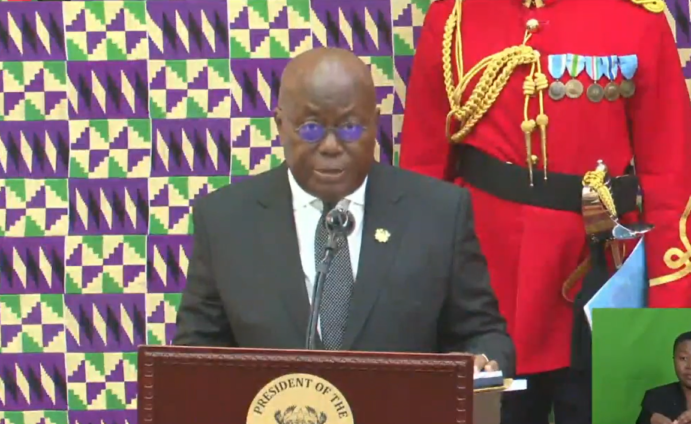
President Akufo-Addo says the freedom of speech in the country currently has reached a very high level.
He said the country has achieved a feat where citizens are allowed to express their opinions on national issues without any fear.
The President said the attractiveness of this feat now allows foreign diplomats to even discuss issues of their host country.
According to him, these diplomats are now able to make pronouncements in Ghana that Ghanaian diplomats cannot dare make in their countries of origin.
“It is interesting to note that freedom of speech has reached such high levels to the extent that some diplomats are able to join in the discussion and make pronouncements on issues Ghanaian diplomats cannot make in their countries of origin,” President Akufo-Addo said when he delivered the 2023 State of the Nation Address on Wednesday, March 8.
The government has already assured media practitioners of its commitment to prioritising press freedom in the management of the country’s democracy.
Reading a speech on behalf of the President as the guest of honour at the 26th GJA Awards held in Accra on November 12, Florence Oboshie Sai-Coffie, says the president wants the media to play its part towards economic recovery as the world faces turbulent economic downturns.
“All agencies of mass media shall at all times be free to uphold the principles and objectives of this constitution and shall uphold the responsibility and accountability of the government to the people of Ghana.”
“We truly believe that in search for solutions for the challenges, the media must be prioritised. Indeed, you are to help with amplifying the vibrant voices of the public and help us to find a pathway that takes us to economic recovery,” she said.
What is Ghana’s current press freedom rating?
Although Ghana is considered a standard for democratic stability, it ranks 60th in the world for press freedom, dropping from an initial 30th position.
This is Ghana’s lowest-ever ranking in 17 years after it ranked 66th and 67th in 2005 and 2002 respectively.
The latest report is out of 180 countries assessed, with Ghana recording a decline in its indicative points from 78.67 per cent to 67.43 compared to last year.
Latest Stories
-
A source of excellence across generations – Vice President Opoku-Agyemang lauds Mfantsipim
36 minutes -
(Photos) Mfantsipim School launches historic 150th anniversary
59 minutes -
Knights and Ladies of Marshall group backs Catholic Bishops’ stance on anti-LGBTQ+
2 hours -
Bright Simons writes: All the Filla in the Ibrahim Mahama/E&P – Gold Fields Saga
2 hours -
Monetise Idiocy In Ghana
2 hours -
The Ghanaian prophet and the mysterious death of his scottish wife Charmain Speirs
3 hours -
Nearly 400 sentenced in Nigeria for links to militant Islamists
4 hours -
Ghana’s recovery supported by gold strength despite global oil price pressures – Standard Bank Research
4 hours -
Methodist Church hails Mfantsipim@150; calls for “fresh consecration” to excellence
4 hours -
‘Excellence is our inheritance’ – Nana Sam Brew-Butler hails Mfantsipim’s 150-year reign in leadership
4 hours -
Kwaku Azar writes: A-G vs OSP
4 hours -
Mfantsipim–Adisadel rivalry built excellence, not division – Sam Jonah
5 hours -
Vice President launches Mfantsipim’s 150 years of shaping Ghana’s greatest mind
5 hours -
I assure Otumfuo, Mahama will join him to commission KNUST Teaching Hospital by end of this year – Haruna Iddrisu
6 hours -
Barcelona dominate derby to extend La Liga lead
6 hours