

Audio By Carbonatix
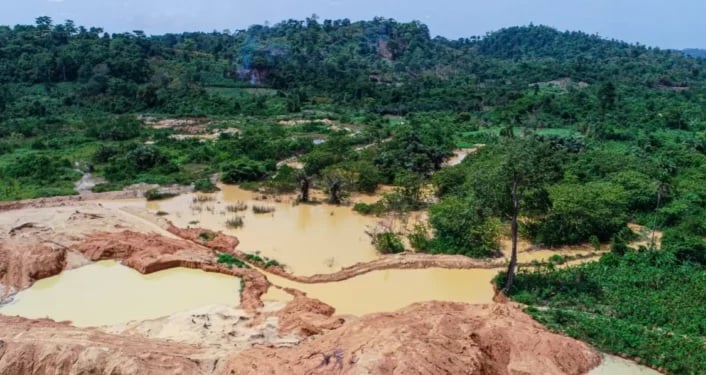
Illegal mining, widely known as galamsey, has destroyed nearly 9,000 hectares of Ghana’s forest reserves, according to the Forestry Commission of Ghana, raising fresh concerns about the growing environmental damage caused by the activity.
The Commission says the scale of destruction has intensified in recent years, with more than 5,200 hectares of forest lost between 2021 and 2024 alone.
A recent survey conducted by the Commission shows that illegal mining activities increased the total degraded area in forest reserves by 5,252.9 hectares within the three years, pushing the overall land affected to 8,923.8 hectares as of 31 December 2024.
Speaking to journalists on Wednesday, 4 March, the Chief Executive Officer of the Forestry Commission, Hugh Brown, said the situation worsened partly due to operational challenges faced by the Commission in recent months.
He explained that the withdrawal of military personnel from anti-galamsey operations left the Commission with limited capacity to respond swiftly to illegal mining activities within protected forest areas.
“The military was withdrawn on the 1st of November, and we were left to our own devices. We had to strengthen our rapid response teams quickly, sometimes putting them in situations where they were not well-equipped,” Dr Brown said.
The report also highlighted regional disparities in the extent of destruction, with the Ashanti Region recording the highest level of forest degradation, followed by the Western North Region.
According to Dr Brown, beyond enforcement challenges, Ghana’s forest protection strategies require urgent modernisation to effectively combat illegal mining.
“We cannot continue protecting forests as we did in the 1920s and 1930s, when forest guards held cutlasses and patrolled boundaries to detect offences. There has been insufficient investment in modern protection measures,” he noted.
Illegal mining remains one of the most pressing environmental challenges in Ghana, contributing to widespread deforestation, pollution of water bodies and loss of biodiversity.
Officials say addressing the problem will require stronger logistics for forest guards, improved surveillance systems, and closer collaboration between security agencies and environmental authorities to protect the country’s remaining forest reserves.
Latest Stories
-
We can tackle multiple priorities – Sam George defends Anti-LGBTQ Bill push
25 minutes -
Statement: Ghana Chamber of Mines’ Response to Claims in Joe Jackson’s “Ananse Stories about the Economy of Ghana”
27 minutes -
GES opens 2026 teacher recruitment for licensed B.Ed graduates
29 minutes -
Ghana must value skilled trades, build resilient learners — Ibn Chambas
37 minutes -
Ghana must rethink education around relevance, resilience and responsibility — Ibn Chambas
40 minutes -
Prince Harry faces defamation lawsuit from charity he co-founded
42 minutes -
South Korea deploys thermal cameras to track escaped zoo wolf
44 minutes -
Calls for royal meeting with Epstein survivors grow ahead of US visit
47 minutes -
Ibn Chambas advocates blend of technology and human values in education
49 minutes -
UMA improves healthcare access in Asutifi North with GH₵700k ‘Kim Taylor Legacy’ Walkway
53 minutes -
Scholarships Authority and Fanaka University offer sponsorship for procurement and supply chain studies
57 minutes -
Bisa Kdei drops new single ‘Go N Look’ featuring Medikal
1 hour -
Benin facing rising terrorism in north as French military presence faces growing criticism
1 hour -
UEW Public Lecture Series 2026: Education debate ‘about the soul of Ghana’s future’ — Dr Ibn Chambas
1 hour -
EU fingerprint and photo travel rules come into force from today
2 hours