

Audio By Carbonatix
The Chief Economist and Head of the Economic Research Department at Development Bank Ghana (DBG) says the Ghana Commodity Exchange (GCX) needs a massive reform to ensure food security in the country.
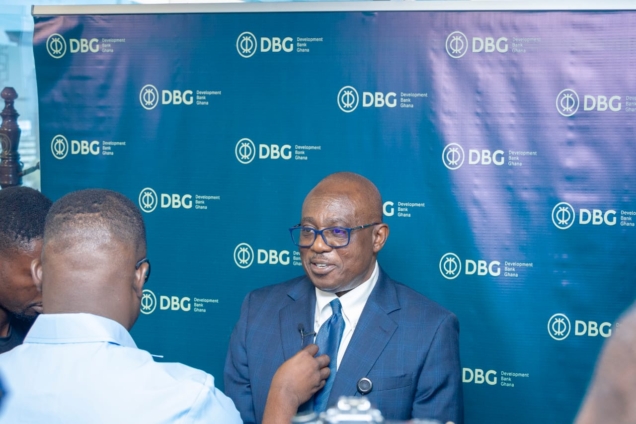
Dr Kwabena Opuni-Frimpong when presenting the findings of the Bank’s multi-stakeholder value chain workshops held across a number of regions in the country, recommended a six-point plan which he believed is the paradigm shift Ghana needs in its agriculture sector.
According to him, the GCX needs to become an aggregator in the agricultural sector to not only provide inputs and materials necessary to facilitate the farmer's work but to collect all produce during harvest and store them.
This move, he said, would solve Ghana’s food insecurity since there will always be food in store for consumption.
“So we recommended that they set up a warehouse commodity which is called MCCL which will become a subsidiary of GCX.
“And that Subsidiary company will be the one that will interact with the farmers at the point of giving them the inputs, at the point of taking the harvest to the point of storage and GCX itself will do the trading [of the produce],” he said on Monday.
Acknowledging that the GCX is currently under-equipped to perform the task, Dr Opuni-Frimpong noted that GCX needed an overall rehabilitation including the construction of new warehouses and the renovation of the existing ones to make them conducive to storing the produce.
He also estimated that an amount of $200 million would be needed to make GCX capable to perform this task.
“What we had from our estimate as well as speaking with GCX is that we may require about $200 million in seed capital if we really want this to go ahead. Remember that they have to buy stock from the farmers, they have to store and do a lot of other things too
“DBG cannot provide that amount of money but I believe that DBG can work with other equitable funders in Ghana who may be willing to do that. Government may want to take a stake into it because I think this is a national security issue,” he said.
The economist also called for GCX to be given the same mandate as the Ghana Cocoa Board so that individuals do not export the food that “we need to survive on when we don’t have enough in stock.”
“A lot of the maize that we get in the lean season are produce that is grown in Ghana, sent to Burkina Faso and dried and kept in warehouses and in the lean season they bring it back to us at a higher price,” he indicated.
Speaking on when these recommendations would ever materialise, Dr Opuni-Frimpong said that relevant stakeholders including the Ministry of Food and Agriculture have been engaged on the issue.
He was therefore optimistic that this recommendation, along with the others the Bank has proposed, will be implemented in due course.
Latest Stories
-
The Ghanaian prophet and the mysterious death of his scottish wife Charmain Speirs
8 minutes -
Nearly 400 sentenced in Nigeria for links to militant Islamists
29 minutes -
Ghana’s recovery supported by gold strength despite global oil price pressures – Standard Bank Research
36 minutes -
Kwaku Azar writes: A-G vs OSP
1 hour -
Mfantsipim–Adisadel rivalry built excellence, not division – Sam Jonah
2 hours -
Vice President launches Mfantsipim’s 150 years of shaping Ghana’s greatest mind
2 hours -
I assure Otumfuo, Mahama will join him to commission KNUST Teaching Hospital by end of this year – Haruna Iddrisu
3 hours -
Barcelona dominate derby to extend La Liga lead
3 hours -
Gov’t to roll out free special education for persons with disabilities from July 1 – Education Minister
3 hours -
Importers and Exporters Association declares full support for Publican AI port system
3 hours -
“We used it to test our officiating officials’ readiness” – Bawah Fuseini after CAA Athletics event
3 hours -
Volleyball emerges as Ghana’s fastest rising sport
3 hours -
National Sports Fund needs strong leadership from the top – Administrator David Wuaku
4 hours -
JoySports Exclusive: Steve McLaren in talks with GFA after expressing interest in Black Stars job
4 hours -
Fire guts auto parts warehouse at Bubuashie, one fire officer injured
4 hours