

Audio By Carbonatix
Chief Justice Paul Baffoe-Bonnie, on Wednesday, December 10, said Gender-Based Violence (GBV) in Ghana, occurring in homes, communities, and increasingly across digital platforms, cannot be eliminated by any single institution.
“Gender-based violence, whether in our homes, communities, or digital platforms, cannot be eliminated by any single institution. Not just the police, not only the courts, and not civil society alone,” he said.
“It requires all of us, united by purpose, commitment, and a shared belief that every individual deserves dignity and safety.”
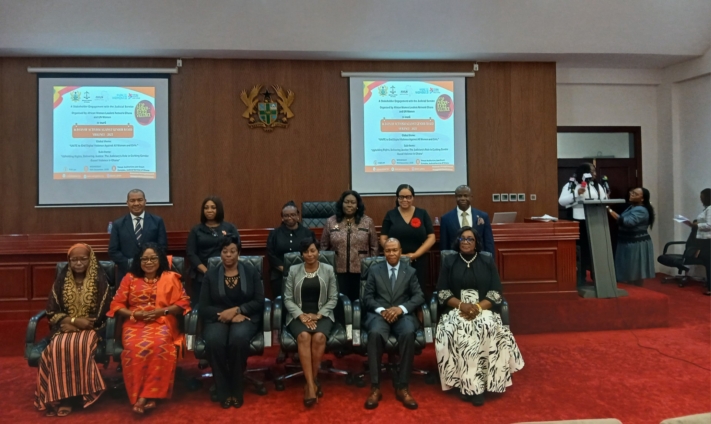
In a speech read on his behalf at the Law Court Complex to mark the 2025 16 Days of Activism Against GBV, the Chief Justice cited national data indicating that one in three women in Ghana has experienced physical, emotional, or sexual violence, noting that the nature of abuse was rapidly evolving.
“Once, abuse stayed behind closed doors. Today, it hides in the glow of our screens. Harm now travels through WhatsApp messages, through the non-consensual sharing of intimate images, through online threats, cyberstalking, and relentless digital humiliation,” he said.
The event, on the sub-theme “Upholding Rights, Delivering Justice: The Role in Curbing Gender-Based Violence in Ghana”, aligned with the global theme: “Unite to End Digital Violence Against All Women and Girls.”
Participants included queen mothers, officials of the Department of Social Welfare, Civil Society Organisations, the Domestic Violence and Victim Support Unit (DOVVSU), the Cyber Security Authority, UN Women, and the African Women Leaders Network (AWLN), Ghana.
Chief Justice Baffoe-Bonnie warned that the country had “entered a new era of violence” and must, therefore, “enter a new era of justice.”
He recalled recent incidents, including the widely reported case of a man who burnt his wife and children to death before taking his own life, and the assault of a teenage girl in the Ashanti Region, which was filmed and circulated online.
“That teenage girl’s pain moved across phones while she was still struggling to find help in her own community. This is the reality we face today: our digital spaces have become new crime scenes,” he said.
Justice Baffoe-Bonnie expressed regret that although Ghana had several laws addressing GBV, many survivors still did not report cases because the justice process was slow, they feared being blamed, or believed nothing would come of their complaints.
“These are the voices we must carry into our decisions. These are the truths that must influence our reforms,” he stated.
The Judiciary, he said, had in recent years taken steps to adopt gender-sensitive court procedures, integrate human-rights approaches, and train judges in handling digital evidence and GBV-related cases.
“The Judiciary is ready to strengthen its response. Justice is a chain; if one link breaks, the survivor falls through,” the Chief Justice said.
He envisioned a justice system “where survivors feel safe using the courts, perpetrators face consequences both online and offline, violence is no longer normalised, and partnerships among CSOs, the media, academia, and development partners are consistent and effective.”
Achieving that vision, he noted, required accountability, transparency, innovation, and empathy.
Justice Baffoe-Bonnie, therefore, urged all stakeholders to challenge harmful norms, close existing protection gaps, and act decisively wherever divisions hinder progress.
Latest Stories
-
Controller issues March 15 ultimatum for Ghana Card verification
2 hours -
Fuel prices set to surge as Cedi slides and global markets tighten
3 hours -
President Mahama honours August 6 helicopter crash widows with Valentine’s Day tribute
4 hours -
Vice President Naana Jane Opoku-Agyemang champions made-in-Ghana chocolates on Valentine’s Day
4 hours -
Six critically injured in gruesome head-on collision near Akrade
6 hours -
Gov’t to extradite foreign national who secretly filmed Ghanaian women to face prosecution – Sam George
7 hours -
U20 WWC: Black Princesses to play Uganda in final round of qualifiers
7 hours -
Burundi takes the helm as African Union declares ‘war’ on water scarcity
7 hours -
‘I will never forget you’ – Kennedy Agyapong thanks supporters, NPP delegates after primaries
8 hours -
Woman found dead in boyfriend’s room at Somanya
10 hours -
Woman feared dead after being swept away in Nima drain amid heavy rain
10 hours -
Court grants GH¢10k bail to trader who posed as soldier at 37 Military Hospital
10 hours -
Tano North MP secures funding to reconstruct decades-old Yamfo Market
10 hours -
Haruna Iddrisu discharged after road traffic accident
11 hours -
Kenyans drop flowers for Valentine’s bouquets of cash. Not everyone is impressed
11 hours