

Audio By Carbonatix
Professor Ernest Kofi Davis, the Acting Director-General of the Ghana Education Service (GES), says policies emerging from the National Education Forum will be implemented in ways that enhance quality education and ensure relevance for all students.
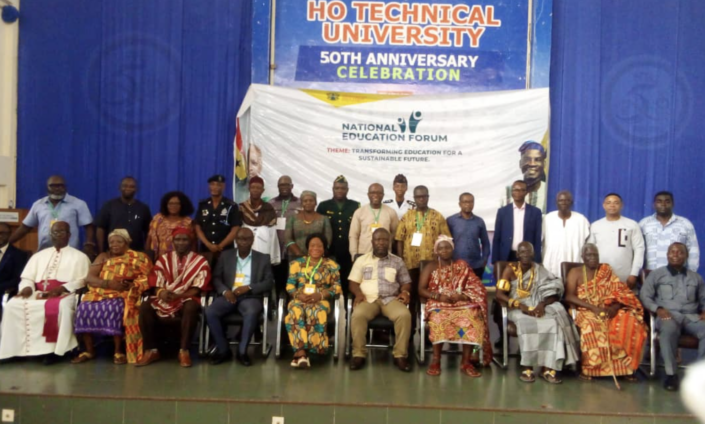
Speaking at the closing session of the Zonal Forum as part of the National Education Forum at Ho Technical University on Wednesday, February 19, Prof. Davis emphasised the need to identify weaknesses in the education system and adopt a bottom-up approach that allowed stakeholders at all levels to contribute to solutions.
“For education to be sustainable, we must first understand what is wrong with our system. The best way to achieve this is by engaging all stakeholders and gathering insights from the ground up,” he stated.
He stressed that policy reforms must be backed by data and scientific research to be effective.
“I believe that reforms rooted in data and science are the ones that truly drive transformation. The process we are following will provide the necessary evidence to implement meaningful changes,” he added.
Prof. Davis reiterated President Mahama’s stance that education, whether in public or private institutions, must be relevant and beneficial to the individual, equipping them with skills to lead meaningful lives.
The Volta Regional Minister, Mr. James Gunu, underscored the critical role of education in national development.
In his closing remarks, he noted that transforming education means transforming society, the country, and the world.
“If we successfully reform our education system, we will have a more sustainable society, a stronger country, and a better world,” he stated.
He likened the reform process to oil refining, where crude oil went through several processes to produce high-quality end products.
“Just like crude oil goes through a refinery, we are processing raw educational data and stakeholder inputs to produce a refined, effective education policy,” he explained.
He assured stakeholders that the government was committed to utilising the outcomes of the forum to shape policies that would drive meaningful improvements in education.
The National Education Forum, which was launched on Tuesday at Serene Hotel in Ho, has now moved into the Zonal Forum level, with the first deliberations focusing on the Volta and Oti Regions.
Stakeholders, including representatives from education directorates, the Ministry of Education, faith-based organisations, and students, were divided into five key thematic groups to discuss crucial areas of reform: Education Financing, Infrastructure Development, Quality Education Delivery, Regulations, Governance, and Accountability and Research, Data, and Evidence-Based Policy Making.
The discussions and recommendations from these groups are expected to shape Ghana’s future education policy reforms.
Latest Stories
-
Seven African referees selected for World Cup 2026 as Ndala, Issa Sy miss out
20 seconds -
Why diaspora investors are using Accra real estate to hedge against global uncertainty in 2026
23 minutes -
GWL urges public support to stem water thefts
25 minutes -
Fire guts 2-storey apartment at Ashaley Botwe
26 minutes -
Come down and account, it’s a constitutional requirement – Martin Kpebu to Ofori-Atta
34 minutes -
The power of the private courtyard: How regalia is redefining resort-style living in Accra
46 minutes -
Beyond roads and bridges: Understanding the true role of your MP
47 minutes -
UK says Russia ran submarine operation over cables and pipelines
48 minutes -
NPRA recovers GH¢27m in 2025, 30% of defaulted pension contributions
51 minutes -
Power fluctuations slash Ashanti region water production by 959,000 cubic metres in March
57 minutes -
Beyond the festivities: Gomoa must turn visibility into development
1 hour -
DVLA clarifies it is not responsible for Toyota Voxy commercial operations
1 hour -
Calls for Ofori-Atta’s return a non-issue if trial proceeds in absentia – Pius Hadzide
1 hour -
France names Ghana first beneficiary of newly established National Health Compact
1 hour -
US Immigration, extradition outcomes likely to influence each other in Ofori-Atta case – Amanda Clinton
1 hour