

Audio By Carbonatix
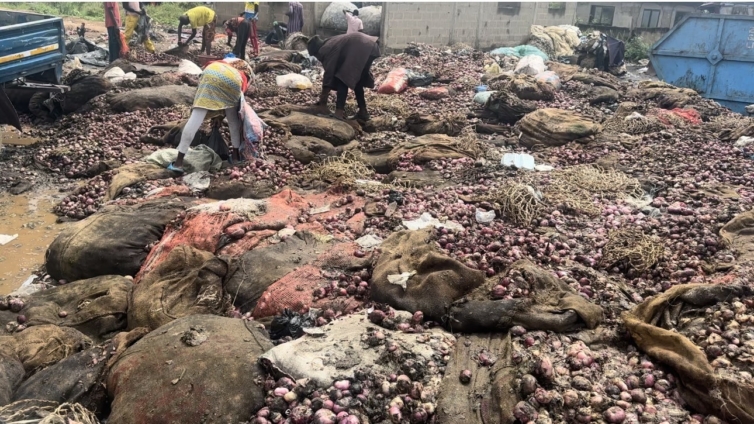
A catastrophic failure in Ghana's agricultural supply chain has resulted in the total loss of 15 truckloads of imported onions at the Adjen Kotoku Market, representing a staggering financial blow estimated at over GH¢3.1 million (approximately $206,000 USD, based on current exchange rates).
The spoilage, driven by excessive road delays, persistent heavy rains, and acute deficiencies in post-harvest infrastructure, has left traders facing ruin, with some considering selling off assets to cover mounting debt.
The stench of decay has reportedly permeated the sprawling Adjen Kotoku market, where heaps of rotten produce have been abandoned. The scale of the loss is unprecedented this season, highlighting Ghana's vulnerability in relying heavily on volatile international food imports without robust local storage and logistics systems.
The Anatomy of the GH¢3.1 Million Waste
The loss calculation reveals the gravity of the situation: with an average truck carrying approximately 420 bags of onions, the 15 spoiled trucks represent a loss of over 6,300 bags of produce. Individual traders who invested capital upfront were wiped out entirely.
One of the affected traders, Shaibu Ibrahim, described his personal disaster.
“I lost a whole truckload of the Nigerian variety from Kano, about 420 bags. We expected to sell each bag for between GH¢1,000 and GH¢1,300, but unfortunately, we couldn’t even make enough to pay the transport fees.”
“We had to plead with some of the drivers to give us time to pay them back because we made no returns at all,” he said.
This financial exposure is compounded by the high-risk nature of the commodity trade, where traders operate without a safety net. Mr. Ibrahim further explained the systemic difficulty: “The risk involved in this business is very high, so insurance companies are reluctant to cover us. A truck can break down on the road or rain can destroy the onions before they arrive.”
The 1,500 km Logistical Nightmare
The primary cause of the massive spoilage is traced back to the extended and torturous cross-border journey from Northern Nigeria to Accra. The Spokesperson for the Onion Traders Association, Osman Mohammed Sidi, pinpointed the specific logistical and varietal vulnerabilities at play this season.
“The reason for the damaged onions this season is mainly due to the long journey they make from Nigeria to Ghana. The onions we import are mostly from Kano, not Sokoto, and the Kano variety is generally less strong,” he explained.
The traders were forced to rely on the less-durable Kano variety due to reported shortages from the preferred sources in Niger, Sokoto, and Burkina Faso. The estimated road distance from Kano to Accra is over 1,500 kilometers.
“The trip from Kano to Ghana takes about eight to 10 days, and if a truck breaks down, it can take up to 12 days. For onions, even a one-day delay can be disastrous as they start to spoil quickly. That’s why many of the onions arrived here in bad condition,” he said.
This extended travel time—often exceeding the shelf-life tolerance of the Kano variety—combined with poor ventilation inside the trucks and the subsequent soaking from heavy rains, created the perfect conditions for rot to accelerate rapidly, resulting in what is globally known as Post-Harvest Losses (PHL), which frequently exceeds 30% for perishables in West Africa.
The Dual Crisis: Market Relocation and Storage Deficit
The traders also lamented that the 2021 relocation of the market from the central Agbogbloshie to the peripheral Adjen Kotoku has directly contributed to the current inability to mitigate losses.
“Previously, when we were at Agbogbloshie, buyers would come for the damaged onions to blend and use. But now, because of the poor road network to this new location, buyers hardly come. That’s one major reason many traders are struggling,” stated Mr. Sidi.
This shift has effectively eliminated a critical local reprocessing market that previously absorbed distressed inventory. Furthermore, the lack of modern, climate-controlled storage facilities is cited as the single biggest threat to both imported and local produce.
Mr. Ibrahim highlighted the superior durability of imports from other regions as a model for Ghana’s future:
“If we concentrate on quality, things will improve. I sometimes import onions from Egypt, Morocco, and China; they travel long distances, yet they don’t spoil. You can store them for two months and still find them fresh, thanks to of their quality. That’s where we need to learn from, focus on quality, not quantity,” he said.
An Urgent Call for Investment and Policy Reform
The Onion Traders Association is now issuing an urgent plea for government intervention, emphasizing that the solution lies in a long-term strategy centered on local production quality and post-harvest management technology. Local onion produce is also highly vulnerable, often cultivated without a focus on long-term storage or durability against excessive fertilizer use which leads to a "larger but less durable" onion.
“We’re appealing to the government to come to our aid. Farmers need proper training in onion cultivation and, more importantly, access to good storage facilities so that when there’s no ready market, they can keep their onions for longer periods without losses,” Mr. Sidi appealed.
The current onion crisis serves as a harsh reminder of the economic costs associated with infrastructure deficits and the critical need for investment in refrigerated or well-ventilated warehouse technology and improved quality control standards for domestic agriculture.
Latest Stories
-
We can tackle multiple priorities – Sam George defends Anti-LGBTQ Bill push
6 minutes -
Statement: Ghana Chamber of Mines’ Response to Claims in Joe Jackson’s “Ananse Stories about the Economy of Ghana”
7 minutes -
GES opens 2026 teacher recruitment for licensed B.Ed graduates
9 minutes -
Ghana must value skilled trades, build resilient learners — Ibn Chambas
17 minutes -
Ghana must rethink education around relevance, resilience and responsibility — Ibn Chambas
20 minutes -
Prince Harry faces defamation lawsuit from charity he co-founded
22 minutes -
South Korea deploys thermal cameras to track escaped zoo wolf
24 minutes -
Calls for royal meeting with Epstein survivors grow ahead of US visit
27 minutes -
Ibn Chambas advocates blend of technology and human values in education
29 minutes -
UMA improves healthcare access in Asutifi North with GH₵700k ‘Kim Taylor Legacy’ Walkway
34 minutes -
Scholarships Authority and Fanaka University offer sponsorship for procurement and supply chain studies
37 minutes -
Bisa Kdei drops new single ‘Go N Look’ featuring Medikal
43 minutes -
Benin facing rising terrorism in north as French military presence faces growing criticism
44 minutes -
UEW Public Lecture Series 2026: Education debate ‘about the soul of Ghana’s future’ — Dr Ibn Chambas
45 minutes -
EU fingerprint and photo travel rules come into force from today
1 hour