


Audio By Carbonatix
Ghana is among the leading African countries with the highest Schengen Visa rejection rates.
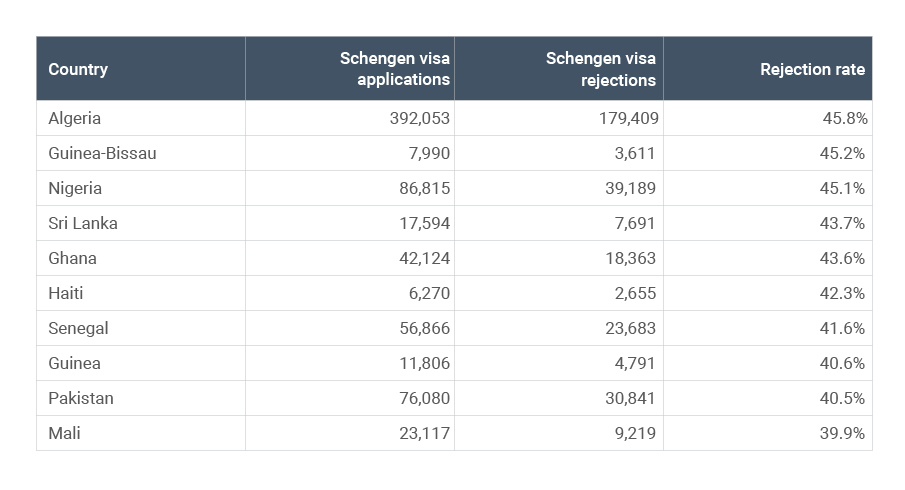
According to a new report by migration consultancy firm Henley & Partners, out of a total of 42,124 Ghanaians who applied for a Schengen Visa in 2022, 18,363 (43.6 per cent) were rejected.
Ranked 5th, Ghana comes after Algeria, Guinea Bissau, Nigeria and Sri Lanka.
The number of applications for Europe’s Schengen Area visas has been declining over the years as rejection rates have surged.
While restrictive for all applications, the European visa regime is notably more stringent towards African visa applicants than those from other regions.
Addressing these issues would signal Europe's commitment to actively engage in business and strengthen trade relations between Africa and Europe.
African visa applicants face more severe restrictions compared to applicants from other regions, resulting in a disproportionately high rejection rate.
In 2022, Africa topped the list of rejections with 30% or one in three of all processed applications being turned down, even though it had the lowest number of visa applications per capita.
This was 12.5% higher than the global average.
The rejection rates for African applicants for Schengen visas are generally 10% higher than the global average, three times higher than the highest rejection rate, and ten times higher than for Americans.
Visa rejection data and trends
Globally, the absolute number of Schengen visa applications decreased from 16.7 million in 2014 to 7.6 million in 2022, representing a decline of almost 9 million applications.
In other words, the global number of Schengen visa applications declined by nearly 54.7%. During the same period, the absolute number of Schengen visa applications in Africa decreased from 2.22 million in 2014 to 2.05 million in 2022, a decrease of almost 171,000 applications or 7.7%.
Africa accounted for seven of the top 10 countries with the highest Schengen visa rejection rates in 2022: Algeria (45.8%), Guinea-Bissau (45.2%), Nigeria (45.1%), Ghana (43.6%), Senegal (41.6%), Guinea (40.6%), and Mali (39.9%).
By contrast, only one in 25 applicants residing in the US, Canada, or the UK were rejected, and one in 10 from Russia.
As per illustration, Algerians face a rejection rate that is ten times greater than that of those applying in Canada, while Ghanaians are four times more likely to be rejected than Russians.
Nigerians face almost three times the rejection rate of applicants in Turkey (15.5) and twice that of Iranians (23.7)
Latest Stories
-
‘We don’t have time’ – Fianoo calls for Schäfer to lead Black Stars temporarily
34 minutes -
CAF will not favour any country – President Motsepe
39 minutes -
Otto Addo was appointed through the backdoor – Kudjoe Fianoo slams GFA
40 minutes -
UG Corporate Football League back from the Easter break
44 minutes -
CGI orders motorbike training at tactical school in Kyebi
2 hours -
Sachet water producers in Berekum defy gov’t directives, increase prices
2 hours -
Critical commodities stuck at port, CSOs warn of family planning crisis
2 hours -
Gender Ministry mourns victims of Volta Lake boat tragedy, deploys support for affected families
2 hours -
MPs undergo training on human trafficking and gender dimensions
2 hours -
Don’t expect instant relief – COMAC CEO warns fuel price drops will be gradual
2 hours -
GIS to unveil comprehensive plans to enhance officers’ welfare and infrastructure
2 hours -
Right move, wrong timing? – COMAC CEO questions govt’s delay on fuel price relief
2 hours -
IMF urges Central Banks to keep inflation in check
3 hours -
NRSA stands firm on Toyota Voxy ban despite transport operators’ opposition
3 hours -
H. Kwasi Prempeh raises concerns over Supreme Court’s handling of OSP constitutionality case
3 hours