

Audio By Carbonatix
The Ghana Anti-Corruption Coalition (GACC) has launched the Citizens' Anti-Corruption Manifesto (CACM) to serve as a basis for conversations on potential anti-corruption reforms.
Executive Secretary of the GACC Beauty Emefa Narteh, expressed the hope that political parties would embrace the issues identified by citizens and be guided by the broad recommendations to fashion out their own specific approach to addressing corruption in Ghana.
The CACM was developed by the Coalition and the Ghana Integrity Initiative (GII), with funding from the STAR-Ghana Foundation.
It is aimed at making corruption a key election issue this year thereby improving Ghana’s anti-corruption performance in subsequent years.
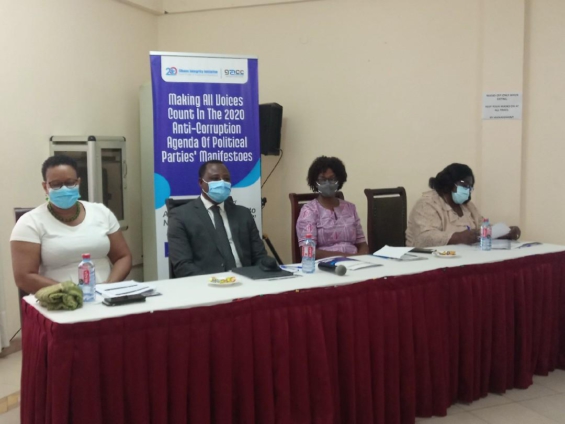
Mrs Narteh said the Coalition and other CSOs were implementing a STAR-Ghana Foundation funded project, dubbed; “Making All Voices Count in the 2020 Anti-Corruption Agenda of Political Parties’ Manifestoes” to increase citizens’ voices in the anti-corruption agenda.
She said the CACM Report underscored government’s inclination to execute its Manifesto rather than the country's development plan.
Joseph Whittal, the Chairman of the Commission on Human Rights and Administrative Justice, who launched the Report, said CSOs were creating a powerful platform that would set out the conversation for the next several months leading to the election.
Mrs Mary Awelana Addah, the Programmes Manager, GII, said going forward the organisation was planning to sustain the discourse by mobilising the mass of CSOs and the media to begin to interrogate the sources of funding of political parties.
Dr Esther Ofei-Aboagye, the Chairperson of STAR-Ghana Foundation, said the Foundation was happy to be associated with the CACM document having an immeasurable value.
The CACM seeks to create stakeholder awareness on citizens’ view on anti-corruption reforms for inclusion in political parties’ manifestos and to increase support and commitment in fighting the canker.
It also seeks to create the pathway for political parties to design and implement appropriate legal and policy/administrative reforms to tackle corruption on a more sustainable basis.
In compiling the CACM, the GII and GACC collated the views of a wide spectrum of sub-groups in Ghana including faith-based organisations, traditional rulers, and anti-corruption experts.
Others were women groups, students, civil society organisations, people with disability and other marginalized groups.
Latest Stories
-
What everyone should know about C-sections
51 minutes -
Health Ministry engages Ga Mantse ahead of Free Primary Healthcare launch
1 hour -
We can tackle multiple priorities – Sam George defends Anti-LGBTQ Bill push
2 hours -
Statement: Ghana Chamber of Mines’ Response to Claims in Joe Jackson’s “Ananse Stories about the Economy of Ghana”
2 hours -
GES opens 2026 teacher recruitment for licensed B.Ed graduates
2 hours -
Ghana must value skilled trades, build resilient learners — Ibn Chambas
2 hours -
Ghana must rethink education around relevance, resilience and responsibility — Ibn Chambas
2 hours -
Prince Harry faces defamation lawsuit from charity he co-founded
2 hours -
South Korea deploys thermal cameras to track escaped zoo wolf
2 hours -
Calls for royal meeting with Epstein survivors grow ahead of US visit
2 hours -
Ibn Chambas advocates blend of technology and human values in education
2 hours -
UMA improves healthcare access in Asutifi North with GH₵700k ‘Kim Taylor Legacy’ Walkway
2 hours -
Scholarships Authority and Fanaka University offer sponsorship for procurement and supply chain studies
2 hours -
Bisa Kdei drops new single ‘Go N Look’ featuring Medikal
3 hours -
Benin facing rising terrorism in north as French military presence faces growing criticism
3 hours