

Audio By Carbonatix
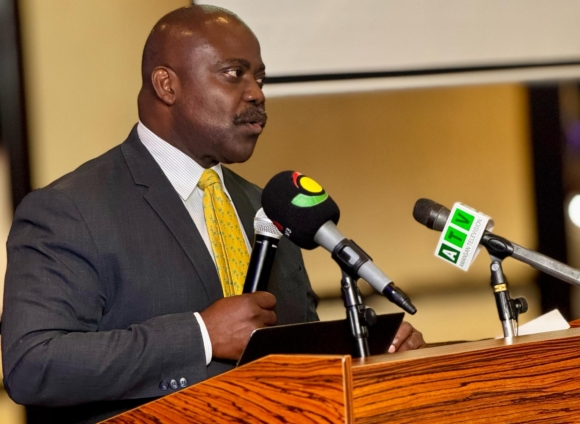
The Chief Executive Officer of Coconut Grove Regency Hotel, who's also the National Treasurer of the Association of Ghana Industries (AGI), Ralph Ayitey, has highlighted the disconnect between the potential of Ghana's poultry industry and how much the country still imports into the country when it can produce locally to meet that demand.
Ghana's poultry sector has been facing significant challenges in recent years, with imports of frozen chicken dominating the market.
Speaking at the launch of the 2025 Integrated Business Establishment Survey (IBES) report by the Ghana Statistical Service (GSS) in Accra, Mr Ralph Ayitey said Ghana consumes around 600,000 to 650,000 heads of imported chicken per day.
"This is a staggering number, and it's a clear indication that our local poultry industry is struggling to meet demand," Ayitey said. "We need to ask ourselves why we are importing so much chicken when we have the potential to produce it locally."
The hotelier emphasised that Ghana has the potential to become self-sufficient in poultry production, but this requires a concerted effort from stakeholders, including the government, farmers, and industry players.
"We need to support our local farmers and provide them with the necessary resources and incentives to increase production," Ayitey stressed. "We also need to address the issue of high production costs, which makes it difficult for our farmers to compete with imported chicken."
Mr Ayitey suggested that the government consider introducing policies to protect the local poultry industry, such as tariffs on imported chicken or incentives for local farmers to increase production.
"We need to make eating local chicken fashionable again," Ayitey said. "We need to promote our local poultry industry and encourage Ghanaians to support our farmers by buying local chicken. This will not only help to reduce our reliance on imported chicken but also create jobs and stimulate economic growth."
He highlighted the potential for poultry farming to contribute significantly to Ghana's economy, saying, "An acre of land can be used to build a 6-storey poultry farm, which can be more economically profitable than an 8-storey apartment block," he noted. "We need to think outside the box and explore innovative ways to support our local industries."
Mr Ayitey is of the view that, by supporting the local poultry industry, Ghana can reduce its reliance on imported chicken, create jobs, and stimulate economic growth. "Let us work together to promote our local poultry industry and make Ghana self-sufficient in chicken production. We owe it to ourselves, our farmers, and our economy."
Formalizing the informal sector
The National Treasurer of the Association of Ghana Industries (AGI) also called on the government to deliberately set out targeted interventions to formalize the operations of Ghana's informal sector.
He emphasised that the informal sector's significant contribution to Ghana's economy, estimated at around 35.6% of the country's GDP, is often underestimated due to a lack of reliable data.
He's thus of the view that the IBES report, which aims to bridge this data gap, providing valuable insights into both the formal and informal sectors, is in the right direction, and commended the Ghana Statistical Service for the initiative, which was supported by AGI.
"It should therefore give us an idea of the number of businesses outside the tax net," Ayitey stated. "There should be targeted interventions to help formalize the operations of the informal sector, since a growing informal sector will not inure to the benefit of our fiscal policies."
To address the challenges faced by the informal sector, Mr Ayitey recommended a multi-sectoral approach, involving the Ministry of Food and Agriculture, Trade, Agribusiness and Industry, and the Ministry of Tourism. He also suggested that the Statistical Service consider developing bankable proposals to support agri-businesses and other informal sector enterprises.
"I wish to recommend that with the Statistical Service being the tip of the tip, let's start developing bankable proposals to Ghanaians to follow through," Ayitey said. "This must involve the Ministry of Food and Agric, Trade, Agribusiness and Industry, and the Ministry of Tourism as well."
Mr Ayitey stressed the need to make doing business in the formal sector more attractive and accessible to informal sector operators. This could involve simplifying the process of formalization, reducing costs, and providing incentives for businesses to register and comply with tax laws.
"If there is enough motivation for informal sector businesses to formalize their operations, I believe tax revenue mobilization will be a lot easier for our tax authorities," Ayitey noted. "It pays to operate a well-structured business, but from a practical perspective, I believe a lot more ought to be done in terms of the ease and cost of doing business in the formal sector to serve as a motivation to those outside the formal sector to formalize."
By formalizing the operations of the informal sector, Mr Ayitey believes Ghana can increase tax revenue, improve economic productivity, and create more jobs. "Let us increase public dialogue to explore some of our data needs as a country to help in determining what is acceptable from a national standpoint."
Latest Stories
-
Ghana to honour Christina Hammock Koch for historic Artemis II mission
3 minutes -
Supreme Court appointments require more than 15 years’ experience – Justice Adjei-Frimpong
20 minutes -
Fire destroys 3-bedroom house at Bogyawe
43 minutes -
Why the Supreme Court is a “policy court” – Justice Richard Adjei-Frimpong breaks it down
48 minutes -
Playback: The Law discussed Supreme Court @150
2 hours -
MTN Momo staff walk to promote wellness and fitness
2 hours -
Assafuah: Sedina Attionu’s return from Nevada will test government’s commitment to accountability
2 hours -
How GRA’s Modified Taxation Scheme is boosting revenue compliance & SMEs competitiveness
3 hours -
Stonebwoy Can Do It: A call to unite behind 2026 BHIM Fest
3 hours -
World Shea Expo returns to Tamale for 2026 edition
3 hours -
Prioritise cocoa sector with better prices, timely payments-Annoh-Dompreh urges NDC
4 hours -
Lands and Mines Watch Ghana endorses Heath Goldfields’ mining capacity
4 hours -
Gbintiri residents protest alleged diversion of 24-hour market project
4 hours -
Justin Bieber headlines Coachella with nostalgia-fuelled set
4 hours -
Ukraine and Russia accuse each other of hundreds of ceasefire violations
4 hours