

Audio By Carbonatix
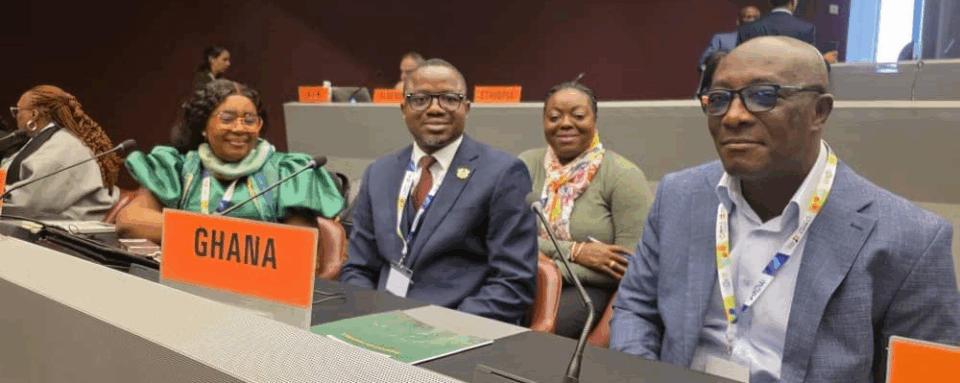
Professor Titus K. Beyuo, the leader of Ghana’s delegation to the 2025 11th Session of the Conference of the Parties (COP11), says Ghana is committed to accelerating tobacco control efforts towards stronger economies, healthier populations, and a more resilient future.
He said tobacco-related diseases were entirely preventable, and the cost of inaction was too high, and that Ghana’s continuous engagement at COP will position it as a regional leader to amplify global cooperation and accountability.
“This will help achieve the commitment made under the WHO FCTC and the UN Political Declaration,” Prof Beyuo stated, adding that, “Ghana’s progress in tobacco control demonstrates strong political will, fiscal reform, and that multisectoral coordination can overcome entrenched challenges.”
Prof Beyuo, who is also the Lambussie MP, remarked in a statement copied to the Ghana News Agency in Accra after a side event at the conference in Geneva, Switzerland.
The members of Ghana’s delegation to the COP11 of the World Health Organisation Framework Convention on Tobacco Control from 17-22 November 2025 included Dr Olivia Boateng, Tobacco Control Focal Person, and Mr Vigil Prah-Ashun, Director, Tobacco and Substance Abuse Directorate, Food and Drugs Authority.
The rest are Mercedes Mari, Principal State Attorney of the Civil Division Office of the Attorney-General and Ministry of Justice, and Labram Musah, Executive Director of Vision for Accelerated Sustainable Development, Ghana (VAST Ghana).
Prof Beyuo said Ghana viewed tobacco control as a matter of health sovereignty, economic resilience, and social justice and that the country’s leadership has put in many efforts to achieve that through key initiatives, including the adoption of the first five-year National Tobacco Control Strategy.
The others were advancing taxation as both a health and economic tool, leveraging the momentum from the FCTC to strengthen systems and governance structures, and championing Africa’s collective action toward reducing NCDs.
He said Ghana was committed to extending legislation to cover shisha, chewing tobacco, and electronic cigarettes to ensure that young people were protected from new and evolving nicotine products.
“Ghana is fully prepared to implement the Illicit Trade Protocol with a national roadmap,” he stated.
Prof Beyuo added, “Work is ongoing to strengthen track-and-trace systems, customs surveillance, border controls, and inter-agency information sharing to curb illicit tobacco trade.”
He said that in the country’s bid to strengthen legislative and fiscal measures, a specific excise tax system was introduced in 2023 through the Excise Duty Amendment Act.
“The new tax system applies 28 pesewas per cigarette stick, equivalent to GHS 5.60 per pack, consistent with ECOWAS tobacco taxation protocols.
“This shift from an ad valorem system to a mixed tax structure that combines specific and ad valorem elements enhances predictability, reduces affordability, and supports public health objectives. The legislation is continually reviewed to address emerging trends and global best practices,” he explained.
The leader of the delegation said tobacco advertising, promotion and sponsorship have been banned, while mandated graphic health warnings on all tobacco products have been instituted and partially enforced smoke-free policies across public spaces.
“National public awareness campaigns have been conducted to highlight the health risks of tobacco use. Tobacco control is included in the National Medium-Term Development Policy Framework 2022 to 2025,” Prof. Beyuo stressed.
He said a fully functional National Tobacco Control Inter-Agency Coordinating Committee, chaired by the Ministry of Health, has been coordinating efforts across key ministries and agencies.
The agencies include health, customs, finance, trade, education, and law enforcement.
He said Ghana was developing a Code of Conduct for public officials to operationalise FCTC Article 5.3, thereby insulating public health policies from industry interference.
He said traditional leaders in Northern Ghana have been engaged to eliminate the use of tobacco in dowry practices and replace it with healthier alternatives.
“Ghana stands ready to work with partners to continue driving progress globally and regionally,” he pointed out.
Mr Labram Musah, on his part, made a presentation on the implementation of the ECOWAS Mixed Excise Tax, “Outcomes since 2023 and Addressing Industry Interference.”
He said the implementation of the taxes has created a win-win scenario in Ghana by increasing excise tax revenue, reducing overconsumption of health-harm products, reducing associated healthcare burden, and reducing disproportionate NCD risk in lower-income groups and increasing health equity.
He mentioned challenges in the implementation, such as Ghana’s excise tax stamps not being designed based on the WHO Article 8 of the Tobacco Protocol (ITP) Requirements.
Mr Musah recommended the Implementation of a track-and-trace system in line with Article 8 of the ITP requirements , and strengthening its tax administration and automatic adjustment of specific cigarette excise tax rates for inflation and income.
He said Ghana must legislate to remove excise tax on electronic cigarettes, undertake upward adjustment of the excise tax rates, or reform to specific tax rates while earmarking the excise tax revenue to the funds tobacco tobacco-related illness and other health-related priorities –Ghana Medical Trust Funds.
He called for financial support for research into the implementation of new rates, and extensive training on the WHO FCTC, particularly on 5.3, 6 and 15.
Latest Stories
-
Mobile money transactions hits GH¢3trn as digital payments surge – BoG Report
12 minutes -
Retirement Is Not Disposal: Why Ghana Must Keep Using the Wisdom of Retired Teachers
16 minutes -
US applauds Ghana–US cooperation as 9 Ghanaians extradited over cybercrime
35 minutes -
The final mic: A nation pauses as Daddy Lumba takes his bow
49 minutes -
Amin Adam rejects ‘blind loyalty’ claims, says Northern support for Bawumia is based on competence
55 minutes -
Ghana Card becomes mandatory for insurance transactions from 2026
58 minutes -
December in GH: Beware of ‘I don’t have Cedis borgas’
60 minutes -
No $300 daily allowance: GAF explains real UN peacekeeping pay
1 hour -
One dead, another in critical condition after wild bees’ attack
1 hour -
Michael Okyere Baafi hosts 2025 Christmas ‘Shop for Free’ initiative for elderly in New Juaben South
1 hour -
Opoku-Agyemang urges long-term investment to grow Africa’s film and creative economy
1 hour -
Analyzing Bank of Ghana’s $10bn forex intermediation in 2025
1 hour -
LA police investigate ‘apparent homicide’ at Rob Reiner’s home
1 hour -
Health Ministry secures GH¢22.8bn to upgrade facilities and expand workforce
1 hour -
ECOWAS denounces coup plots, moves to bolster West Africa’s security architecture
1 hour