

Audio By Carbonatix
Ghana has experienced the largest relative increase in primary forest loss of all tropical countries, according to an analysis of satellite data published by US-based World Resource Institute (WRI).
The report says Ghana's loss of primary forest cover surged 60 percent from 2017 to 2018 – almost entirely from its protected areas.
Attempts at forestalling degradation of the forests have had limited success.
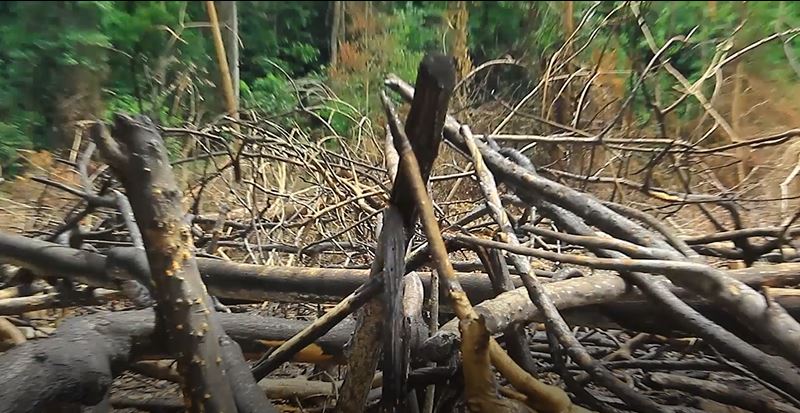
One of such forest that has suffered the chainsaw is Tinte Bepo forest reserve at Mmehame near Mankranso in the Ashanti region.
‘Mmehame’ in the Twi language literally means don't come and worry me.
But a name that is supposed to reflect in people's lives is quite the opposite.
People give it a different sense of its name.
And there is only one species that will soon be seen in this beautiful forest if people continue to cut down trees; the human being.
Mmehame has 300 residents, mainly farmers surrounded by beautiful nature – rainforest.
But within a few kilometers lies a sad reality - the destruction of Tinte Bepo forest reserve.
The chainsaw is falling on all of Tinte Bepo's jungle.
"Unlike in the past, there are no trees here to protect us when it rains. And rainfall patterns have also changed. I am truly concerned by the destruction of the forest." One of the residents, Twum Isaac tells JoyNews.
The reserve was dominated by economical trees like odum, mahogany, mansomia, emire, and danta.
"In the past, we saw different animals but now they have all moved." Twum says.
Rainforests provide humans with more than just trees.
Biodiversity loss causes sickness, poverty and even wars.
Thousands of plant species that provide human medicines would be lost.
Many poor communities like Mmehame won't get plant life for medication.
The world health organization estimates about 80 percent of African population uses traditional urban medicine as part of primary healthcare.
Lack of vegetation could result in rapidly increasing climate change.
Rainforests are also known as carbon sinks. This means they consume carbon dioxide, clearing it from the atmosphere.
While aspiring to become industry-friendly, Ghanaians must also spare a thought for the ecology.
That's why Envirotech Bamboo limited is restoring the degraded forest with bamboo.
CEO, Bernice Dapaah and her team are planting thousands of bamboo in Mmehame and surrounding areas.
The initiative would not only provide vegetation to the environment but create an economic empowerment program for women.
The choice of bamboo to restore the forest is because of its ability to produce more oxygen and renewable capacity.
Communities in Kintampo and Bands have benefitted from the exercise.
Bernice says environmental protection is her topmost priority.
It is the hope of the organization that the Mmehame forest would be restored to protect lives and vegetation.
Latest Stories
-
Mussa Dankwah is like a ‘lotto doctor’ – Miracles Aboagye
5 minutes -
Investors target Ho Airport for training and maintenance hub — GACL Chair
10 minutes -
NDC’s ‘grand deception’ on anti-LGBTQ+ bill exposed – Ntim Fordjour
10 minutes -
Speak out against Mahama government’s LGBTQI+ u-turn – Ntim Fordjour to clergy
14 minutes -
Ghanaians worse off despite improved macroeconomic indicators — Miracles Aboagye
18 minutes -
Police intercept narcotics, arrests five suspects in Upper West
24 minutes -
Government to establish Kumasi Machinery Innovation Park under 24-Hour Economy programme
26 minutes -
When Hormuz Fails: The day a waterway stops the world
27 minutes -
Ghanaian students in UK to protest over unpaid fees, stipends
28 minutes -
Inflation to go up marginally in April 2026 – Report
29 minutes -
Newborn baby found abandoned at Kronkromase cemetery, residents in shock
30 minutes -
VIP Jeoun Transport increases fares effective April 8
33 minutes -
Minority warns against alleged LGBTQ provisions in constitutional review
38 minutes -
Wave of violence kills at least 26 in Nigeria as army thwarts mass church abduction
56 minutes -
Anti-LGBTQ+: Mahama must be held to account to fulfil his promise – Ntim Fordjour
57 minutes