

Audio By Carbonatix
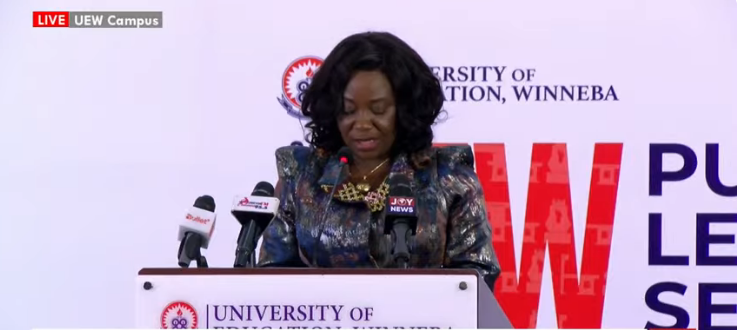
The Chief Executive Officer of Telecel Ghana, Patricia Obo‑Nai, has warned that Ghana’s education system risks becoming outdated if it fails to keep pace with rapidly changing industry demands and technological advancements.
Speaking at the UEW Public Lecture Series on April 10, she stressed that rethinking education is no longer optional but necessary to prepare young people for the future.
According to her, the rapid pace of technological change and shifts in the job market mean traditional academic systems may no longer be sufficient.
“Today, the skills that industries demand, including mine, are evolving faster than many curricula… if education remains unchanged, whilst everything around it changes, we are creating a gap between learning and relevance,” she stated.
She explained that this growing disconnect has real consequences, beginning with students and eventually affecting the broader economy.
“And that gap is costly because students feel it first, employers feel it next, and eventually the economy feels it most,” she added.
Mrs Obo-Nai described the lecture series as more than an academic exercise, calling it a “national conversation” that challenges Ghana to rethink how it prepares its youth.
She commended the University of Education, Winneba, for leading such discussions, noting that its role in training teachers has far-reaching implications for national development.
“Training teachers is shaping generations… the work done here travels beyond campus. It enters every profession that depends on someone having been taught well,” she noted.
She also highlighted the importance of partnerships between academia and industry, arguing that no single institution can drive education reform alone. As part of Telecel Ghana’s contribution, she outlined initiatives such as its graduate transition programme, female engineering scholarships, and the Digitech Academy, which has trained about 2,000 students across 13 regions in digital skills,s including coding, robotics, and web design.
She emphasised the need to promote inclusion, particularly for women in engineering, noting that stronger female participation leads to more representative and innovative industries.
The event, held at the Jophus Anamuah‑Mensah Conference Centre, formed part of UEW’s flagship lecture series, which brings together policymakers, academics, and industry leaders to discuss pressing national issues.
This year’s lecture, themed “Rethinking Education for Sustainable Development,” featured Mohamed Ibn Chambas as the main speaker, with the programme hosted by Vice-Chancellor Stephen Jobson Mitchual.
The series continues to serve as a platform to bridge the gap between research and policy, often attracting government representatives, including officials from the Ministry of Education, as Ghana seeks to align its education system with broader goals of industrial growth, innovation, and inclusive development.
Mrs Obo-Nai concluded by urging students to view education as a continuous process rather than a one-time achievement.
“Let us not treat education as something you complete. Let’s treat it as something you continue,” she said.
Latest Stories
-
Ntim Fordjour rejects call for more dialogue, says Anti-lgbtq bill has faced a decade of debate and delay
1 minute -
Catholic Bishops say moral values must match economic priorities in Anti-LGBTQ+ debate
29 minutes -
IGP Yohuno urges merit and hard work ahead of Police Academy exams
42 minutes -
Queendalyn Yurglee releases debut album ‘Clouds of Glory’
1 hour -
UDS moves to clear MPhil student wrongly linked to robbery case
2 hours -
Vodza Regatta 2026: Prof Audrey Gadzekpo rallies investors for coastal tourism growth
2 hours -
Introduction of 100 new Metro Mass buses won’t affect transport unions – GPRTU
2 hours -
Deputy Transport Minister backs Yellow Line traffic initiative
2 hours -
MTN Ashanti-Fest music concert set to hit Kumasi on Saturday
2 hours -
Authorities probe discovery of dead fish at Tema shipyard
2 hours -
Minority welcomes fuel tax cuts, demands accountability for GH¢1 levy
2 hours -
It remains a priority — Sam George on Anti-LGBTQ bill
2 hours -
Police arrest Nigerian national seen in viral videos wearing police uniforms
2 hours -
Free golf training empowers underprivileged girls in Accra
3 hours -
Why SIGA’s reset is not a market sin, but a national necessity
3 hours