

Audio By Carbonatix
The Ghana Immigration Service (GIS) has formalised a significant commitment to intensifying security cooperation with the European Union (EU), targeting enhanced border management, counter-terrorism coordination, and regional stability across the volatile Sahel and Coastal West Africa regions.
The high-level engagement in Accra signals a renewed focus on securing Ghana’s porous northern frontiers against external threats.
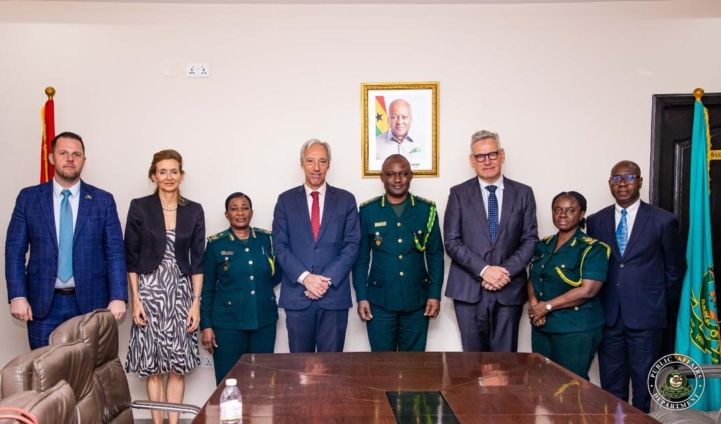
The discussions were spearheaded by a delegation led by the EU Special Representative for the Sahel, Juan Crauviño, and included the EU Ambassador to Ghana, Rune Skinnebach, meeting extensively with GIS leadership.
H.E. Juan Crauviño underscored the critical strategic importance of Ghana, stating that his mandate requires a clear understanding of security realities in strategic countries like Ghana, necessitating close collaboration with all 27 EU member states.
He offered strong commendation for Ghana’s internal security vigilance, despite the extreme volatility of the broader Sahel region:
Ghana “has been resilient to the risk of incursions from terrorists because of local initiatives.”
However, GIS leadership painted a sobering picture of the operational challenges. Comptroller-General of Immigration, Samuel Basintale Amadu, described the Sahel as a growing security concern, noting pointedly that “the region sits on top of Ghana and pressure is coming down.”
The meeting zeroed in on the unique geographical and social characteristics of Ghana’s northern borders, which span approximately 500km. H.E. Crauviño highlighted the complexities:
He stressed that these conditions “require tailored approaches different from European border management systems.”
Comptroller-General Amadu detailed how these factors complicate security operations, noting that “Sometimes boundaries cut through houses… criminals take advantage, disguising themselves as border residents.”
He lamented that limited mobility significantly hampers effective patrols and response efforts along the vast northern frontier.
EU Ambassador to Ghana, Rune Skinnebach, highlighted the explicit focus of the EU’s financial and technical assistance, confirming the severity of the security landscape in the region.
“60% of our support goes to the north because we are very cognisant of the challenges there,” he stated.
The Ambassador specifically praised the progress of the EU Security and Defence Initiative (EUSDI), which is designed to enhance surveillance, technology deployment, and inter-agency coordination in these critical border regions.
Deputy Comptroller-General for Operations and Command Post, Laud Affrifah, expanded on the technical needs, underscoring the necessity for improved surveillance technology, rapid response mechanisms, and enhanced officer training, particularly given the ethnic and geographic complexities along the northern borders.
Affrifah confirmed that previous high-impact initiatives, such as Operation Conquered Fist, have successfully strengthened multi-agency presence across the northern boundary, but maintained that "more investment in technology and training is crucial."
He also attributed Ghana's relative stability to proactive community-level security engagement, which is vital in preventing radicalisation, highlighting the "close cooperation between security agencies and local communities."
Comptroller-General Amadu expressed profound appreciation for the EU’s sustained backing, specifically citing support provided through the International Centre for Migration Policy Development (ICMPD), the International Organisation for Migration (IOM), and various targeted EU-funded initiatives.
In closing, H.E. Crauviño described the high-level meeting as “constructive and encouraging,” cementing the EU's strategic view of Ghana as a key partner:
“We believe there is a need to work more closely with West African countries, and Ghana is a very strong friend,” he concluded, reaffirming commitment under the EUSDI framework and broader EU–Africa security arrangements.
The meeting decisively reinforces the joint commitment to build a resilient security architecture capable of countering the escalating threats emanating from the Sahel region.
Latest Stories
-
Catholic Bishops say moral values must match economic priorities in Anti-LGBTQ+ debate
28 minutes -
IGP Yohuno urges merit and hard work ahead of Police Academy exams
41 minutes -
Queendalyn Yurglee releases debut album ‘Clouds of Glory’
1 hour -
UDS moves to clear MPhil student wrongly linked to robbery case
2 hours -
Vodza Regatta 2026: Prof Audrey Gadzekpo rallies investors for coastal tourism growth
2 hours -
Introduction of 100 new Metro Mass buses won’t affect transport unions – GPRTU
2 hours -
Deputy Transport Minister backs Yellow Line traffic initiative
2 hours -
MTN Ashanti-Fest music concert set to hit Kumasi on Saturday
2 hours -
Authorities probe discovery of dead fish at Tema shipyard
2 hours -
Minority welcomes fuel tax cuts, demands accountability for GH¢1 levy
2 hours -
It remains a priority — Sam George on Anti-LGBTQ bill
2 hours -
Police arrest Nigerian national seen in viral videos wearing police uniforms
2 hours -
Free golf training empowers underprivileged girls in Accra
3 hours -
Why SIGA’s reset is not a market sin, but a national necessity
3 hours -
SIGA Directive: Beyond the theatre of institutional displacement
3 hours