


Audio By Carbonatix
Tens of thousands of genetically modified (GMO) mosquitoes have been released in Djibouti in an effort to stop the spread of an invasive species that transmits malaria.
The friendly non-biting male Anopheles stephensi mosquitoes, developed by Oxitec, a UK-based biotechnology company, carry a gene that kills female offspring before they reach maturity.
Only female mosquitoes bite and transmit malaria and other viral diseases.
It is the first time such mosquitoes have been released in East Africa and the second time in the continent.
Similar technology has been successfully used in Brazil, the Cayman Islands, Panama, and India, according to the US Centres for Disease Control and Prevention (CDC).
More than one billion such mosquitoes have been released around the world since 2019, CDC says.
The first batch of the mosquitoes were released into the open air on Thursday in Ambouli, a suburb of Djibouti city.
It is a pilot phase in a partnership between Oxitec Ltd, Djibouti’s government and Association Mutualis, an NGO.
“We have built good mosquitoes that do not bite, that do not transmit disease. And when we release these friendly mosquitoes, they seek out and mate with wild type female mosquitoes,” Oxitec head Grey Frandsen told the BBC.
The laboratory-produced mosquitoes carry a "self-limiting" gene that prevents female mosquito offspring from surviving to adulthood when they mate.
Only their male offspring survive but would eventually die out, according to the scientists behind the project.
Unlike the sterile male Anopheles colluzzi mosquitoes released in Burkina Faso in 2018, the friendly stephensi mosquitoes can still have offspring.
The release is part of the Djibouti Friendly Mosquito Program which was started two years ago to stop the spread of Anopheles stephensi, an invasive species of mosquito first detected in the country in 2012.
The country was then on the verge of eliminating malaria, when it recorded close to 30 malaria cases. Since then, malaria cases have risen exponentially in the country to 73,000 by 2020.
The species is now present in six other African countries - Ethiopia, Somalia, Kenya, Sudan, Nigeria and Ghana.
The Stephensi species, originally from Asia, is very difficult to control. It is also referred to as an urban mosquito that has outsmarted traditional methods of control. It bites both during the day and at night and is resistant to chemical insecticides.
Dr Abdoulilah Ahmed Abdi, a presidential health adviser in Djibouti, told the Financial Times news website that the government’s objective was to “urgently reverse malaria transmission in Djibouti, which has spiked over the past decade”.
“Not long ago, it [malaria] was extremely rare in our communities," said Association Mutualis director Dr Bouh Abdi Khaireh.
"Now we see malaria patients suffer on a daily basis across Djibouti. There is an urgent need for new interventions.”
It has been easy to roll out the new anti-malaria project due to Djibouti's small size, a mostly urban country of slightly over a million people, the organisers said.
“Malaria is a serious disease that really affects our health. People are really waiting to see how these friendly mosquitoes will help us win the fight,” Saada Ismael, a malaria survivor who took part in the community preparation, told the BBC.
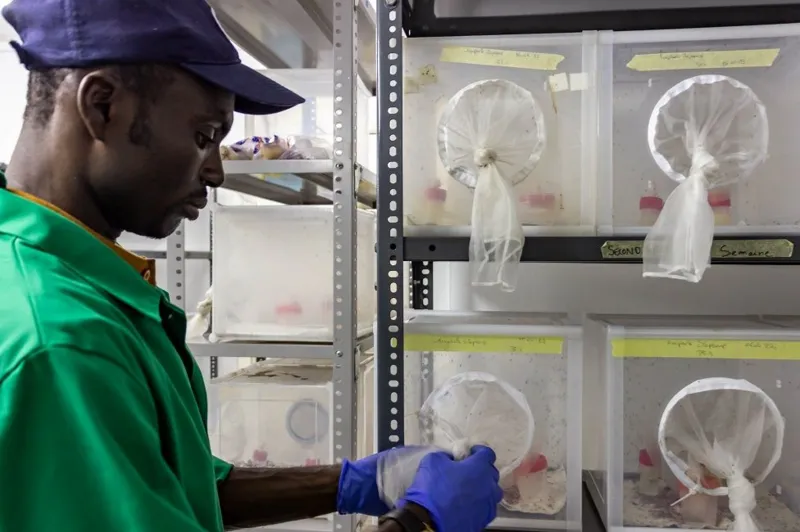
Genetically modified organisms have always been a controversial subject in Africa. Environmental groups and campaigners have warned of consequences to ecosystems and existing food chains.
But Mr Frandsen from Oxitec says no adverse effects on environmental or human health has been documented for over 10 years, during which the developer of biological solutions has released a billion modified mosquitoes.
“Our focus is ensuring that whatever we release in the environment is safe, and highly effective. There is no environmental impact. They are non-toxic, non-allergenic and species-specific,” he added.
The genetically modified genes are not found in the mosquitoes’ saliva and according to Oxitec, even a person who is bitten by one will not be exposed to the effects of the genes.
"This new solution may be controversial but it is the future,” said presidential health adviser Dr Abdi.
If successful, larger field trials and eventual operational deployment of the mosquitoes will continue until next year in the country.
Malaria is a deadly disease that kills at least 600,000 people every year globally. Nine in 10 of all deaths occur in sub-Saharan Africa, according to the World Health Organization.
Latest Stories
-
We can tackle multiple priorities – Sam George defends Anti-LGBTQ Bill push
26 minutes -
Statement: Ghana Chamber of Mines’ Response to Claims in Joe Jackson’s “Ananse Stories about the Economy of Ghana”
27 minutes -
GES opens 2026 teacher recruitment for licensed B.Ed graduates
29 minutes -
Ghana must value skilled trades, build resilient learners — Ibn Chambas
38 minutes -
Ghana must rethink education around relevance, resilience and responsibility — Ibn Chambas
40 minutes -
Prince Harry faces defamation lawsuit from charity he co-founded
42 minutes -
South Korea deploys thermal cameras to track escaped zoo wolf
44 minutes -
Calls for royal meeting with Epstein survivors grow ahead of US visit
47 minutes -
Ibn Chambas advocates blend of technology and human values in education
49 minutes -
UMA improves healthcare access in Asutifi North with GH₵700k ‘Kim Taylor Legacy’ Walkway
54 minutes -
Scholarships Authority and Fanaka University offer sponsorship for procurement and supply chain studies
57 minutes -
Bisa Kdei drops new single ‘Go N Look’ featuring Medikal
1 hour -
Benin facing rising terrorism in north as French military presence faces growing criticism
1 hour -
UEW Public Lecture Series 2026: Education debate ‘about the soul of Ghana’s future’ — Dr Ibn Chambas
1 hour -
EU fingerprint and photo travel rules come into force from today
2 hours