


Audio By Carbonatix
The Ghana Gold Board (GoldBod) has argued that the reported $214 million—or $300 million—loss under the Gold-for-Reserves (G4R) programme in 2025 should not be interpreted as a national setback, but rather as a strategic gain for the country.
In a statement issued on Monday, January 5, the board explained that the Bank of Ghana (BoG), working alongside GoldBod as its aggregator, generated over $10.8 billion in foreign exchange from artisanal and small-scale mining (ASM) gold exports in 2025 alone.
“Even if the cost of the programme is $214 million, the foreign exchange accumulated—over $10 billion—is of immense economic benefit. This is a net gain for Ghana, not a loss,” GoldBod noted, highlighting that the expenditure was part of a deliberate strategy to meet critical external obligations and strengthen reserves.
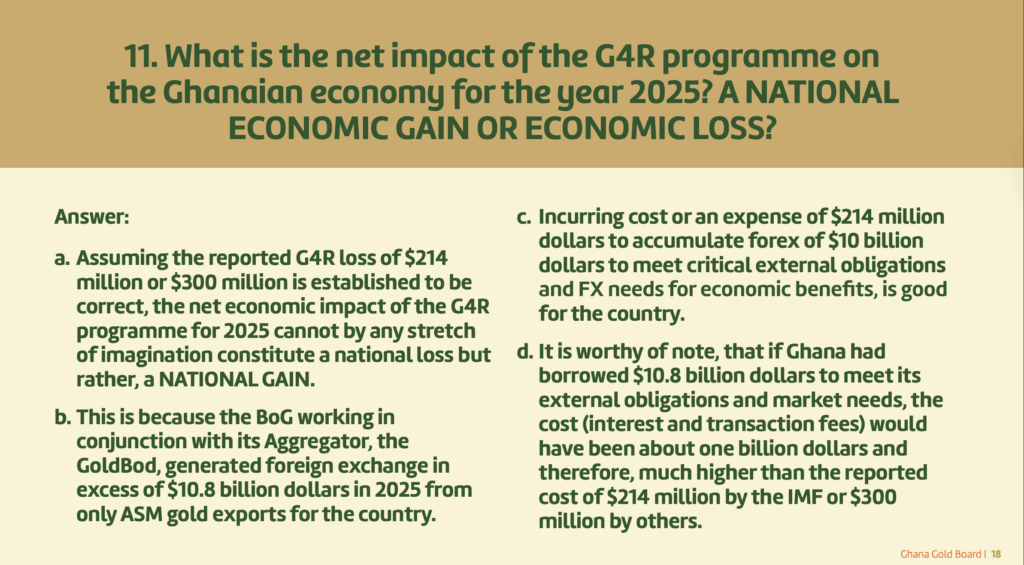
The board further emphasised that had the country borrowed $10.8 billion to meet similar external obligations, interest and transaction fees would have amounted to approximately $1 billion, far exceeding the reported cost of $214 million cited by the IMF or $300 million by other commentators.
GoldBod concluded that the G4R programme’s financial design, rather than operational inefficiency, underpinned the reported cost, and stressed that such strategic investments are essential for stabilising the economy and ensuring Ghana meets its international obligations efficiently.
Latest Stories
-
[Watch Live] Obrafour, Kwaw Kese, Tinny, Keche and others thrill fans at Gomoa Easter Carnival
26 minutes -
After more than 14 years at Atletico Madrid, what next for Simeone?
1 hour -
Conquering the World – Building on the foundations laid by Otto Addo
1 hour -
Gomoa Easter Carnival: Experts charge indigenes to own festival to ensure sustainability
2 hours -
Gomoa Easter Carnival: Edem Agbana and Joy Prime fans shower festival with huge endorsements
4 hours -
Gov’t to overhaul free zones into manufacturing hubs for local production – Trade Minister
5 hours -
Ghana losing $2.5bn yearly from raw exports – Trade Minister reveals
5 hours -
Mahama unveils plans for Kwahu Airport, Convention Centre
5 hours -
World’s oldest leader, Paul Biya to get a deputy for first time in 43-year rule
5 hours -
Search for missing US airman continues as Trump threatens ‘hell’ if Iran does not reach deal
5 hours -
US says it has arrested relatives of late Iranian general Qasem Soleimani
5 hours -
La Liga: Real Madrid’s title hopes hang in the balance as Mallorca snatch stoppage-time winner
5 hours -
FA Cup: Haaland hat-trick powers Man City past Liverpool into semi-finals
6 hours -
FA Cup: Chelsea thrash Port Vale to reach Wembley semi-final
6 hours -
Gov’t to boost tourism in coastal communities through infrastructure, sanitation – Vice President
6 hours