

Audio By Carbonatix
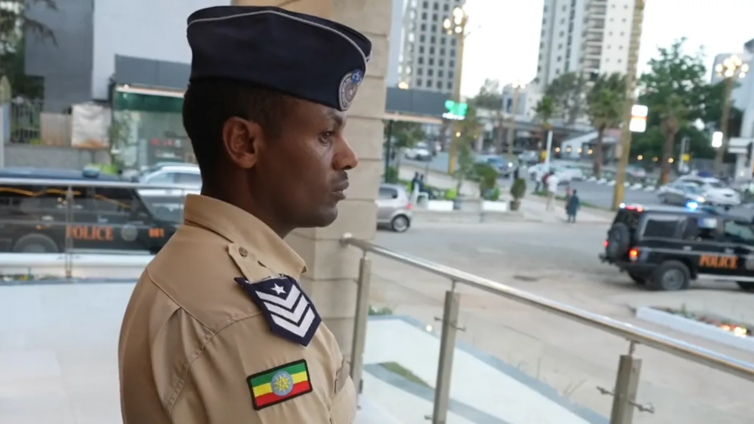
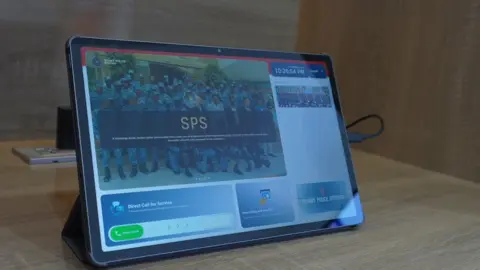
Computer tablet screens glow inside a row of partitioned booths at this new-style Ethiopian police station.
There is no commotion. There is no front desk, no bench of anxiously waiting civilians, no officer calling out names.
This pilot project of what is being called a "smart" or unmanned police station in the Bole district of the capital, Addis Ababa, is the latest chapter in Ethiopia's bid to catch up with the digital revolution.
A large monitor on the wall cycles through welcome messages and images of Prime Minister Abiy Ahmed.
But at the moment, there are uniformed officers standing by to demonstrate how the system works - it makes the place feel more like a tech showroom.
Recently opened, the staff "are here to help people get used to it", the police's head of technology expansion department, Cdr Demissie Yilma, tells the BBC.
Inside a booth, he taps a screen and goes through the steps to make a report.
Demissie selects the type of incident - a crime, a traffic report or a general concern - enters the details and presses a button to submit the comment.
Then, an officer - who is a real person in a remote location rather than a chatbot - pops up on the screen and begins to ask questions and take down information.
"If there is a problem, officers respond immediately and patrol the area mentioned by the reporter," Demissie says.
In its first week last month, the smart police station (SPS) received just three reports: a lost passport, a financial fraud case and a routine complaint.
But Demissie believes the number of reports will grow as locals become more aware of it.
"The future police service should be near the citizens," he says.
Ironically, using a computer tablet to communicate with officials may mean less human-to-human contact, but authorities believe the SPS could increase access to the police in places where there may not be enough personnel to staff a fully-fledged station.
At the project's launch on 9 February, the prime minister was quoted in state media as saying that it was aimed at making "law enforcement institutions competent and competitive" and he framed it as part of a wider digital reform drive.
The smart police station is attempting to mirror a broader shift in how citizens interact with the state.
The national strategy launched last year - known as Digital Ethiopia 2030 - is the government's blueprint for digitising public services from identity systems and payments to courts and public administration.
Low figures for the proportion of Ethiopians with internet access have meant the country has lagged behind others on the continent in digital transformation.
Also, conflict and political upheavals in recent years have led to internet blackouts.
But as the telecoms sector has opened up, the country is embracing mobile phone digital payments in birr, the local currency.
The government has also introduced a national digital ID system and put several government services online.
Supporters of the moves argue that these changes are long overdue in a country with rapid urban growth and a young population.
Birhan Nega Cheru, a senior software engineer in Addis Ababa, is pleased with the shift.
"When they work well, they reduce paperwork and visits to offices," he tells the BBC.
But he also recognises security and privacy issues and the dangers that those "who are not digitally literate can easily be scammed".
"Urban users, younger people, businesses, those with smartphones and skills, benefit most," the software engineer says.
"Older people, rural communities and low-income groups are at risk of being left out."
And the numbers support his assertions.
Digital adoption in Ethiopia remains uneven. In a report last year, the UN's educational organisation, UNESCO, found that 79% of its citizens were not connected to the internet.
But Zelalem Gizachew, a technology policy analyst, argues that the government's strategy has been chipping away at the digital divide.
"Digital literacy remains a challenge," he says. "That is why the Digital Ethiopia 2030 strategy puts emphasis on training and skills, not just technology."
He points to measurable changes over the past five years.
"Digital payments have boomed with trillions of birr now moving through electronic transactions. Broadband access has expanded sharply, and more than 130 government services have been digitised.
"These are foundational investments," Zelalem says. "You cannot modernise public services without infrastructure, policy and skills."
For now, the smart police station remains a pilot.
It is in a controlled environment where officers guide users through a system which is still finding its footing. Traditional stations continue to operate, and most citizens still rely on in-person reporting.
Whether the model expands will depend less on how sleek the technology looks, and more on whether people choose to use it when no-one is there to explain the screens.
In that sense, the quiet room in Bole is not a finished product. It is an experiment, and a small window into how Ethiopia's broader digital ambitions may play out in everyday life.
Latest Stories
-
Prudential Life settles GH¢100,000 medical bills under its PRUCares Valentine Experience Initiative
9 minutes -
Wa West Picnic: Peter Lanchene Toobu champions peace, health and unity in landmark celebration
21 minutes -
Dr Mensah Market flooded after downpour in Kumasi
28 minutes -
Armed men reportedly storm Adjen Kotoku Onion Market amid tensions
1 hour -
Tecco Mensah writes: Why football fans must look beyond statistics
2 hours -
Police recover stolen Honda CR-V in Kumasi within 48 hours
3 hours -
Apetorku Gbodzi 2026 Festival opens in Dagbamete with development focus
3 hours -
President Mahama arrives in Lyon to co-chair One Health Summit
3 hours -
Beverly View Plus Hotel draws crowds amid coastal Easter rush in Volta
3 hours -
Maiden Zongo Festival held in Wa amid calls to tackle drug abuse among the youth
3 hours -
FDA warns of fake HIV test kits on Ghanaian market
4 hours -
Africa urged to build resilient health systems as donor support tightens
4 hours -
Easter gesture: Ablakwa settles medical bills for 85 North Tongu constituents
6 hours -
Africa must harness its population strength—Titus-Glover
6 hours -
Visa-free access doesn’t mean unlimited stay – Lom Ahlijah
6 hours