

Audio By Carbonatix
The presidential election on December 7, 2020, may produce a winner as none of the candidates is estimated to poll more than 50 percent of the votes, the Governance Research Bureau (GRB) has predicted.
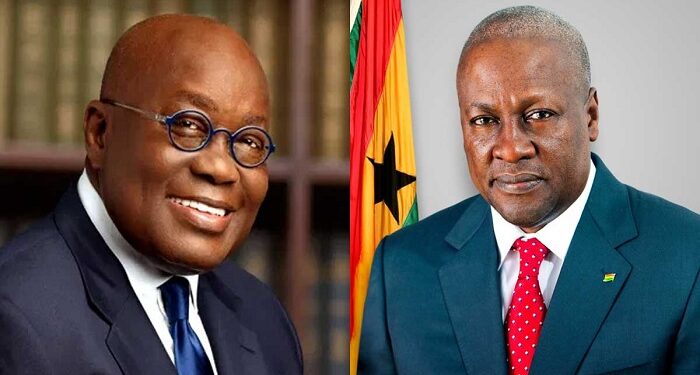
Based on its analysis of EC certified results since 1992 and the 2020 voters register, the Bureau estimates that the NPP’s Nana Akufo-Addo will poll 49.19 percent (8,389,273 votes), with NDC’s John Mahama taking 48.27 percent (8,233,881 votes), while the others make do with 2.54 percent (433,257 votes).
According to a press release from the Bureau, signed by its Coordinator, Mohammed Affum, the statistical tool used for the prediction was the Generalised Linear Model (GLM)whose dependent variable is the percentage of votes likely to be obtained by the parties with the independent variables being the Constituency and Parties.
The release said the standard errors that emerged were 0.76 percent of the percentage of votes that NPP obtained, 0.75 percent for NDC, and 0.32 percent for the other parties.
The Bureau said a 95 percent confidence interval estimate for the percentage of votes for the NPP has a lower limit of 47.69 percent (8,134,646 votes)and an upper limit of 50.68 percent (8,646,900 votes).
The NDC has a lower limit of 46.80 percent(7,983,123 votes) and an upper limit of 49.74 percent (8,484,639 votes)while the other parties have a lower limit of 1.92 percent (326,964 votes) and an upper limit of 3.16 percent (539,550 votes).
According to the press release, the model also predicts that the bulk of Nana Addo’s votes will come from the Western, Ahafo, Bono, Ashanti, and Eastern regions with a performance rating of 53.45 percent, 52.83 percent, 56.18 percent, 72.40 percent, and 56.97 percent respectively.
For John Mahama, the Western North, Volta, Oti, Upper West, Upper East, Northern, North East, Savannah, and Bono East regions are projected to give him 60.16 percent, 90.39 percent,66.97 percent, 61.33 percent, 62.55 percent, 59.28 percent, 49.07 percent, 61.88 percent and 56.59 percent of the votes respectively.
The release said the model estimated that in the swing regions of Greater Accra and Central respectively, the NPP would gain 49.75 percent and 50.16 percent and the NDC, 49.42 percent and 47.08 percent.
In the parliamentary elections, the Governance Research Bureau predicts that the NPP will win 107 seats with the NDC taking 112 while 56 can go either way, according to the model.
The 56 constituencies are the following:
Bono Region: Tain. Bono East: Nkoranza South and Pru West. Central Region: Agona East, Agona West, Ajumako Enyan Essiam, Asikuma Odoben Brakwa, Awutu Senya West, Cape Coast North, Effutu, Gomoa East, Gomoa West, KEEA, Mfantseman, and Twifu Ati Morkwa. Eastern Region: Akwatia, Abirem North, and Suhum.
Greater Accra:Ablekuma Central, Ablekuma South, Bortianor Ingleshie, Korle Klottey, Krowor, Ledzokuku, Madina, and Okaikwei North.
Northern Region: Bimbilla, Kpandai, Mion, Tatale Sanguli, Wulensi, and Yendi.
North East: Bunkpurugu, Chereponi, Nalerigu, Walewale. Savannah Region: Salaga South. Oti Region: Akan, Krachi West, Krachi Nchumuru, Nkwanta North.
Upper East: Builsa South, Navrongo Central, Talensi, Tempane, and Zebilla. Upper West: SissalaEast and Sissala West.
Western Region: Ellembelle, Evalue Gwira, Jomoro, Mpohor, Mpohor Wassa East, Prestea Huni Valley, Shama, and Tarkwa-Nsuaem.
The Bureau said its model operates on the principle that for presidential candidates to win, they would have to increase their average votes in their respective strongholds while they maintain average or above-average performance in their opponent's strongholds.
In addition, they should go beyond their average performance in the swing regions of Greater Accra and Central regions, otherwise, average performance in their strongholds, as well as their opponent’s strongholds and swing regions, takes the election to the second round, while below-average performance signals defeat, it explained.
“While our model relies solely on analysis of quantitative data to reach its conclusions, and these are measurable, we concede that qualitative variables in the constituencies and at the national level may alter the results predicted,” the Bureau observed, adding that the results from the model should be regarded as a guide for political actors.
Latest Stories
-
NPP leaders converge at party headquarters ahead of NEC meeting on polling station elections
54 seconds -
Fuel prices may rise in Ghana despite global drops – Duncan Amoah
4 minutes -
‘No one is above the law’- Volta Chiefs condemn EOCO over handling of Council of State member case
5 minutes -
AMA creates alternative pedestrian routes at Kaneshie after footbridge closure
9 minutes -
Ghanaians were misled- NPP accuses NDC of politicising Anti-LGBTQ bill
9 minutes -
Photos: Mahama receives full state welcome in Paris ahead of talks with French President Macron
31 minutes -
Deputy Health Minister endorses Women in Medicine Fellowship
31 minutes -
Duncan Amoah pushes for Consumer Protection Bill amid VIP fare hike
44 minutes -
LMWG backs Damang lease award to E&P, demands transparency and results
48 minutes -
Volta Chiefs condemns EOCO over alleged disregard for court ruling in Council of State member case
49 minutes -
Matthew Perry’s stepmother says ‘Ketamine Queen’ should get maximum sentence
49 minutes -
Northern Regional Police Command intensifies anti-drug operations, arrests 217 suspects
51 minutes -
The architect of a healthier Ghana: Mahama’s vision and legacy in primary healthcare
53 minutes -
Israel carries out large wave of air strikes across Lebanon
58 minutes -
BBC upholds complaints over racial slur in Baftas broadcast
58 minutes