

Audio By Carbonatix
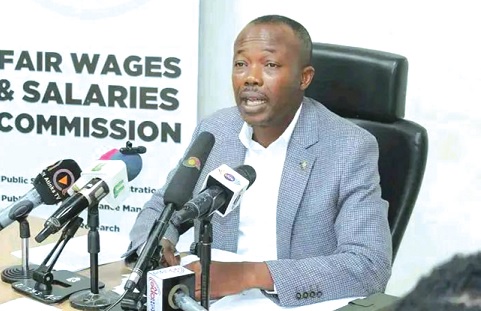
The Chief Executive of the Fair Wages and Salaries Commission (FWSC), Ben Arthur, has warned that public service workers who live in government accommodation but still receive allowance to cover same will be surcharged.
Equally to be surcharged are employees who use state vehicles yet receive fuel and vehicle maintenance allowances. He said the practice was a drain on public funds.
Negotiation
Mr Arthur issued the warning at a negotiation meeting with the Health Service Workers Union (HSWU) to address long-standing grievances of the union.
During a discussion of the union's demands for better working conditions, salaries and other benefits, some leaders of the union indicated that some health workers were taking 20 per cent of their basic salary as accommodation allowance even though they were living in government accommodation.
Mr Arthur indicated that the decision was aimed at curbing the practice of double-dipping, where employees received government-provided housing and a separate allowance for accommodation at the same time.
Mr Arthur said the surcharges would be used to recover misused funds and improve public services. The Chief Executive of the FWSC emphasised that the practice was unacceptable and amounted to a misuse of public funds.
"This is an abuse of the system," Mr Arthur stated. "Those found guilty will face surcharges and other disciplinary actions."
Accommodation allowance
Under the country’s tax laws and labour practices, accommodation allowance for government workers is a benefit provided to employees to help offset the costs of housing.
It is a monthly or annual stipend added to their salary to support their accommodation needs. The allowance is usually a percentage of the employee's basic salary.
However, not all government workers are eligible as it is usually reserved for specific job grades, ranks or categories of employees.
Monitoring
The commission, Mr Arthur said, had begun auditing government employees' benefits through the payroll monitoring exercise and expressed optimism that it would help to identify those taking advantage of the system.
The Chief Executive of FWSC urged employees to comply with the directive and to report any colleagues who were double-dipping. The move is part of the commission's efforts to ensure fairness and transparency in government compensation and benefits.
Mr Arthur commended the leadership of the union for their cooperation with the employer, represented by the FWSC and the Ministry of Health.
"We recognise the critical role healthcare workers play in our society. We are committed to ensuring they are fairly compensated and work in a conducive environment," he said.
The Deputy General Secretary of HSWU, Patricia O. Tweneboah, expressed optimism about the negotiations, stating that she was hopeful both parties would conclude negotiations soon.
She had earlier indicated that pressure was mounting at the grass roots for the union to embark on a strike because they believed an industrial action was the only way to press home their demands.
At the end of the meeting, the government and HSWU pledged to continue to dialogue to address any outstanding issues and work towards a harmonious relationship.
The almost concluded negotiation is a positive development for the healthcare sector as it would ensure that patients continued to receive quality care from skilled professionals.
About the commission
FWSC is the government’s mandated organisation for the determination and management of salaries for all public servants whose salaries are drawn from the consolidated fund.
It is also to advise government on all salary-related matters in the country.
FWSC works hand in hand with the Ministry of Employment and Labour Relations (sector ministry), the Ministry of Finance, the Controller & Accountant-General’s Department and the Public Services Joint Standing Negotiation Committee.
It exists to ensure that best practices in job grading, evaluation, performance management and research are employed in pay administration to ensure that pay in the public services is linked to productivity and that high-calibre employees are attracted to and retained within the public service.
Set up by the Fair Wages and Salaries Commission Act, 2007, it also ensures fair, transparent and systematic implementation of the government’s public service pay policy.
Latest Stories
-
Dozens killed as Angola flood death toll rises
25 minutes -
Russia confirms deaths of 16 Cameroonians fighting in Ukraine war, Yaounde says
36 minutes -
Plan to scrap presidential elections puts Zimbabweans at loggerheads
46 minutes -
Guinea-Bissau transporters strike over higher fuel prices
56 minutes -
Iran ceasefire deal a partial win for Trump – but at a high cost
1 hour -
Oil slides below $100 after Trump announces two-week ceasefire
1 hour -
Madagascar declares state of emergency over energy situation due to Iran war
1 hour -
Ex-Meta worker investigated for downloading 30,000 private Facebook photos
2 hours -
World Bank says Nigerian economy to grow in 2026 but Iran war lifts inflation
2 hours -
Ringleader of suspected human trafficking network arrested in Ethiopia
2 hours -
Italy’s Eni discovers 2 trillion cubic feet of gas offshore Egypt
4 hours -
South Sudan’s Kiir sacks parliament speaker and deputy
5 hours -
In Ghana Town, a ‘stateless’ future for hundreds born and raised in Gambia
5 hours -
Russia confirms 16 Cameroonian soldiers killed in Ukraine war
5 hours -
USA striker Patrick Agyemang ruled out of World Cup due to injury
5 hours