

Audio By Carbonatix
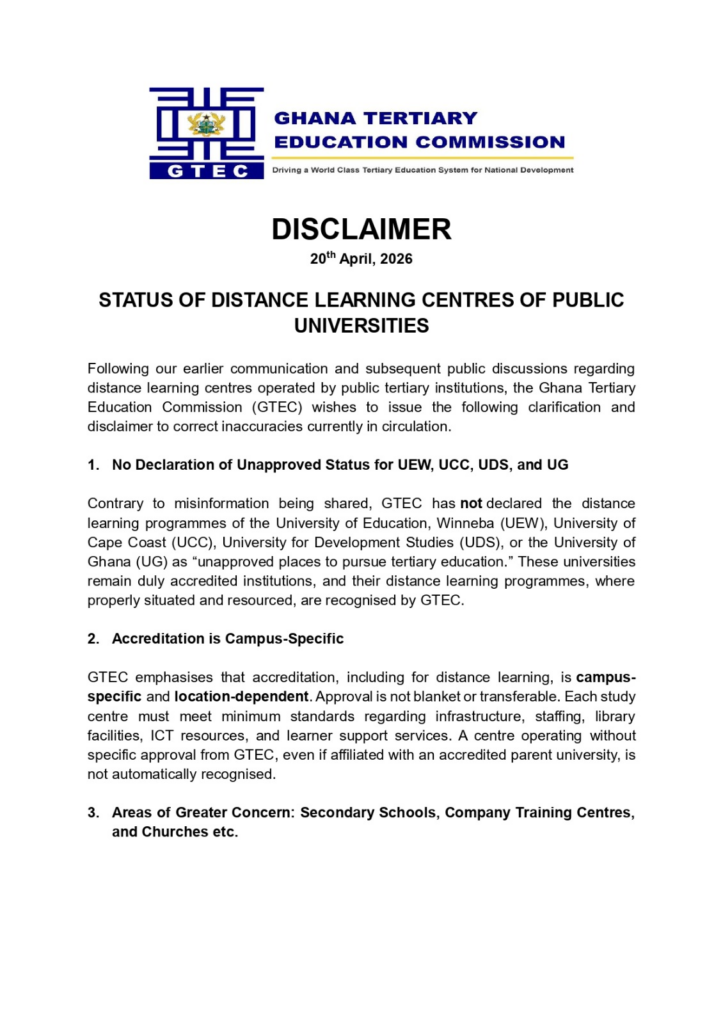
The Ghana Tertiary Education Commission (GTEC) has issued a clarification to correct what it describes as growing inaccuracies and public misunderstanding surrounding the regulation and approval of distance learning centres operated by public universities in Ghana.
The statement follows recent public debate triggered by earlier regulatory communication from the Commission regarding the operation of such centres across the country.
GTEC has firmly denied claims that it has declared distance learning programmes run by leading public universities as unapproved or invalid.
The Commission specifically refuted suggestions that the University of Education, Winneba (UEW), University of Cape Coast (UCC), University for Development Studies (UDS), and the University of Ghana (UG) have been blacklisted or barred from offering distance education.
“Contrary to misinformation being shared, GTEC has not declared the distance learning programmes of UEW, UCC, UDS, or UG as ‘unapproved places to pursue tertiary education’,” the statement clarified.
It stressed that these institutions remain fully accredited and recognised, adding that their distance learning programmes are acceptable where they are properly structured, resourced, and approved.
A key emphasis of the Commission’s clarification is that accreditation in higher education is not automatically extended to all satellite or study centres affiliated with a university.
GTEC explained that accreditation is “campus-specific and location-dependent”, meaning that each study centre must undergo separate assessment and approval.
Approval is therefore not blanket or transferable across all locations linked to a university.
According to the Commission, each centre must meet strict minimum requirements, including adequate infrastructure, qualified teaching staff, library and ICT facilities, and effective learner support systems.
It warned that any centre operating without explicit approval, even if linked to a recognised public university, is not officially authorised for the delivery of tertiary academic programmes.
GTEC also raised concerns about the increasing use of non-traditional and informal spaces for distance learning activities without regulatory approval.
These include secondary schools, corporate training centres, churches, and other makeshift venues being used to host tertiary-level academic programmes.
The Commission said such facilities often fall short of required standards for higher education delivery.
It stated clearly that these venues are not permitted to operate as distance learning centres unless they have undergone formal evaluation and received approval from GTEC.
Despite the concerns raised, GTEC reaffirmed its support for distance learning as a legitimate and strategic method of expanding access to tertiary education in Ghana.
However, it stressed that such programmes must meet strict quality assurance requirements.
These include the provision of suitable physical and digital infrastructure, qualified academic personnel, robust student support systems, and formal approval of each study centre by the regulator.
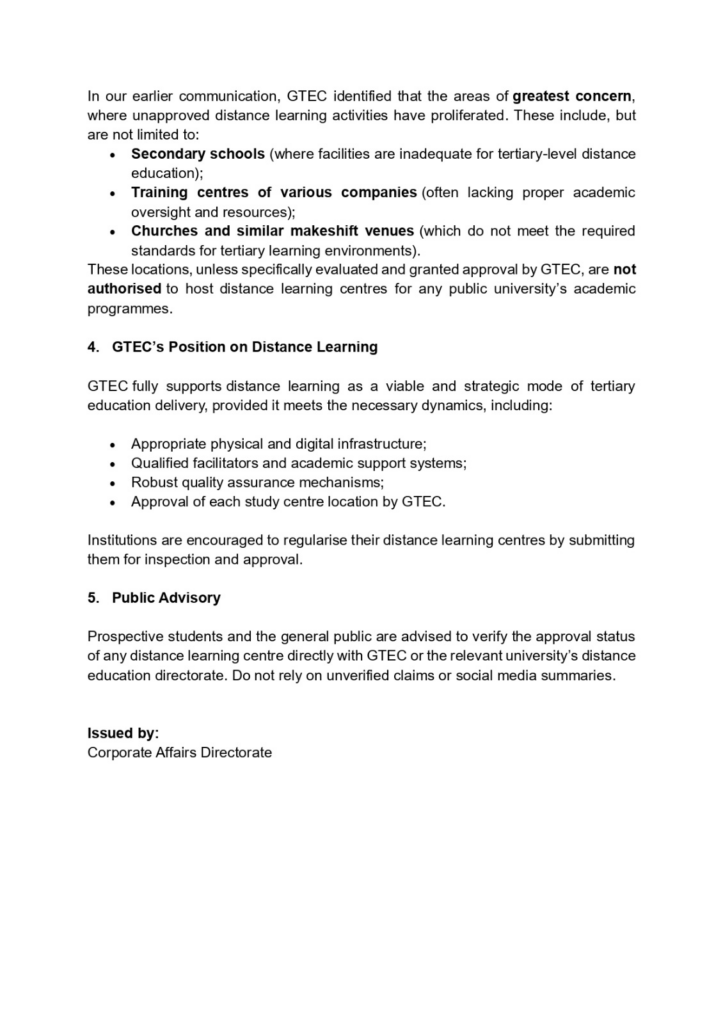
Institutions have been urged to take steps to regularise all distance learning operations by submitting their centres for inspection and accreditation.
GTEC further advised prospective students and the general public to exercise caution when selecting distance learning centres.
It encouraged individuals to verify the accreditation status of any facility directly through the Commission or the relevant university’s distance education directorate before enrolling.
The Commission also cautioned against reliance on social media reports and unverified claims, warning that misinformation could lead students to enrol in unapproved or substandard institutions.
"Prospective students and the general public are advised to verify the approval status of any distance learning centre directly with GTEC or the relevant university’s distance education directorate. They are further advised not to rely on unverified claims or social media summaries," the statement concluded.
Latest Stories
-
Star Oil paid GH¢2.7bn in taxes, levies in nine months of 2026
7 minutes -
Samson’s Take: The rule of law is cheaper before the bulldozer
8 minutes -
GRA blames system failure for delay in issuing receipt over passenger’s customs duty
29 minutes -
Livestream: Newsfile discusses World Cup visa scandal, beach demolitions, education strikes, BRICS bid
33 minutes -
NC-PTAs welcomes end of teachers’ strike, urges parents to prepare children for Monday
42 minutes -
Government procures over 2,000 transformers as Ghana’s electricity access hits 89.13% – Energy Minister
1 hour -
UTAG-UG threatens strike on October 19 over unpaid allowance
1 hour -
Let The Constitution direct Chieftaincy to deliver “All Development Is Local”
2 hours -
John Jinapor outlines renewable energy, nuclear power priorities for 2027
3 hours -
Ghana explores centre of excellence for hearing, communication and cochlear implant care
4 hours -
Schizophrenia-related disorders lead mental health cases recorded in Ghana
4 hours -
Dutch authorities enlist Ghana in hunt for fugitive drug lord Bolle Jos
5 hours -
Ghana housing finance conference adopts communiqué to improve affordable housing access
9 hours -
Special Initiatives Minister urges Wa Technical Institute to enrol more girls as EU-backed solar training lab opens
9 hours -
In the matter of my first year at the Bar
10 hours