

Audio By Carbonatix
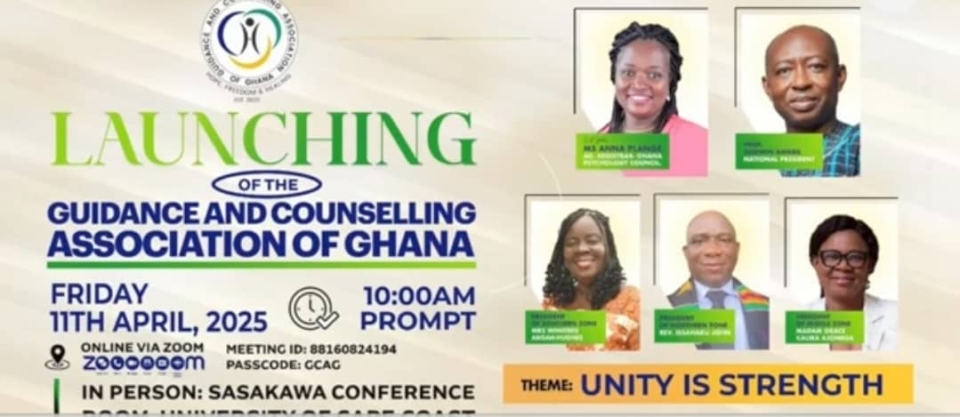
The Guidance and Counselling Association of Ghana (GCAG) has launched a special awards ceremony, marking a transformative moment for mental health advocacy and counselling in Ghana.
The event held in Cape Coast, which brought together professionals from across the country, signalled a new chapter in the nation’s approach to emotional and psychological well-being.
National President, Professor Godwin Awabil, described the occasion as “a milestone for mental health, education, and spiritual well-being.”
In his address, Prof. Awabil offered a compelling vision of the crucial role that guidance and counselling play in society. He noted that the work of counsellors extends far beyond traditional therapy rooms.
Across classrooms, churches, prisons, and communities, they are supporting individuals to confront challenges such as anxiety, substance abuse, violence, and trauma.
“Counsellors are the quiet architects of personal transformation,” he said, highlighting that their work is both preventative and developmental. Whether instilling discipline in schoolchildren or guiding adults through emotional recovery, they are essential to Ghana’s human development.
Prof. Awabil explained that the formation of the GCAG in August 2023 responded directly to a long-standing professional identity crisis. “There were too many designations—counselling psychologist, paraprofessional, guidance officer—which led to confusion about who we are and what we stand for,” he noted.
That confusion was resolved in November 2023 when the Ghana Psychology Council approved a unified title—Licensed Professional Counsellor (LPC)—for all master’s degree holders in Guidance and Counselling. With over 1,000 members to date, the GCAG now serves as the collective voice of these professionals.
A key theme in Prof. Awabil’s remarks was the need to safeguard the discipline itself. He raised concern over the replacement of Guidance and Counselling programmes at some universities with psychology-focused courses, warning that this trend threatens the broader field. Of particular worry, he said, was the quiet omission of the word “guidance” from certain academic degrees. “Children especially need guidance to grow, while adults may lean more towards counselling,” he stressed. “Removing ‘guidance’ from our training risks neglecting one of the most essential aspects of developmental support.”
With a vision to become the most highly recognised body for counselling practitioners in Ghana, the GCAG’s mission is anchored in national transformation. Its objectives include collaborating with institutions such as the Ghana Education Service to enhance student performance, supporting human resource development, and contributing to peace and social stability. Strategic partnerships with key regulatory bodies like the Ghana Psychology Council and the Ghana Tertiary Education Commission are also expected to help raise standards in professional training and ethical conduct.
The GCAG prides itself on inclusivity, offering four membership categories: Regular, Associate, Honorary, and Student. This broad framework allows experienced professionals, aspiring counsellors, educators, and even administrators to contribute to and benefit from the association’s growing network. “Membership offers more than credentials—it’s about community, development, and advocacy,” Prof. Awabil explained. Members also gain access to job opportunities, training programmes, research publications, and insights into the counselling profession.
A highlight of the ceremony was a special awards presentation, recognising individuals who have made outstanding contributions to counselling in Ghana. The applause that followed reflected not only gratitude but a shared sense of optimism—that more professionals would be inspired to give their best to a field often practised quietly behind the scenes. “This launch isn’t just ceremonial,” said Prof. Awabil. “It’s a clarion call for unity and renewed commitment. Our field must not only survive but thrive.”
In closing, Prof. Awabil reaffirmed the GCAG’s core values: competence, integrity, respect, collaboration, unity, and teamwork. These values, he believes, should serve not just as the foundation of the profession but as guiding principles for national development. “As we officially unveil the GCAG,” he declared, “we do so with the conviction that our work as counsellors is not peripheral—it is central to Ghana’s future. Let this day mark the beginning of stronger mental health services, more inclusive education, and a more resilient society.”
With enthusiastic applause and renewed commitment, the ceremony drew to a close. But the movement had only just begun. The Guidance and Counselling Association of Ghana now stands as a beacon for advocacy, development, and care—ready to guide not only individuals but the entire nation towards a healthier, more balanced future.
Latest Stories
-
A source of excellence across generations – Vice President Opoku-Agyemang lauds Mfantsipim
1 hour -
(Photos) Mfantsipim School launches historic 150th anniversary
2 hours -
Knights and Ladies of Marshall group backs Catholic Bishops’ stance on anti-LGBTQ+
3 hours -
Bright Simons writes: All the Filla in the Ibrahim Mahama/E&P – Gold Fields Saga
3 hours -
Monetise Idiocy In Ghana
3 hours -
The Ghanaian prophet and the mysterious death of his scottish wife Charmain Speirs
4 hours -
Nearly 400 sentenced in Nigeria for links to militant Islamists
4 hours -
Ghana’s recovery supported by gold strength despite global oil price pressures – Standard Bank Research
4 hours -
Methodist Church hails Mfantsipim@150; calls for “fresh consecration” to excellence
5 hours -
‘Excellence is our inheritance’ – Nana Sam Brew-Butler hails Mfantsipim’s 150-year reign in leadership
5 hours -
Kwaku Azar writes: A-G vs OSP
5 hours -
Mfantsipim–Adisadel rivalry built excellence, not division – Sam Jonah
5 hours -
Vice President launches Mfantsipim’s 150 years of shaping Ghana’s greatest mind
6 hours -
I assure Otumfuo, Mahama will join him to commission KNUST Teaching Hospital by end of this year – Haruna Iddrisu
6 hours -
Barcelona dominate derby to extend La Liga lead
6 hours