

Audio By Carbonatix
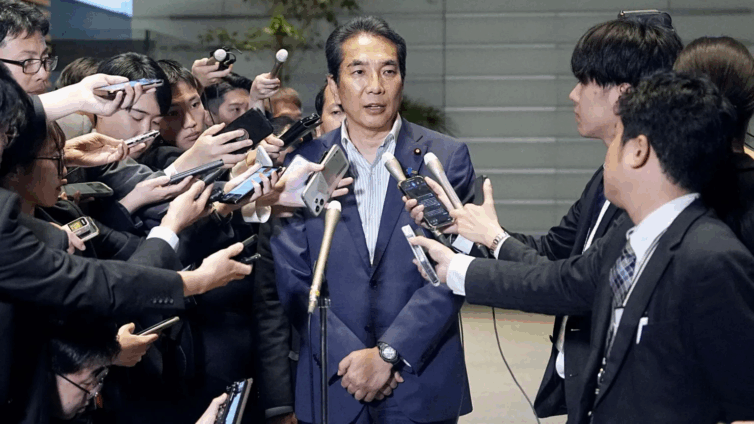
When Japan's farm minister declared that he never had to buy rice because his supporters give him "plenty" of it as gifts, he hoped to draw laughs.
Instead, Taku Eto drew outrage - and enough of it to force him to resign.
Japan is facing its first cost-of-living crisis in decades, which is hitting a beloved staple: rice. The price has more than doubled in the last year, and imported varieties are few and far between.
Eto apologised, saying he had gone "too far" with his comments on Sunday at a local fundraiser. He resigned after opposition parties threatened a no-confidence motion against him.
His ousting deals a fresh blow to Prime Minister Shigeru Ishiba's minority government, which was already struggling with falling public support.
Rice can be a powerful trigger in Japan, where shortages have caused political upsets before. Riots over the soaring cost of rice even toppled a government in 1918.
So it's not that surprising that rice prices have a role in Ishiba's plummeting approval ratings.
"Politicians don't go to supermarkets to do their grocery shopping, so they don't understand," 31-year-old Memori Higuchi tells the BBC from her home in Yokohama.
Ms Higuchi is a first-time mother of a seven-month-old. Good food for her postnatal recovery has been crucial, and her daughter will soon start eating solid food.
"I want her to eat well, so if prices keep going up, we may have to reduce the amount of rice my husband and I eat."
A costly error?
It's a simple issue of supply and demand, agricultural economist Kunio Nishikawa of Ibaraki University says.
But he believes it was caused by a government miscalculation.
Until 1995, the government controlled the amount of rice farmers produced by working closely with agricultural cooperatives. The law was abolished that year, but the agriculture ministry continues to publish demand estimates so farmers can avoid producing a glut of rice.
But, Prof Nishikawa says, they got it wrong in 2023 and 2024. They estimated the demand to be 6.8m tonnes, while the actual demand, he adds, was 7.05m tonnes.
Demand for rice went up because of more tourists visiting Japan and a rise in people eating out after the pandemic.
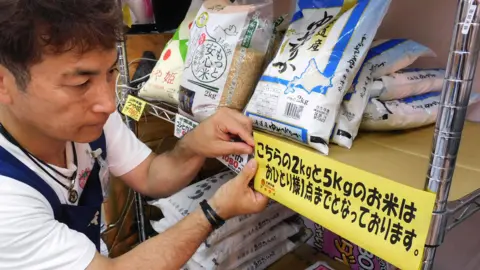
But actual production was even lower than the estimate: 6.61m tonnes, Prof Nishikawa says.
"The demand for rice indeed jumped, due to several factors - including the fact that rice was relatively affordable compared to other food items and a rise in the number of overseas visitors," a spokesperson for the agriculture ministry told the BBC.
"The quality of rice wasn't great due to unusually high temperatures, which also resulted in lower rice production."
Growing rice is no longer profitable
Rice farmers have been unable to make enough money for many years, says 59-year-old Kosuke Kasahara, whose family have been in farming for generations.
He explains that it costs approximately 18,500 yen ($125.70; £94.60) to produce 60kg of rice but the cooperative in his area of Niigata on the west coast of Japan offered to buy it last year at 19,000 yen.
"Until three or four years ago, the government would even offer financial incentives to municipalities that agreed to reduce rice production," he adds.
The ministry spokesperson confirms that the government has offered subsidies to those choosing to produce wheat or soybeans instead of rice.
Meanwhile, younger farmers have been choosing to produce different types of rice that are used for sake, rice crackers or fed to livestock because demand for rice in Japan had been falling until last year.
"I got tired of fighting retailers or restaurants that wanted me to sell rice cheaply for many years," says Shinya Tabuchi.
But that's been flipped on its head, with the going rate for 60kg of rice today at 40,000 to 50,000 yen.
While higher prices are bad news for shoppers, it means many struggling farmers will finally be able to make money.
But as the public grew angry with the surge, the government auctioned some of its emergency reserves of rice in March to try to bring prices down.

Many countries have strategic reserves - stockpiles of vital goods - of crude oil or natural gas to prepare for exceptional circumstances. In Asia, many governments also have stockpiles of rice.
In recent years, Japan's rice stockpile had only been tapped in the wake of natural disasters.
"The government has always told us that they would not release its emergency rice stocks to control the price, so we felt betrayed," Mr Tabuchi says.
Despite the government's rare decision to release rice, prices have continued to rise.
Tackling soaring prices
The cost of rice is also soaring in South East Asia, which accounts for almost 30% of global rice production - economic, political and climate pressures have resulted in shortages in recent years.
In Japan, though, the issue has become so serious that the country has begun importing rice from South Korea for the first time in a quarter of a century, even though consumers prefer homegrown varieties.
PM Ishiba has also hinted at expanding imports of US rice as his government continues to negotiate a trade deal with Washington.
But shoppers like Ms Higuchi say they are unlikely to buy non-Japanese rice.
"We've been saying local production for local consumption for a long time," she says. "There has to be a way for Japanese farmers to be profitable and consumers to feel safe by being able to afford home-grown produce."

This divides opinion among farmers.
"You may hear that the industry is ageing and shrinking, but that is not necessarily true," says Mr Tabuchi, who believes the sector has been too protected by the government.
"Many elderly farmers can afford to sell rice cheaply because they have pensions and assets, but the younger generation has to be able to make money. Instead of guaranteeing the income of all the farmers and distorting the market, the government should let unprofitable farmers fail."
Mr Kasahara disagrees: "Farming in rural areas like ours is about being part of a community. If we let those farmers fail, our areas will be in ruins."
He argues the government should set a guaranteed buying price of 32,000 to 36,000 yen per 60kg of rice, which is lower than today's price but still allows farmers to be profitable.
And given what happened to Eto, it is also a sensitive topic for politicians.
The country is due to hold a key national election this summer, so pleasing both consumers and farmers, especially the elderly in both camps, who tend to vote more, is crucial.
Latest Stories
-
Ga Adangbe traditional priests petition Mahama over McDan aviation licence revocation
32 seconds -
Anti-LGBTQ Bill: NDC’s arrogance is worrying – Hassan Tampuli
11 minutes -
Let’s give OSP time to mature, not to scrap it – Hassan Tampuli
15 minutes -
Nigeria convicts 386 Islamist militants in mass trials
20 minutes -
Djibouti president wins election with 97.8% of vote, state media says
25 minutes -
We don’t have mandate to deduct tax from rent allowance of security services personnel – Interior Ministry clarifies
39 minutes -
Ablakwa receives Presidential Special Envoy on Reparations to advance global agenda
56 minutes -
Christina Koch becomes first woman to travel around the moon on Artemis II
1 hour -
Epstein survivors’ calls to meet King Charles and Queen harder to ignore as US visit approaches
1 hour -
UN Secretary-General names Ghana’s Anita Kiki Gbeho as South Sudan envoy
1 hour -
Mali withdraws recognition of Sahrawi Republic, backs Morocco’s autonomy plan
1 hour -
Gov’t distributes over 8,500 laptops to One Million Coders project
1 hour -
Julius Debrah, ‘man to beat’ as NDC’s James Agbey dismisses Musah Dankwah’s polls
1 hour -
GPRTU in Savannah Region to protest alleged eviction in Damongo
2 hours -
Re: Reinsurance does not replace process — A response to the SIGA–SIC defence
2 hours