

Audio By Carbonatix
Across West Africa’s growing landscape of innovation, one name continues to stand out as a symbol of scientific creativity and sustainable progress.
Olumide Babatope Falana, a Nigerian-born agricultural and environmental engineer, is steadily earning recognition for blending artificial intelligence, precision engineering, and environmental consciousness in ways that redefine what modern agriculture can achieve.
His recent development of a synchronised palm oil extraction system in Nigeria represents another important step in a career that continues to shape the future of agricultural technology across the region.
Falana’s journey reflects an uncommon mix of scientific depth and social purpose. His research has consistently focused on creating solutions that address Africa’s most pressing agricultural challenges while aligning with global calls for cleaner and more sustainable food systems.
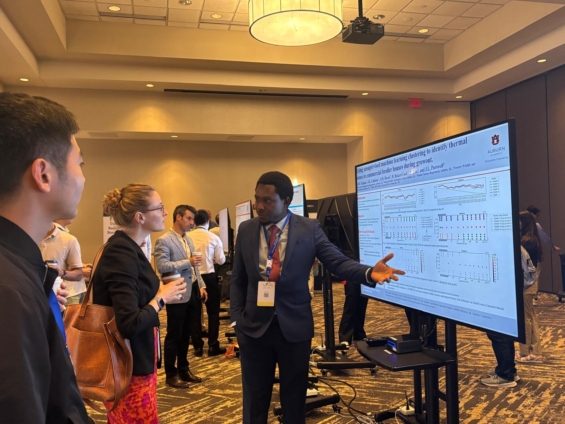
In earlier work, he designed data-driven poultry management systems that use artificial intelligence to monitor environmental conditions, optimise feeding, and improve animal welfare. These innovations were presented at leading global events, including the International Poultry Scientific Forum in Atlanta, where Falana received recognition for research that combines food security with environmental responsibility.
Colleagues describe him as an engineer who does not merely invent but reimagines. His projects integrate advanced analytics, local materials, and energy-saving mechanisms to create systems that work for both high-tech industries and rural communities.
His latest invention, a synchronised palm oil processing system, introduces an intelligent method that allows sterilisation, stripping, and extraction to occur in one continuous sequence. The design improves efficiency, reduces waste, and limits pollution while ensuring a consistent output for processors.
Industry leaders in Ghana believe that the invention’s potential reaches far beyond Nigeria. Ghana’s palm processing sector, which depends heavily on small-scale producers, could benefit greatly from a technology that lowers fuel consumption and production costs while improving quality control. Analysts say the system supports the Ghana Beyond Aid vision by promoting industrial innovation that adds value locally and strengthens export potential within the subregion.
Falana’s influence also extends to his vision for collaboration. He advocates for stronger regional partnerships in science and engineering, emphasising that African researchers should lead in solving global problems. “Our inventions should not only address local challenges,” he explains. “They should contribute to shaping global solutions that highlight Africa’s creativity and capability.”
From Nigeria’s innovation hubs to Ghana’s emerging technology centres, Olumide Falana’s work embodies a new era of African ingenuity. His approach combines the precision of modern engineering with the wisdom of sustainable development, offering a model for how technology, ecology, and entrepreneurship can coexist to power a continent’s transformation.
As Africa moves toward a more self-reliant future, Falana’s journey serves as an inspiring reminder that the continent’s next great technological revolution is already underway—and it is being led by minds like his.
Latest Stories
-
Gender Ministry mourns victims of Volta Lake boat tragedy, deploys support for affected families
2 minutes -
MPs undergo training on human trafficking and gender dimensions
2 minutes -
Don’t expect instant relief – COMAC CEO warns fuel price drops will be gradual
5 minutes -
GIS to unveil comprehensive plans to enhance officers’ welfare and infrastructure
22 minutes -
Right move, wrong timing? – COMAC CEO questions govt’s delay on fuel price relief
23 minutes -
IMF urges Central Banks to keep inflation in check
47 minutes -
NRSA stands firm on Toyota Voxy ban despite transport operators’ opposition
49 minutes -
H. Kwasi Prempeh raises concerns over Supreme Court’s handling of OSP constitutionality case
57 minutes -
Global childhood cancer cases soar
57 minutes -
Airline pilots fear retribution over refusing to fly in Middle East, aviators’ group says
58 minutes -
Police intensify security in Bosomtwe communities after deadly clash
1 hour -
Corporate Income Tax contributes highest to 2025 petroleum revenue
1 hour -
Ghana less exposed to global oil disruptions — Fitch
1 hour -
Property rates: Stakeholders advocate digitisation, transparency, …
1 hour -
Police officer killed in road crash at Atortorkorpe in Ada
1 hour