

Audio By Carbonatix
Model and actress Savannah Adwoa Mensah remembers the exact moment her sense of digital safety shattered.
She was scrolling lazily through Facebook on a quiet Saturday morning when her thumb froze on an image. It was her face.
Or so it seemed.
At first, she assumed it was a mis-tagged memory or an old promotional shot. But the longer she stared, the more unsettling the details became: the lighting too precise, the skin too flawless, the eyes too intense.
Everything about the image was her – and yet it was entirely fabricated.
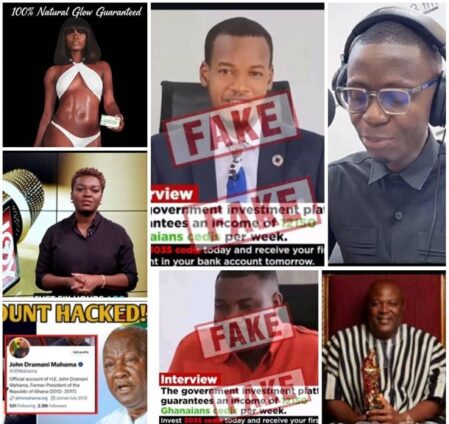
The post promoted an obscure herbal skincare brand with a hollow promise: “100% Natural Glow Guaranteed.”
The endorsement was fake. Her likeness had been digitally generated and subtly manipulated for commercial gain.
The company behind the advert was a digital ghost. It had no physical address nor verification badge. All it had was an assembly line of uncanny, AI-generated images of women.
Alarmed, Savannah Mensah reported the page to Meta [1] [2] and issued a public warning: “If you see an ad of me promoting this product, it’s not me. It’s an AI-generated image used without my consent.”
Savannah Mensah is just one of several Ghanaian public figures, media personalities and celebrities whose images are increasingly and deceptively being used by faceless individuals and entities to aggressively market products and services they know nothing about.
Another such public figure is Maame Esi Nyamekye Thompson, a senior journalist with Joy News.
Her AI-generated likeness was used to promote a completely fake diabetes treatment.
The advertisement boldly declared: “Try an innovative product that changes the concept of diabetes treatment. Doctors are amazed at its effectiveness, and patients are thrilled with the results.
"Start treatment today!”
Thompson, stunned by the impersonation, responded publicly: “This is still ongoing. I never did this advert lol.”
Cloned voices, fake videos and a continent-wide crisis. The theft of one’s digital likeness is not only a personal violation; it is an attack on public trust.
A single synthetic image, video, or voice clip can undo years of professional integrity. For journalists, activists, political figures and public personalities, the consequences are particularly severe.
The alarm in Ghana sounded louder in September 2024, when popular broadcaster of Accra-based Citi FM Bernard Avle became the target of a voice-cloning scam.
Criminals used AI to replicate his distinct voice to promote a fraudulent product.
The incident shook the media fraternity: if Avle’s voice could be cloned this flawlessly, what stopped bad actors from using the same AI tools to influence political discourse or commit financial fraud ahead of elections?
In November 2023, two South African public-broadcast anchors — Bongiwe Zwane and Francis Herd — were digitally impersonated in hyper-realistic AI-generated videos promoting fraudulent investment schemes.
Millions viewed [3] [4] the videos before platforms could react, with one Facebook version getting 113,000 views and another about 11,000 views.
A version posted on YouTube has been viewed 134,000 times.
A 2025 report by TransUnion Africa and digital verification firm Smile ID revealed that deepfake-linked fraud in Africa surged sevenfold in late 2024.“Deepfake, synthetic identities and AI-enhanced scams are no longer fringe threats — they’re real, fast-moving risks reshaping how trust is built and broken in the digital economy,” the report warned.
Ghana’s legal framework contains tools to fight these violations — but the terrain is largely untested.
Technology lawyer Desmond Isreal explains that victims of deepfakes have multiple avenues for redress.
“If someone’s image or voice or even likeness is used in a deepfake without their consent, there is a violation in terms of personal data,” Israel told The Fourth Estate.
“If the deepfake is developed by an entity that collects the data for its model or uses it for commercial purposes, there would be clear liability under the Data Protection Act.”
Beyond the Data Protection Act, he points to fundamental constitutional protections.
“If you use somebody’s likeness without their permission, they could also have some cause of action in terms of the general breach of their privacy.
Article 18 [of Ghana’s Constitution] speaks about the privacy of your correspondence and property."
But Israel notes that it is the human or company deploying the technology that must be held accountable, rather than the algorithm that produces the deepfake.
Yet enforcement remains slow, forensic tools scarce, and digital evidence challenges daunting. Ghana’s courts have not yet confronted the full weight of synthetic media cases, Israel says.
For media literacy advocate Stephen Tindi, the danger is greater than the courts’ readiness.
"We do not know the extent to which they are common. The technologies have become widely available. So they are more common than we know,” Tindi, a lecturer at the University of Media, Arts and Communication (UniMAC) told The Fourth Estate
As a legal practitioner Isreal puts it: “We interpret our laws to give meaning and to ensure people can get redress.
”Synthetic impersonation is not emerging. It is here, he says and warns that unless Ghana decisively strengthens its systems, digital doubles, forgeries and clones will continue to multiply, targeting anyone with a face, a voice, or an online presence.“You’ll have to really open your eyes when you’re out there because you can easily encounter them,” Tindi warns.
The author, Winifred Lartey, is a 2025 Fellow of the Next Generation Investigative Journalism Fellowship – Cohort 7 at the Media Foundation for West Africa.
Latest Stories
-
We can tackle multiple priorities – Sam George defends Anti-LGBTQ Bill push
35 minutes -
Statement: Ghana Chamber of Mines’ Response to Claims in Joe Jackson’s “Ananse Stories about the Economy of Ghana”
36 minutes -
GES opens 2026 teacher recruitment for licensed B.Ed graduates
38 minutes -
Ghana must value skilled trades, build resilient learners — Ibn Chambas
47 minutes -
Ghana must rethink education around relevance, resilience and responsibility — Ibn Chambas
49 minutes -
Prince Harry faces defamation lawsuit from charity he co-founded
51 minutes -
South Korea deploys thermal cameras to track escaped zoo wolf
53 minutes -
Calls for royal meeting with Epstein survivors grow ahead of US visit
56 minutes -
Ibn Chambas advocates blend of technology and human values in education
58 minutes -
UMA improves healthcare access in Asutifi North with GH₵700k ‘Kim Taylor Legacy’ Walkway
1 hour -
Scholarships Authority and Fanaka University offer sponsorship for procurement and supply chain studies
1 hour -
Bisa Kdei drops new single ‘Go N Look’ featuring Medikal
1 hour -
Benin facing rising terrorism in north as French military presence faces growing criticism
1 hour -
UEW Public Lecture Series 2026: Education debate ‘about the soul of Ghana’s future’ — Dr Ibn Chambas
1 hour -
EU fingerprint and photo travel rules come into force from today
2 hours