

Audio By Carbonatix
"Look at ice falling from the skies. God has blessed Ghana. I believe God is washing away coronavirus from Ghana," a man is heard shouting in a video circulating online.
The rainfall in the Ashanti Regional capital, Kumasi in the afternoon of April 20, 2020, saw particles of ice falling from the sky.
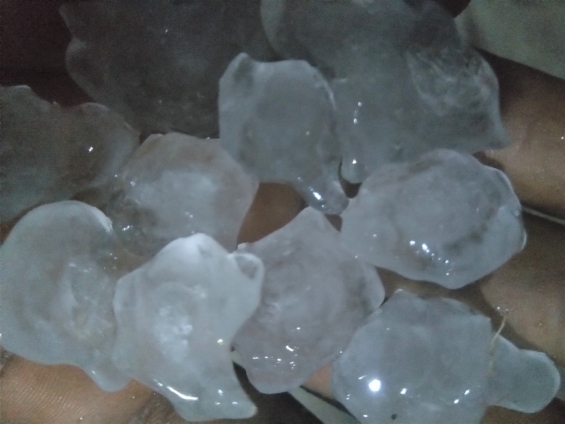
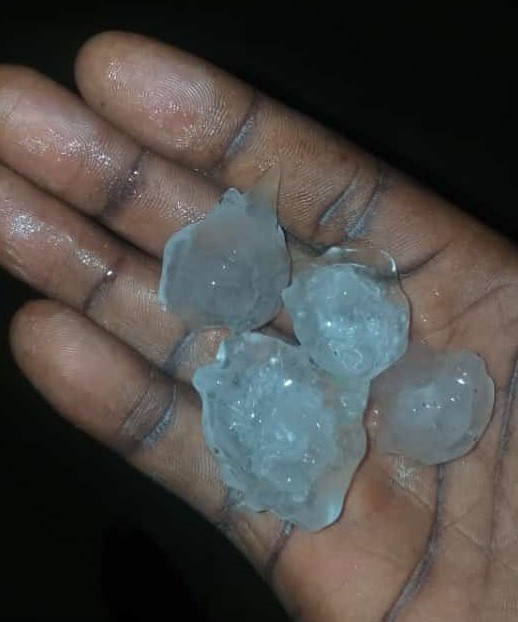
The sight of the 50-pesewa-sized objects excited many who defied the intensity of the rain to pick them.
The hailstones or Asukɔtwea, in Twi, came down again during a downpour in the evening of June 15, just about two months from the first event.
Though some of us used, years ago, to hear their strike on rooftops of our houses when it rained, they seemed to have filed for divorce from the rains on our blind side, for a while now.
What is a hailstone?
Hailstone is a solid component of rainfall. It appears in the form of large lump of ice of various shapes and sizes formed in the clouds.
It occurs with lightning activities known as thunderstorms. Heavy rains, hail and snow, among others, are mostly produced by thunderstorms. A thunderstorm that produces hailstones and snow are known as hailstorm and thundersnow, respectively.
Several parameters are used to distinguish ice pellets from hailstones.
But simply, the diameter of ice pellets should not exceed 5mm and that of the latter should exceed 5 mm. Next time, Just go for your ruler, when your veranda is invaded by ice pellets or hailstones when it rains.
Well, matter exists as: solid, liquid, and gas or vapour. When heat is applied to solid, at a certain temperature, it turns to liquid, when additional heat is applied, it turns into gas. For example, frozen ice turning into liquid and finally into vapor upon application of heat. In the reverse, when heat is taken from gas, it turns into liquid. Further energy drawn from the liquid results in solid formation. This is how ice is formed from water vapour.
Before hailstones are formed, some basic conditions must be satisfied: These are upward motions, high atmospheric water content, among others.
The higher you go, the cooler it becomes. At higher altitude, the temperature is cold.
In the atmosphere, there’s water vapor among other particles.
When dry air comes into contact with a thunderstorm, it loses energy through a process known as evaporative cooling, and becomes liquid.
When it cools further in the case of high thunderstorm activities, the liquid turns into solid or ice, lowering the freezing level of the thunderstorm clouds, resulting in large volumes of hailstone formation.
Hailstone formation is therefore more frequent in temperate regions than the tropics, because temperate regions have much cooler atmospheric temperature.
In the tropics, however, it takes place more frequently at higher altitudes, where atmospheric temperatures are relatively cooler than low-land areas. So high land areas, like Abetifi, are likely to have hailstones than low land areas in the Upper East.
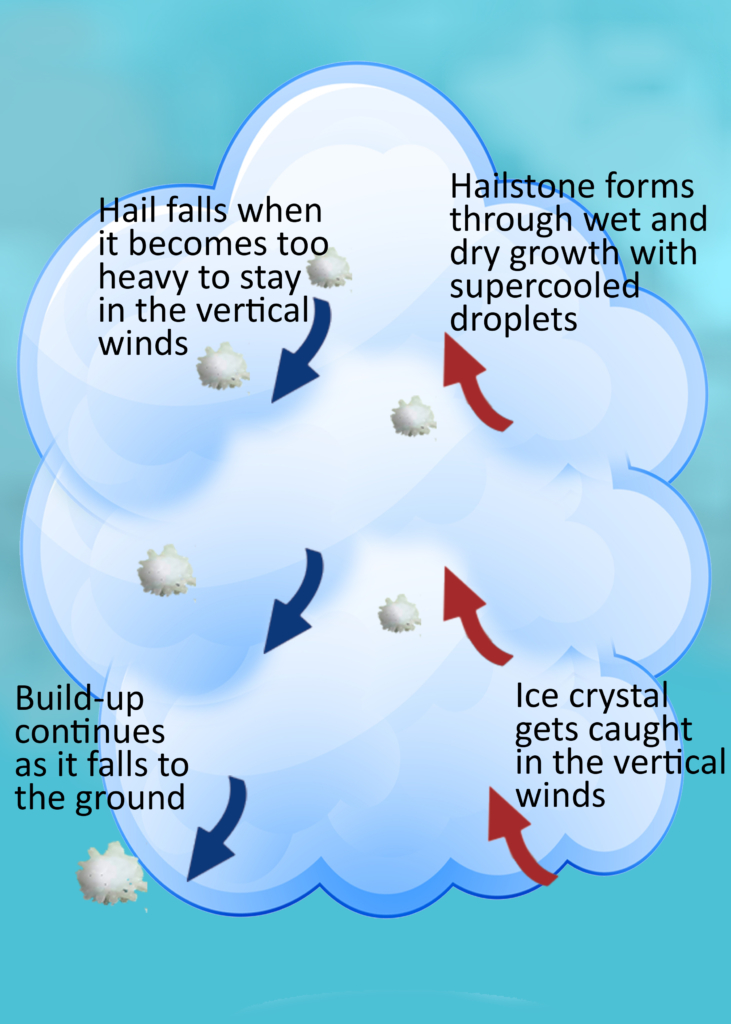
In a process known as accretion, these ice particles are attracted to each other resulting in a build-up.
“There are some charged particles known as cloud condensation nuclei which attract the cloud droplets,” said Climate Scientist at KNUST, Prof. Isaac Tetteh.
The light weight of the initial build-up helps it float in the atmosphere.
Their floatation is due to updraft or upward moving air, often within a cloud, which tends to support it, similar to how a head porter balances pan on the head.
However, further accumulation makes it vulnerable to the charm of gravity and, therefore, falls.
It’s like you’re sitting on a plastic chair and two people join you. The chair is no longer able to give the support because the weight on the chair has increased. This causes the chair to break, causing the three persons to fall.
The stronger the vertical winds, the greater the hailstone formation as it gets time to accumulate.
Why now?
Prof. Tetteh believes so far as the meteorological conditions had been satisfied, hailstone formation is invertible.
When you want to prepare a soup, you need meat, vegetables, water and other ingredients. Therefore, for hailstones, certain factors must be available. But what made the ingredients available in the long term will take further investigation to unravel and that’s where climate change comes in.
“Hailstone formation is purely meteorological, we can’t totally take out climate change. It may be linked to remote factors we are yet to find out,” Prof. Tetteh noted.
It’s clear, researchers might have to scrutinize barrage of data to get to the bottom of the recent icy rains in Kumasi.
In any case, a unique thing in the past may have thought of ‘homecoming’.
Latest Stories
-
Onion supply to Ghana threatened as trucks held up in transit dispute
3 minutes -
President Mahama to attend One Health Summit in France, hold bilateral talks with Macron
40 minutes -
Mahama endorses ADB at Kwahu Business Summit
2 hours -
Every gram will be tracked – Gold Board unveils traceability push to deal with illegally-mined gold
2 hours -
Analysis: Why the Bank of Ghana sold half its gold reserves
2 hours -
Buy wrong gold, face prosecution – Gold Board CEO cracks down on rogue dealers
2 hours -
Africa pushes integrated health agenda ahead of One Health Summit in Lyon
3 hours -
We own the strategy, its not head office decision – GCB MD positions bank as engine of Ghana’s economy
3 hours -
No more waiting for head office – GCB boss pushes Ghana-first banking
3 hours -
Mahama lauds Julius Debrah for shaping Kwahu Business Forum
4 hours -
Why actors beg in difficulty – Patience Ozokwor on Nollywood financial struggles
4 hours -
Any man who apologises to woman deserves to suffer – Brymo
4 hours -
Nigerian artistes no longer put effort into making music – Omah Lay claims
4 hours -
‘I’m now skeptical about going into politics’ – Davido
4 hours -
Nigeria’s Seplat Energy resumes operations as oil workers halt strike action
5 hours