

Audio By Carbonatix
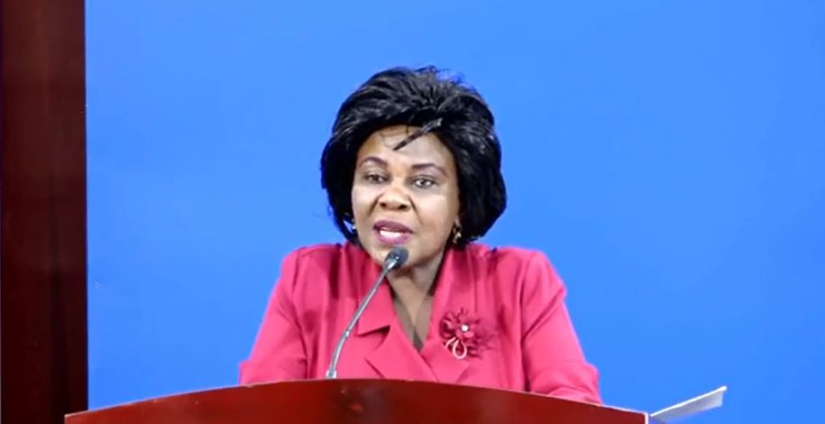
The Sanitation and Water Resources Minister, Cecilia Abena Dapaah, has stated that the activities of illegal miners in river bodies continue to be a major challenge to the distribution of safe water in the country.
She said the phenomenon, in addition to other human activities, has led to a deficit in water production and poor water quality, which is affecting government’s efforts to embark on certain projects to improve water supply.
Speaking at a Ministry of Information press briefing on Monday, Mrs. Cecilia Dapaah observed that illegal miners dump solid and liquid wastes into rivers, thereby blocking machines that pump water.
“I must say the biggest and the most serious challenge is this phenomenon of galamsey or illegal mining in our river bodies. This has created huge problems for our water systems and our concern, I must stress, is that, if we are borrowing close to $1 billion to do projects and the raw water sources are contaminated, polluted and the machines will be drawing in mud, where are we going and what do we want to do with our water bodies?
“We have our own people mining in the river bodies and in the buffer areas and this must stop. I am told and briefed that Regional Security Council (REGSEC), they are on top of this issue; very soon we would take some of you [journalists] with us to go and find out the progress of work but this needs to stop,” she said.
Other challenges facing the Ministry
She admitted that there are still barriers to access to safe water; however, the government is working to identify and solve all such challenges in the water distribution system.
According to her, the phenomenon of non-revenue water was as high as 54% in 2017 but has been reduced to 45% through interventions made by the Ghana Water Company Limited (GWCL).
“We also have the challenge of intermittent water supply and this is because any time the power is off, our machines go off and it takes us time to also get to work when the power is restored. We have obsolete electro-mechanical equipment that we are trying to replace and work on them.
“Old distribution and transmission pipelines; for those of us who are younger than 60 years, some of these pipelines were laid 65 years ago and we need to replace them. We have old metres that give us wrong readings; now we have installed bulk metres to give us the quantum of water we produce so that we can account for.
“We also have the challenge of illegal connections and this is a very serious issue. Just yesterday, a resident of East Legon was caught red-handed; he had connected two big pipes into our main lines and had denied the whole area of water. When he was apprehended and the pipes were disconnected, immediately, water started flowing in people’s homes,” she stated.
Latest Stories
-
Ghana–China Forum explores zero-tariff trade opportunities
10 minutes -
What is wrong with us?: A quiet truth we can no longer ignore
23 minutes -
What is wrong with us? : When sirens become symbols of power rather than protection and emergencies
42 minutes -
Businesses scramble to get noticed by AI search
1 hour -
From perk to performance: Why employee wellness must be a core business strategy
1 hour -
Bank of Ghana’s $1.3bn profit from gold sale could help narrow 2025 losses
1 hour -
Odau Twafohene Baffour Osei Afrifa appointed Regent of Akyem Chia
1 hour -
We are focused on engineering low interest rate regime – BoG Governor assures
2 hours -
How Sporting hero Gyokeres could end European run
2 hours -
The attack on Ghanaian traders in Burkina Faso and the blame game: Why Hybrid Security Governance Holds the Key (II)
2 hours -
Bayern face waiting game on ‘very special’ Kane
2 hours -
The Problem with Nutrition Advice on Social Media – Lessons from a study among University Students
2 hours -
Arteta calls for perspective as Arsenal look to avoid slump
2 hours -
Kasoa Old Market traders given final eviction notice ahead of redevelopment
2 hours -
GH¢15 sachet water price is a ceiling, not fixed – Producers clarify
2 hours