

Audio By Carbonatix
Legal expert Martin Kpebu has attributed the growing impunity of military personnel in the country to high rates of illiteracy and a culture of mob justice in Ghana.
According to him, despite there not being any rule in Ghana permitting the military to mete out brutality on civilians, the culture of instant justice in the country was fueling military impunity, thus increasing military brutality cases on citizens.
“It’s just the impunity, the impunity that has been going on over these decades that is what is manifesting in what they did.
“There’s that impunity because there is this sub-culture that even Ghanaians, some of our own people, anything that happens, the least thing they say ‘we want you to bring in the soldiers. Bring in the soldiers to discipline them,’” he said on JoyNews’ AM Show.
“Would you believe that people still think that way today? People have no regard for the rule of law. They will tell you that ‘o bring in the military, as for soldier, soldier will come and brutalise them,’” he added.
He stated that a lack of appreciation for due process in the court of law has also contributed to this culture of instant justice, which fuels military brutality.
He stated that the low legal literacy rate in the country has led to most Ghanaians seeing brutality from state security apparatus as a legitimate means of addressing issues in the country.
He said, “You know, because often the court system takes some time, people don’t understand how the court system works and are often very interested in instant justice. But, you know, for instance, justice is also very rife in our culture; we kind of like it, that’s what eats into allowing the military to do what they do. Some people like it.
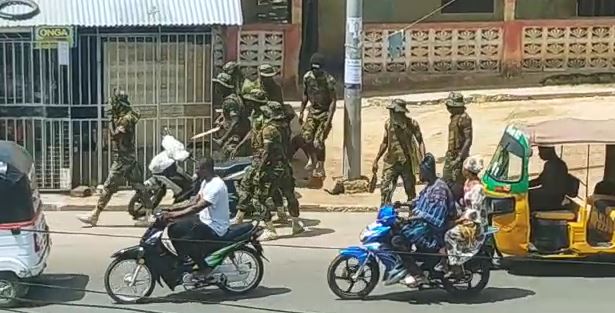
“This video you’ve seen, I’ve heard some people saying, ‘yeah, that’s how it is because when you go to court, it takes forever. However, people fail to appreciate that the rule of law requires that there should be due process so you cannot just go to court and within a week you’ve finished. No. there are processes.”
Thus, he called for education to quell the thirst for instant justice and its consequent military brutality.
“Thus, it comes back to the point that you have to do more education. As long as we have this high rate of illiteracy in Ghana, these soldiers would have room to operate because some people like what they do.
“They say ‘yes that’s justice, as for soldiers when you bring them, they’ll brutalise you, and everything will become quiet.’ So from what I see in this picture, I pray that the authorities will identify the soldiers and have them prosecuted,” he concluded.
Latest Stories
-
A source of excellence across generations – Vice President Opoku-Agyemang lauds Mfantsipim
17 seconds -
(Photos) Mfantsipim School launches historic 150th anniversary
24 minutes -
Knights and Ladies of Marshall group backs Catholic Bishops’ stance on anti-LGBTQ+
1 hour -
Bright Simons writes: All the Filla in the Ibrahim Mahama/E&P – Gold Fields Saga
2 hours -
Monetise Idiocy In Ghana
2 hours -
The Ghanaian prophet and the mysterious death of his scottish wife Charmain Speirs
3 hours -
Nearly 400 sentenced in Nigeria for links to militant Islamists
3 hours -
Ghana’s recovery supported by gold strength despite global oil price pressures – Standard Bank Research
3 hours -
Methodist Church hails Mfantsipim@150; calls for “fresh consecration” to excellence
3 hours -
‘Excellence is our inheritance’ – Nana Sam Brew-Butler hails Mfantsipim’s 150-year reign in leadership
4 hours -
Kwaku Azar writes: A-G vs OSP
4 hours -
Mfantsipim–Adisadel rivalry built excellence, not division – Sam Jonah
4 hours -
Vice President launches Mfantsipim’s 150 years of shaping Ghana’s greatest mind
4 hours -
I assure Otumfuo, Mahama will join him to commission KNUST Teaching Hospital by end of this year – Haruna Iddrisu
5 hours -
Barcelona dominate derby to extend La Liga lead
5 hours